Join us on a literary world trip!
Add this book to bookshelf
Grey
Write a new comment Default profile 50px
Grey
Subscribe to read the full book or read the first pages for free!
All characters reduced
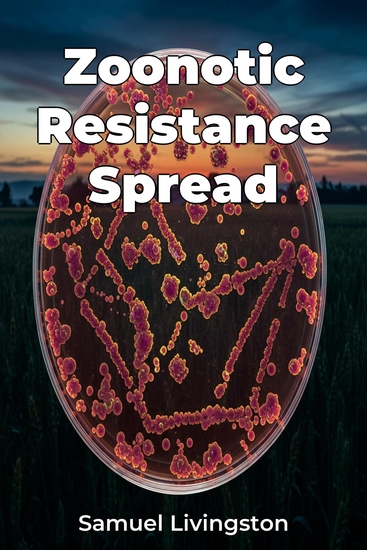
Zoonotic Resistance Spread - cover

Zoonotic Resistance Spread

Samuel Livingston

Translator A AI

Publisher: Publifye

  • 0
  • 0
  • 0

Summary

Zoonotic Resistance Spread tackles the urgent global health crisis of antibiotic resistance, focusing on how the overuse of antibiotics in animal agriculture facilitates the transfer of resistant bacteria to humans. The book highlights the interconnectedness of animal health, human health, and environmental factors, emphasizing how agricultural practices contribute to the spread of antimicrobial resistance (AMR). For instance, the routine use of antibiotics in livestock creates selective pressures, leading to the evolution and proliferation of resistant bacteria that can then jump to humans, threatening our ability to treat common infections.

 
The book uniquely adopts a "One Health" perspective, underscoring the need for interdisciplinary collaboration to combat AMR, rather than solely focusing on treatment after infection. It meticulously unfolds, starting with the basics of antibiotic resistance, then examining transmission pathways from animals to humans via agriculture and food, and finally analyzing the public health implications and potential solutions. By drawing on epidemiological studies and genomic analyses, the book provides a comprehensive overview of the problem and possible intervention strategies, valuable for students, researchers, healthcare professionals, and policymakers alike.
Available since: 02/27/2025.
Print length: 86 pages.

Other books that might interest you

  • Planetary Formation - Astrophysics and Biogenesis Theories - cover

    Planetary Formation -...

    Steff Jaywan

    • 0
    • 0
    • 0
    Planetary formation is a captivating process that unfolds over millions to billions of years, sculpting the celestial bodies that populate our cosmos. It begins within the swirling embrace of a protoplanetary disk, a vast expanse of gas and dust leftover from the birth of a new star. Within this cosmic crucible, tiny grains of dust collide and coalesce, forming larger and larger aggregates known as planetesimals. Through the relentless pull of gravity, these planetesimals grow into protoplanets, embryonic worlds with the potential to one day become full-fledged planets. 
      
    As these protoplanets continue to accrete material from the surrounding disk, they undergo a dynamic interplay of gravitational interactions, collisions, and mergers. Some protoplanets may grow to become gas giants, like Jupiter and Saturn, while others may evolve into terrestrial planets, such as Earth and Mars. The process of planetary differentiation further shapes these nascent worlds, as heavier elements sink toward their cores, creating layered structures with distinct compositions and properties.
    Show book
  • Cryptography For Beginners - Unlocking the Secrets of Secure Communication - cover

    Cryptography For Beginners -...

    Robert Francis

    • 0
    • 0
    • 0
    Unlock the secrets behind secure communication with "Cryptography for Beginners." In an age dominated by digital interactions, understanding the fundamentals of cryptography has never been more crucial. This comprehensive guide takes readers on a captivating journey through the history, principles, and applications of cryptographic techniques, making this complex field accessible to anyone eager to learn. 
    "Cryptography for Beginners" is not just a book; it's a roadmap to empower individuals, students, and professionals in navigating the intricate realm of cryptography. With clear explanations, practical insights, and a focus on real-world applications, this book is your key to unlocking the secrets of secure communication in the digital era. 
     
    Show book
  • Compost after Reading - A Practical Manifesto for Purposeful Decomposition - cover

    Compost after Reading - A...

    Cassandra Marketos

    • 0
    • 0
    • 0
    Composting is so much more than just transforming food into soil; it is deeply existential, radical, and soul-opening. And no, it's not just for gardeners. You can compost in a bowl on your kitchen counter, or a bag under your sink, and you can compost things you're told you can't (although there are some things you probably shouldn't). Everyone can compost. And even if you're not going to compost at all, knowing about compost is engaging with a dialogue about zero waste. With wry and brilliant writing, ​Cassanda Marketos brings the culture, beauty, community, and philosophy of compost to life in this one-of-a-kind, inventive work of narrative nonfiction that brings compost out of the dark ages and into the contemporary moment. Delightfully philosophical and inviting, it is an accessible guide to everything you need to know about compost, with actionable advice for beginners and experienced composters. You will learn why compost works, where to put your compost, how to pick your compost set up, the basics of decomposition, what to put in a compost pile, where to source your compost materials, and how to build a pile. With insights on what tools to consider, how to deal with odors, insects, and other critters, and transitioning your compost pile for colder weather, find easy-to-follow compost pile designs, tips on composting in small spaces, composting with worms, and how to compost things you're always told you can't (you just need to know how). This book has something for everyone, at any stage in their compost journey, and includes edgy, delightful illustrations by the artist Sludge Thunder throughout. And...it's literally compostable. Read it, follow the advice, and toss it into your compost pile.
    Show book
  • The New World on Mars - What We Can Create on the Red Planet - cover

    The New World on Mars - What We...

    Robert Zubrin

    • 0
    • 0
    • 0
    When Robert Zubrin published his classic book The Case for Mars a quarter century ago, setting foot on the Red Planet seemed a fantasy. Today, manned exploration is certain, and as Zubrin affirms in The New World on Mars, so too is colonization. 


    We will settle on Mars, and with our knowledge of the planet, analyzed in depth by Dr. Zubrin, we will utilize the resources and tackle the challenges that await us. What we will we build? Populous Martian city-states producing air, water, food, power, and more. Zubrin's Martian economy will pay for necessary imports and generate income from varied enterprises, such as real estate sales—homes that are airtight and protect against cosmic space radiation, with fish-farm aquariums positioned overhead, letting in sunlight and blocking cosmic rays while providing fascinating views. Zubrin even predicts the Red Planet customs, social relations, and government that will overcome traditional forms of oppression to draw Earth immigrants. 


    With all of this in place, Zubrin's Red Planet will become a pressure cooker for invention, benefiting humans on Earth, Mars, and beyond. We can create this magnificent future, making life better, less fatalistic. The New World on Mars proves that there is no point killing each other over provinces and limited resources when, together, we can create planets.
    Show book
  • TESLA: Inventions Researches and Writings - Lectures Studies Articles on Experiments Inventions Patents & Letters with Autobiography - cover

    TESLA: Inventions Researches and...

    Nikola Tesla, Thomas Commerford...

    • 0
    • 0
    • 0
    Madison & Adams presents to you this meticulously edited Tesla collection. The edition includes the works of this visionary scientist, his autobiography and the extensive biography dedicated to his various  areas of Tesla's research and inventions . 
    
    Biography "The Inventions, Researches and Writings of Nikola Tesla"  is a comprehensive compilation of Tesla's pioneering activities, research, and works. The ideas and inventions are conveyed in their own way, determining by their own place by intrinsic merit. But with the fact that Tesla blazed a path that electrical development would later follow for years to come, the compiler of the book endeavored to bring together all of Tesla's work up to that point in Tesla's life. Aside from indicating the range of his thought and originality of his mind, the book has historical value because it describes the scope of Tesla's early inventions. Tesla is recognized as one of the foremost electrical researchers and inventors and, at the time of publication, the book was the "bible" of every electrical engineer practicing the profession.
    This edition includes as well the writings of the scientist himself:
    My Inventions – Autobiography
    A New System of Alternate Current Motors and Transformers
    Experiments with Alternate Currents of Very High Frequency 
    Experiments with Alternate Currents of High Potential and High Frequency
    On Light and Other High Frequency Phenomena
    On Electricity
    My Submarine Destroyer
    High Frequency Oscillators for Electro-Therapeutic and Other Purposes
    Alternate Current Electrostatic Induction Apparatus
    An Electrolytic Clock
    Electric Discharge in Vacuum Tubes
    Notes on a Unipolar Dynamo
    The Age of Electricity
    The Problem of Increasing Human Energy
    Talking with Planets
    Little Aeroplane Progress
    How to Signal to Mars
    The Wonder World to Be Created by Electricity
    Nikola Tesla Sees a Wireless Vision
    The True Wireless
    On Roentgen Radiations
    An Interesting Feature of X-Ray Radiations
    Roentgen Rays or Streams
    Tesla's Wireless Light…
    Show book
  • On the Origin of Species - cover

    On the Origin of Species

    Charles Darwin

    • 0
    • 0
    • 0
    Charles Darwin's seminal work published in 1859, presents the theory of evolution through natural selection. The book outlines how species change over time, with variations in physical and behavioral characteristics allowing organisms better suited to their environment to survive and reproduce, passing on favorable traits to future generations. Darwin cites evidence from his observations, experiments, and research, including on his voyage aboard the HMS Beagle, to argue that all life shares a common ancestor and that the diversity of species arises through this process of gradual evolution, rather than through special creation as widely believed at the time. The book challenged prevailing religious and scientific views, sparking intense debate, but Darwin's theory of natural selection has since become the foundation of modern evolutionary biology.
    Show book