Rejoignez-nous pour un voyage dans le monde des livres!
Ajouter ce livre à l'électronique
Grey
Ecrivez un nouveau commentaire Default profile 50px
Grey
Abonnez-vous pour lire le livre complet ou lisez les premières pages gratuitement!
All characters reduced
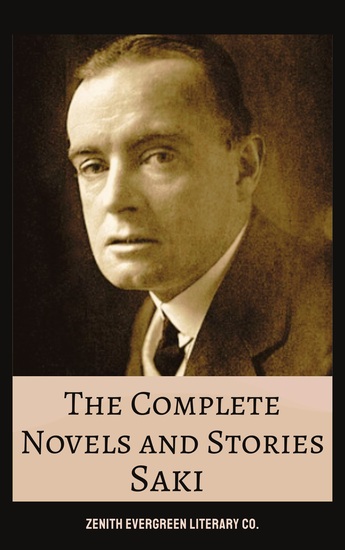
The Complete Novels and Stories of Saki - The Witty Macabre and Brilliantly Ironic Works of H H Munro - cover

The Complete Novels and Stories of Saki - The Witty Macabre and Brilliantly Ironic Works of H H Munro

Saki Saki, Zenith Evergreen Literary Co.

Maison d'édition: Zenith Evergreen Literary Co.

  • 0
  • 0
  • 0

Synopsis

Darkly humorous, sharply observant, and timelessly satirical—Saki's stories are some of the finest examples of Edwardian wit and narrative surprise.

This definitive Kindle edition gathers all the works of H. H. Munro, better known as Saki—whose razor-sharp prose and perfectly crafted plots skewered the pretensions of polite society while revealing the wild, strange impulses lurking just beneath the surface.

From mischievous children and feral animals to biting aristocratic comedy, this collection includes everything from his classic short stories to his lesser-known novels and plays.

📘 This collection includes:
✔ The Chronicles of Clovis, Beasts and Super-Beasts, Reginald, The Unbearable Bassington, and more
✔ All short stories, including Tobermory, The Open Window, and The Schartz-Metterklume Method
✔ Chronologically arranged, cleanly formatted for Kindle with active TOC

💬 What Readers Say:
"Wilde meets Wodehouse—with teeth."
"Saki is wicked, witty, and criminally underrated."
"Each story is a perfect bite of dark delight."

Perfect for fans of P. G. Wodehouse, Oscar Wilde, Roald Dahl, and Edwardian satire, this collection is an essential for lovers of short fiction, dark comedy, and classic storytelling.

📥 Download The Complete Novels and Stories of Saki today and rediscover a master of mischievous prose.
Disponible depuis: 02/05/2025.
Longueur d'impression: 928 pages.

D'autres livres qui pourraient vous intéresser

  • Anathema - From their pens to your ears genius in every story - cover

    Anathema - From their pens to...

    Alexander Kuprin

    • 0
    • 0
    • 0
    Alexander Kuprin was born in Narovchat, Penza in Russia on 7th September 1870. 
    At 3 his Father died and he and mother moved to Moscow. By 10 he was enrolled at the Second Moscow Military High School and there his interest in literature began. The Alexander Military Academy followed and two years later he was a sub-lieutenant and posted to an Infantry Regiment for a further four years. 
    Despite his duties he was a now a keen writer and published his first short story at this time. His military duties also garnered him experiences for his breakthrough work ‘The Duel’.  Leaving the military he left for Kiev to work for local newspapers.  He continued to publish both stories and novels and by 1901 he was in St Petersburg becoming part of a group that included Chekhov, Ivan Bunin, Maxim Gorky and Leonid Andreyev.  
    In the years that followed further controversial works and acclaim followed.  His comments on the regime meant he was also put under secret police surveillance.   
    As World War I erupted, Kuprin opened a military hospital but was then given command of an infantry company in Finland. He was soon discharged on grounds of ill health.  
    The October Revolution saw him praise Lenin, but he warned that the Bolsheviks threatened Russian culture and might cause further widespread suffering to the peasants.  As Civil War raged he took his family to Helsinki and then on to Paris. 
    Exile saw his talents decline further and his succumbing to alcoholism. He became lonely and withdrawn. The family's poverty increased his malaise.   
    In May 1937, the Kuprin’s returned to Moscow.  He now saw his work published but wrote almost nothing new.  In 1938 his health rapidly deteriorated.  Already suffering from a kidney problems and sclerosis, he had now developed cancer of the oesophagus.  
    Alexander Kuprin died on 25th August 1938.
    Voir livre
  • The Garden Lodge - cover

    The Garden Lodge

    Willa Cather

    • 0
    • 0
    • 0
    "The Garden Lodge" is a short story by Willa Cather, first published in 1905. It tells the story of a woman asked by her husband if she would agree to tear down their garden lodge and build a new summer house there instead. She grows nostalgic as she remembers spending fond times there with tenor Raymond d'Esquerre when he was visiting. Although a moderate and no-nonsense woman, the singer rekindled her passion for music during his stay. She had to let go of it after her lazy brother killed himself and her father was crippled with debts. She then proceeds to go to the garden lodge and plays a piece of opera that she played with the tenor the previous summer. However, after a night's sleep she comes around and tells her husband she agrees the lodge should go.
    Voir livre
  • A Lickpenny Lover - From their pens to your ears genius in every story - cover

    A Lickpenny Lover - From their...

    O Henry

    • 0
    • 0
    • 0
    William Sydney Porter was born on 11th September 1862 in Greensboro, North Carolina. At age 3 his mother died from tuberculosis. From an early age it was clear Porter had a large appetite for reading as he absorbed the world around him. 
    He first attended at a school run by his aunt before enrolling at the Lindsey Street High School and then worked at his uncle’s drugstore and gained a pharmacists’ license in 1881.  
    A persistent cough took him to Texas in the hope that a change of climate would help his symptoms. He took on various types of work, initially from ranch hand and cook and then as varied as pharmacist, draftsman, bank teller and journalist. He also began to write, though for now, purely as a hobby. 
    He was a member of several singing and dramatic groups when he met 17 year old Athol Estes, daughter of a wealthy Austin family. Despite her mother’s objection owing to Athol’s tuberculosis, they began courting and in July 1887, they eloped and soon married. 
    Athol, impressed by his writing, encouraged him to get them published. A job as a draftsman at the Texas General Land Office paid a healthy $100 dollars per month and life was good. 
    But then life turned cruel. His son died a few hours after birth although a daughter, Margaret, came the following year.  His job had to be vacated but another was found at the First National Bank of Austin. The bank operated informally and Porter was careless in keeping the books. He lost that job but began writing for the humourous weekly The Rolling Stone and the Houston Post. Some time later the federal Bank auditors went through his former accounts and he was arrested on charges of embezzlement. 
    Porter fled the day before his trial to Honduras. Holed up for several months he began to write.  Athol had become too ill to travel to meet him and learning that her health was deteriorating he surrendered to the court in February 1897.  Bail was obtained so that he could stay with Athol during her final days.  
    Porter was sentenced to five years at the Ohio Penitentiary in Columbus. His pharmacy qualifications got him the job of night druggist.  His sentence also gave him time to write and publish fourteen short stories. In December 1899 in McClure’s Magazine he published a short story as O Henry.  
    He was released two years early in July 1901, and reunited with Margaret, now 11, in Pittsburgh.  He now began his most prolific period of writing; a short story per week for the New York World, while also publishing works in other magazines.  Eventually over 600 of his short stories were published. 
    Porter was a heavy drinker and in 1908 his health, which had deteriorated for several years, took a dramatic turn for the worse, as did his writing.  
    O Henry died of cirrhosis of the liver complicated by diabetes and an enlarged heart on 5th June 1910.
    Voir livre
  • Tales From Edgar Allan Poe - Volume 4 - cover

    Tales From Edgar Allan Poe -...

    Edgar Allan Poe

    • 0
    • 0
    • 0
    Edgar Allan Poe was an American writer, poet, editor and literary critic, considered part of the American Romantic Movement.  Best known for his tales of mystery and the macabre, Poe was one of the earliest American practitioners of the short story and is considered the inventor of the detective-fiction genre.  He is further credited with contributing to the emerging genre of science fiction. Here is a fourth collection of some of his best stories:  The Tell-Tale Heart, Eleanora, and Silence: A Fable.
    Voir livre
  • War and Peace - Book 7: 1810-11 (Unabridged) - cover

    War and Peace - Book 7: 1810-11...

    Leo Tolstoy

    • 0
    • 0
    • 0
    War and Peace is a literary work mixed with chapters on history and philosophy by the Russian author Leo Tolstoy. It was first published serially, then published in its entirety in 1869. It is regarded as one of Tolstoy's finest literary achievements and remains an internationally praised classic of world literature.
    Book 7: 1810-11: The Bible legend tells us that the absence of labor idleness was a condition of the first man's blessedness before the Fall. Fallen man has retained a love of idleness, but the curse weighs on the race not only because we have to seek our bread in the sweat of our brows, but because our moral nature is such that we cannot be both idle and at ease.
    Voir livre
  • Sailors' Yarns (Unabridged) - cover

    Sailors' Yarns (Unabridged)

    Pierre Loti

    • 0
    • 0
    • 0
    Pierre Loti born to a Protestant family, Loti's education began in his birthplace, Rochefort, Charente-Maritime. At age 17 he entered the naval school in Brest and studied at Le Borda. He gradually rose in his profession, attaining the rank of captain in 1906. In January 1910 he went on the reserve list. He was in the habit of claiming that he never read books, saying to the Académie française on the day of his introduction (7 April 1892), "Loti ne sait pas lire" ("Loti doesn't know how to read"), but testimony from friends proves otherwise, as does his library, much of which is preserved in his house in Rochefort. In 1876 fellow naval officers persuaded him to turn into a novel passages in his diary dealing with some curious experiences in Istanbul. The result was the anonymously published Aziyadé (1879), part romance, part autobiography, like the work of his admirer, Marcel Proust, after him.
    SAILORS' YARNS: Within the tropics, on a wondrous evening when the Southern trades were blowing with their balmiest softness, the corporeal portion of his being tired with a healthy muscular fatigue, gently lulled by the slumberous rhythmic motion of the ship.
    Voir livre