
Join us on a literary world trip!
Add this book to bookshelf
Grey
Write a new comment Default profile 50px
Grey
Subscribe to read the full book or read the first pages for free!
All characters reduced
Japanese Castles - cover

Japanese Castles

Sabine Lorca

Translator A AI

Publisher: Publifye

  • 0
  • 0
  • 0

Summary

Japanese Castles explores the evolution and significance of Japan's feudal fortifications, revealing their pivotal role in military strategy and societal structure. These imposing structures, far from being mere defensive strongholds, mirrored Japan's complex social hierarchy and technological advancements. For example, castle design evolved from simple earthenworks to elaborate, multi-tiered keeps, reflecting the changing dynamics of warfare and political power during the Warring States period and under the Tokugawa shogunate.

 
The book examines the architectural and strategic significance of Japanese castles, highlighting key elements like moats, baileys, keeps, and gatehouses. It traces their development through different eras, demonstrating how castles transformed from symbols of regional power to emblems of centralized authority. Each chapter builds upon the last, providing a comprehensive understanding of Japanese castles within their historical context, supported by illustrations, photographs, and maps.

 
Japanese Castles adopts a fact-based historical approach, making it accessible to a broad audience interested in military history, Japanese history, and architectural history. It emphasizes the enduring legacy of these structures, exploring their preservation, cultural significance, and continued relevance in modern Japan. This exploration offers a unique lens through which to understand Japanese history, moving beyond traditional narratives to reveal deeper insights into the nation's past.
Available since: 03/20/2025.
Print length: 65 pages.

Other books that might interest you

  • Super Basic Leadership - A Guide to Understanding and Developing Leadership Skills - cover

    Super Basic Leadership - A Guide...

    Paul D. Pantera

    • 0
    • 0
    • 0
    Do you want to begin your leadership journey, but you have no idea where to start? 
    There are plenty of managers in this world, but there are very few leaders. 
    To be a true leader, you need certain traits and aspects, many of which some people believe only come naturally. 
    But what if I told you that you are not innately born with leadership skills, but these skills could be taught and learned? 
    You have come to the right place. Super Basic Leadership is the perfect starting point for anyone who wants to become an excellent leader. The skills you can gain in this audiobook will teach you leadership skills that you can transfer into many different walks of life. 
    Regardless of your career or whether you want to use your leadership skills in work or your social life, this audiobook will teach you how to be the best and most effective leader possible. 
    Inside Super Basic Leadership, discover:The basics of effective leadership.Leadership roles and characteristics.The differences between leadership and authority.The value of trust in good leadership.The importance of self-discipline.Leadership challenges you may face along the way. 
    Isn’t it time for you to stop being a manager and become a leader?
    Show book
  • Sulla and Caesar: The History of the Roman Republic’s Final Dictators - cover

    Sulla and Caesar: The History of...

    Charles River Editors

    • 0
    • 0
    • 0
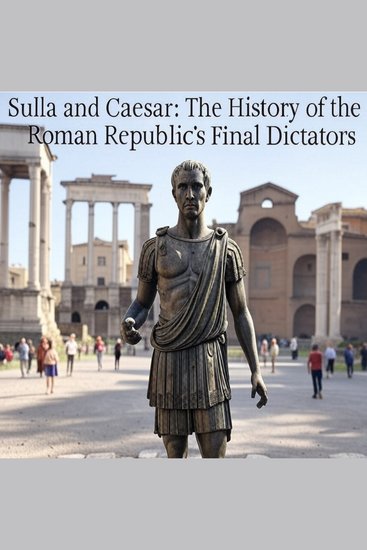
    Julius Caesar is still remembered for winning a civil war and helping bring about the end of the Roman Republic, leaving a line of emperors in its place, but it’s quite possible that none of what Caesar did would’ve happened without the template for such actions being set 40 years earlier. At the time, when Caesar was in his teens, war was being waged both on the Italian peninsula and abroad, with domestic politics pitting the conservative, aristocratic optimates against the populist, reformist populares, and this tension ultimately escalated into an all-out war. One of the leading populares was Caesar’s uncle, Gaius Marius, a military visionary who had restructured the legions and extended the privileges of land ownership and citizenship to legionaries on condition of successful completion of a fixed term of service. In the late 2nd century B.C., Marius had waged a successful campaign against several Germanic tribes, and after earning eternal fame in the Eternal City, Marius was appointed a consul several times. In 88 B.C., he entered into conflict with his erstwhile protégé, the optimate Sulla, over command of the army to be dispatched against Mithridates VI of Pontus, a long-time enemy of Rome and its Greek allies.  
    Ironically, Marius’s reforms had made the legions fiercely loyal to their individual generals rather than the state, which allowed Sulla to march his army against Rome and force Marius into exile. With that, Rome’s first civil war was officially underway, but Sulla’s triumph proved short-lived. Just as Sulla departed for a campaign, Marius returned at the head of a scratch army of veterans and mercenaries, taking over the city and purging it of Sulla’s optimate supporters, and though Marius died in 86 B.C., his party remained in power. After Sulla finished mopping up the last scraps of resistance, he intended to take back Rome for himself at the head of his legions. 
    Show book
  • The Fly Girls Revolt - The Story of the Women Who Kicked Open the Door to Fly in Combat - cover

    The Fly Girls Revolt - The Story...

    Eileen A. Bjorkman

    • 0
    • 0
    • 0
    In 1993, U.S. women earned the right to fly in combat, but the full story of how it happened is largely unknown. The Fly Girls Revolt chronicles the actions of a band of women who overcame decades of discrimination and prevailed against bureaucrats, chauvinists, anti-feminists, and even other military women. 


    Drawing on extensive research, interviews with women who served in the 1970s and 1980s, and her personal experiences in the Air Force, Eileen Bjorkman weaves together a riveting tale of the women who fought for the right to enter combat and be treated as equal partners in the U.S. military. 


    Although the military had begun training women as aviators in 1973, by a law of Congress they could not fly in harm's way. Time and again when a woman graduated at the top of her pilot training class, a less-qualified male pilot was sent to fly a combat aircraft in her place. 


    Most of the women who fought for change between World War II and today would never fly in combat themselves, but they earned their places in history by strengthening the U.S. military and ensuring future women would not be denied opportunities solely because of their sex. The Fly Girls Revolt is their story.
    Show book
  • Concentration and Meditation - cover

    Concentration and Meditation

    Swami Paramananda

    • 0
    • 0
    • 0
    This series of exercices is designed for children and adults suffering from nighttime anxiety or panic attacks. It provides essential tools and techniques for getting rid of tension and overcoming any anxiety, so as to fall asleep quickly and achieve a refreshing sleep. You will get in a relaxed state in which you can get rid of any fear of the dark, find guidance on how to overcome panic attacks, and familiarize yourself with powerful visualization techniques to get rid of tensions and rise from sleep in a relaxed, restored state.
    Show book
  • Towards Happiness ― A Psychoanalytic Approach to Finding Your Way - cover

    Towards Happiness ― A...

    M.D. Ahron Friedberg, Sandra...

    • 0
    • 0
    • 0
    Drawing on a range of clinical cases, Towards Happiness presents an engaging, insightful look at how we define and achieve happiness in core aspects of our lives: work and money, wellness and personal growth, sex and love, family and friendship, and aging. 


    The book includes a series of essays by Dr. Ahron Friedberg, a prominent psychiatrist, concerning how his patients sought to achieve greater happiness during challenging periods of their lives, and how as a consequence they grew personally and professionally. Each chapter considers a core topic through the lens of Dr. Friedberg's practice, demonstrating how patients worked through difficult, sometimes chronic personal issues. Throughout, there are useful summaries of key points. While candidly acknowledging that each life is different, Towards Happiness offers practical examples that can enhance listener's efforts to achieve greater levels of happiness and reorient their lives towards a deeper capacity for happiness. 


    Towards Happiness offers honest insights into the compromises, sacrifices, and resulting degrees of success that characterize pursuing happiness, and will be of great interest to psychoanalysts, clinical psychologists, and other mental health professionals. It will also be useful listening for anyone seeking to understand the achievement of happiness in their own lives.
    Show book
  • Bye Bye I Love You - The Story of Our First and Last Words - cover

    Bye Bye I Love You - The Story...

    Michael Erard

    • 0
    • 0
    • 0
    With our earliest utterances, we announce ourselves—and are recognized—as persons ready for social life. With our final ones, we mark where others must release us to death's embrace. In Bye Bye I Love You, linguist and author Michael Erard explores these phenomena, commonly called "first words" and "last words," uncovering their cultural, historical, and biological entanglements and honoring their deep private significance. Erard draws from personal, historical, and anthropological sources to provide a sense of the breadth of beliefs and practices about these phenomena across eras, religions, and cultures around the world. 


    What do babies' first words have in common? How do people really communicate at the end of life? In the first half of the book, Erard tells the story of first words in human development and evolution, and how the attention to children's early language—a modern phenomenon—arose. In the second half, he provides a groundbreaking overview of language at the end of life and the cultural conventions that surround it. Throughout he reveals the many parallels and asymmetries between first and last words and asks whether we might be able to use a linguistic understanding of end of life to discover what we truly want.
    Show book