Join us on a literary world trip!
Add this book to bookshelf
Grey
Write a new comment Default profile 50px
Grey
Subscribe to read the full book or read the first pages for free!
All characters reduced
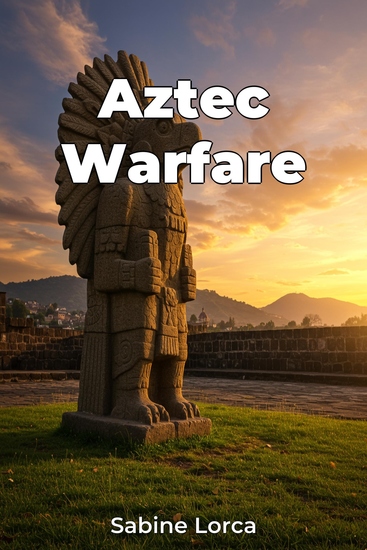
Aztec Warfare - cover

Aztec Warfare

Sabine Lorca

Translator A AI

Publisher: Publifye

  • 0
  • 0
  • 0

Summary

Aztec Warfare explores how the Aztec Empire, a relatively small group, dominated Mesoamerica through its sophisticated military system. The book examines the Aztecs' military organization, weaponry, tactics, and the role of ritual warfare. Readers will learn the Aztec army possessed a complex command structure and logistical support enabling sustained military campaigns. Also, the controversial practice of sacrificial captivity intertwined military action with religious belief. 

 
The book progresses logically, beginning with the historical context before delving into the structure of the Aztec army, weaponry, and battlefield tactics. Finally, it explores the religious dimensions of Aztec Warfare.

 
By drawing on archaeological evidence, indigenous codices, and Spanish accounts, Aztec Warfare avoids simplistic portrayals of the Aztecs as solely bloodthirsty warriors. Instead, it analyzes their military system as an integrated part of their society, offering valuable insights into pre-Columbian military history.
Available since: 03/29/2025.
Print length: 65 pages.

Other books that might interest you

  • A Swiss Foreign Policy for the 21st Century - cover

    A Swiss Foreign Policy for the...

    Thomas Bernauer, Katja...

    • 0
    • 0
    • 0
    Switzerland is facing critical foreign policy challenges. Its relationship with the EU is still unsettled, the geopolitical landscape is changing rapidly, and technological innovation brings additional dynamics into play. This book provides a forward-looking guide for all those concerned with Swiss foreign policy issues, and an overview of Swiss foreign policy along its key areas. It deals, for example, with foreign trade, international financial markets, migration, environmental policy, humanitarian cooperation, and peace promotion and security policy. The contributions are written by academics and practicioners. They shed light on the respective global or regional context in which Switzerland's foreign policy operates, and analyze achievements, challenges,  opportunities, and risks as well as potential ways forward. Published on behalf of the Swiss Society for Foreign Policy.
    With forewords by Foreign Minister Ignazio Cassis and National Councilor Christa Markwalder, President of the Swiss Society for Foreign Policy, and contributions by: Thomas Bernauer, Fritz Brugger, Aymo Brunetti, Gilles Carbonnier, Francis Cheneval, Cedric Dupont, Katja Gentinetta, Isabel Gunther, Paula Hoffmeyer-Zlotnik, Joelle Kuntz, Sandra Lavenex, Philipp Lutz, Matthias Oesch, Pascal Sciarini, Charlotte Sieber-Gasser, Cedric Tille, Andreas Wenger, Achim Wennmann, Sacha Zala.
    The German version of «A Swiss Foreign Policy for the 21st Century» is available as «Eine Aussenpolitik für die Schweiz im 21. Jahrhundert».
    Show book
  • Sayajirao the maharaja who defied the King - cover

    Sayajirao the maharaja who...

    Amit Schandillia

    • 0
    • 0
    • 0
    The 1911 Delhi Durbar was the third and the last, and a very special one. It was an event of many historical firsts—the first time Delhi took over from Calcutta as India's capital, the first time a reigning British monarch visited India in person, and the first time an Indian king openly defied the British monarch outside of a war. The king in question was Sayajirao Gaekwad. From here onwards, his story was a story of defiance and insubordination with the most cautious mix of diplomacy. How did he manage that? Listen here!
    Show book
  • John Adams - Independence Forever - cover

    John Adams - Independence Forever

    Janet Benge, Geoff Benge

    • 0
    • 0
    • 0
    Written for readers age 10 and up -- enjoyed by adults!John's heart sank. A British man-of-war was plowing through the frigid waters of the Atlantic Ocean in hot pursuit of his ship. If the British caught up with the Boston, John would be hanged. He had proudly signed the Declaration of Independence and was carrying the colonies' secret papers. He couldn't be captured now!Growing up in Massachusetts, longing to be a farmer like his father, John Adams never imagined the vital role he would one day play in the transformation of the colonies into an independent American nation. As the injustices of British rule stirred up the colonists to revolution and independence, this rising young lawyer became and influential member of the Continental Congress and a passionate advocate for freedom.As a foreign diplomat for the young United States, first vice president, and second president, this true American patriot held firmly to his integrity and left an uncompromising legacy: independence forever.
    Show book
  • Geniuses of Science – 20 Brilliant Lives in 5 Minutes - The Essence Of Greatness - Fast Facts About Great Minds - cover

    Geniuses of Science – 20...

    5 Minutes, 5 Minute Biographies,...

    • 0
    • 0
    • 0
    Whether you're commuting, relaxing, or curious to learn something new:These short, vivid biographies offer quick insights, big ideas, and timeless inspiration. Enter the minds that changed the way we see the universe. From Oppenheimer to Steve Jobs, Darwin to Edison – their discoveries, struggles, and legacies, brought to life in five powerful minutes each.
    Show book
  • The Lifted Veil - cover

    The Lifted Veil

    George Eliot

    • 0
    • 0
    • 0
    George Eliot's 1859 novella, The Lifted Veil, departs radically from the grounded realism of her longer and better known works, such as Middlemarch and Daniel Deronda. Its tone calls to mind the works of middlebrow Sensationists, like Wilkie Collins (The Moonstone), and of some of the better known authors of Victorian era horror writings, such as Bram Stoker (Dracula) and Mary Shelley (Frankenstein).Eliot here explores mystical themes, considering the world of phenomena which are felt but not seen. Yet in doing so she suggests that the apparent clairvoyance of her main character, Latimer, may in fact be, at least in part, psychological expressions of his early life experiences. This view is supported by the fact that most of Latimer's vision-based predictions of how people will behave and events unfold do not, in the end, turn out as he had foretold.Much of this work's power and complexity lie in Latimer's relationship with Bertha, whom he ultimately, unhappily, marries. Bertha is the one person whose thoughts and feelings he is not able to read, raising the question: What is it about Bertha that renders her inaccessible to his psychic penetration – and what does this tell us about her, and about him.
    Show book
  • From Terrain to Brain - Forays into the Many Sciences of Wine - cover

    From Terrain to Brain - Forays...

    Erika Szymanski

    • 0
    • 0
    • 0
    In From Terrain to Brain, Professor Erika Szymanski makes wine science accessible to non-experts. Rather than approach wine science as body of facts about wine, Szymanski explores how wine science can open up multiple ways of seeing, understanding, and appreciating wine. 


    Too often, wine science is presented as a comprehensive body of knowledge that enthusiasts aiming to become experts should memorize. This book instead uses scientific research to explore wine as an endlessly rich cultural phenomenon. By foregrounding recent research and developments in wine science, From Terrain to Brain presents wine science as a work-in-progress rather than a codified body of knowledge. 


    Each chapter takes listeners on a journey or "foray" through a topic in wine science, such as minerality, climate, microbiome, and yeast. Chapters are organized from "terrain" (geography, terroir, soil) and cell "membrane" (microbiology) through "brain" (the experience of tasting) and "drain" (sustainability). Throughout, From Terrain to Brain emphasizes that wine science, wine culture, and tradition are interconnected and places scientific research in social and historical context.
    Show book