Begleiten Sie uns auf eine literarische Weltreise!
Buch zum Bücherregal hinzufügen
Grey
Einen neuen Kommentar schreiben Default profile 50px
Grey
Jetzt das ganze Buch im Abo oder die ersten Seiten gratis lesen!
All characters reduced
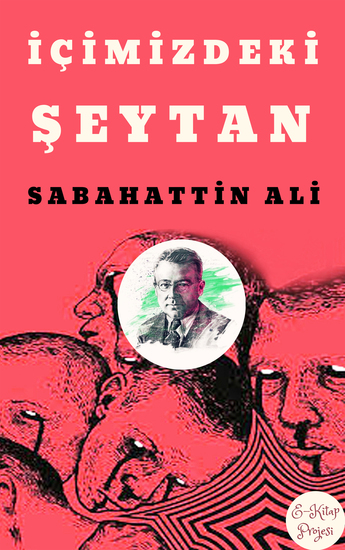
İçimizdeki Şeytan - cover

İçimizdeki Şeytan

Sabahattin Ali

Verlag: E-Kitap Projesi & Cheapest Books

  • 0
  • 0
  • 0

Beschreibung

"Içimizdeki Seytan", Sabahattin Ali'nin 1940 yilinda yayimladigi bir romandir. Roman, Macide ve Ömer isimli iki önemli karakterin askini içerir. Eserde kisilerin iç konusmalari ve kendileri ile hesaplasmalari yaygin olarak kullanilmis, bu yolla duygu ve hisler çok basarili bir sekilde anlatilmistir. Ömer'in sürekli kendini sorgulamasi, olaylara çözüm üretmek istemesi ve basarisiz olmasi göze çarpan hususlardandir. Ömer bu sikintilari içindeki seytandan kaynaklandigina kanaat getiriyor. Bu romaninda, Sabahattin Ali toplumsal gündemin kisilikler üzerindeki baskisini ve güçsüz insanin "kapana kisilmisligini" etkileyici bir biçimde anlatiyor:

"Ögleden evvel saat on birde Kadiköy'den Köprü'ye hareket eden vapurun güvertesinde iki genç yan yana oturmus konusuyorlardi. Deniz tarafinda bulunani sismanca, açik kumral saçli, beyaz yüzlü bir delikanli idi. Baga bir gözlügün altinda daima yari kapali gibi duran ve esya üzerinde agir agir dolasan kahverengi miyop gözlerini vakit vakit arkadasina ve solda, günesin ziyasi altinda uzanan denize çeviriyordu. Düz ve biraz uzunca saçlari, arkaya atilmis olan sapkasinin altindan dökülerek sag kasini ve gözkapaginin bir kismini Örtüyordu. Çok çabuk konusuyor ve söz söylerken dudaklari hafifçe büzülerek agzi güzel bir sekil aliyordu."
Verfügbar seit: 18.12.2023.
Drucklänge: 300 Seiten.


Weitere Bücher, die Sie mögen werden

  • The Dunwich Horror — Part 4 of 10 - Timeless Terrors - cover

    The Dunwich Horror — Part 4 of...

    H. P. Lovecraft

    • 0
    • 0
    • 0
    Title: The Dunwich Horror — Part 4 of 10 
    Author: H. P. Lovecraft 
    Narrator: Jonathan Dunne 
    Original Publication: 1929 
    Public Domain: Yes 
    Series Placement: Timeless Terrors No. 62 — Part 4 of 10 
    Description: 
    Welcome to Timeless Terrors No. 62, continuing H. P. Lovecraft’s chilling masterpiece of cosmic dread: The Dunwich Horror. 
    The strange occurrences at the Whateley farmhouse intensify. Wilbur Whateley’s unnatural growth and mysterious abilities are only the beginning, as the unseen presence in the attic grows ever more powerful. Shadows move where they should not, the hills tremble with otherworldly force, and the village whispers of terror spread farther than ever. 
    Locked away with his grandfather, Wilbur nurtures a secret that is too vast, too alien, and too hungry to remain hidden. Every sound, every shadow, hints at the approaching horror, and the villagers’ fear grows alongside the incomprehensible forces at work. 
    Narrated by Amazon-bestselling horror author Jonathan Dunne, this performance brings Lovecraft’s cosmic horror vividly to life, exploring the thin boundary between human reality and ancient, unknowable forces. 
    This is Part 4 of a 10-part complete audiobook. Stay tuned — the nightmare continues.
    Zum Buch
  • Bertram Cope's Year - cover

    Bertram Cope's Year

    Henry Blake Fuller

    • 0
    • 0
    • 0
    In 1918, when Henry Blake Fuller was 62 years old, he completed Bertram Cope's Year. Though Fuller was well known as an accomplished realist and had published twelve previous novels, this was his first to address sexual ambivalence. Bertram Cope, a young college teaching assistant, is befriended by Medora Phillips, a rich society type who tries to match him with three eligible young women. However, Bertram is emotionally attached only to his friend and housemate, Arthur Lemoyne. The portrayal of various friendships makes it an ironic and witty comedy of manners.
    Zum Buch
  • Tornado at Sea A (Unabridged) - cover

    Tornado at Sea A (Unabridged)

    George Cupples

    • 0
    • 0
    • 0
    George Cupples (2 August 1822 - 17 October 1891) was a Scottish journalist and a writer, who became famous at the end of 19th century for his maritime novels. In particular, his novel The Green Hand: adventures of a naval lieutenant was considered "one of the best sea stories ever written" at the time. His wife, Anne Jane Cupples, also became a famous writer of juvenile and children books.
    A TORNADO AT SEA: "What was my horror when I saw the quicksilver had sunk so far below the mark, probably fixed there that morning, as to be almost shrunk in the ball! Whatever the merchant service might know about the instrument in those days, the African coast was the place to teach its right use to us in the old Iris.
    Zum Buch
  • A Slander - cover

    A Slander

    Anton Pavlovich Chekhov

    • 0
    • 0
    • 0
    Short story about the spread of a gossip
    Zum Buch
  • Don Quixote - The Lost Manuscript - cover

    Don Quixote - The Lost Manuscript

    Miguel de Cervantes

    • 0
    • 0
    • 0
    Miguel de Cervantes Saavedra was born September 29, 1547, was a Spanish writer widely regarded as the greatest writer in the Spanish language and one of the world's pre-eminent novelists. He is best known for his novel Don Quixote, a work often cited as both the first modern novel and one of the pinnacles of world literature. Much of his life was spent in poverty and obscurity, many of its details are disputed or unknown, and the bulk of his surviving work was produced in the three years preceding his death. Despite this, his influence and literary contribution are reflected by the fact that Spanish is often referred to as "the language of Cervantes".[12] An incident in the story of Don Quixote (1870), by English painter Robert Hillingford, depicts a scene from Cervantes' magnum opus. In 1569, Cervantes was forced to leave Spain and moved to Rome, where he worked in the household of a cardinal. In 1570, he enlisted in a Spanish Navy infantry regiment and was badly wounded at the Battle of Lepanto in October 1571. He served as a soldier until 1575 when he was captured by Barbary pirates; after five years in captivity, he was ransomed and returned to Madrid. His first significant novel, titled La Galatea, was published in 1585, but he continued to work as a purchasing agent, then later a government tax collector. Part One of Don Quixote was published in 1605, Part Two in 1615. Other works include the 12 Exemplary Novels a long poem, Journey to Parnassus); and Eight Plays and Eight Entr'actes. The Travails of Persiles and Sigismunda, was published posthumously in 1616.
    Zum Buch
  • Fading Voices - From their pens to your ears genius in every story - cover

    Fading Voices - From their pens...

    Boleslaw Prus

    • 0
    • 0
    • 0
    Aleksander Głowacki who wrote under the nom de plume Boleslaw Prus was born on 20th August 1847 at Hrubieszów in the Kingdom of Poland, at that time, controlled by the Russian Empire. 
    At three his mother died and then at nine his father.  Female relatives helped raise him but at 15 he joined the Polish uprising against the might of Imperial Russia.  Wounded on the battlefield, arrested and imprisoned, he was later released into the care of a relative and resumed secondary school and then Warsaw University but poverty forced him to leave after two years.  At some point he developed agoraphobia which often caused problems. 
    In 1869, he enrolled in the Forestry Department at Puławy but was soon sacked and so he began a system of self-education that led to work as a newspaper columnist on a wide-ranging series of topics that eventually became the ‘Weekly Chronicles’ and spanned 40 years. 
    With his finances now stabilized he married and then adopted his late brother-in-law’s son.  
    It seems he had doubts as to the scale of his talents and early on adopted the name ‘Boleslaw Prus’ for both his journalistic and literary offerings. 
    His work as a short-story writer met with much acclaim. He wrote several dozen of them, originally published in newspapers and ranging in length from micro-story to novella. His keen observation of everyday life and sense of humor are evident in them.  
    During his career he also wrote novels. After ‘Pharoah’, in 1895, he embarked on a four-month journey taking in Berlin, Dresden, Nuremberg, Rapperswil in Switzerland, where he stayed for two months, and his final destination, Paris.  Here his agoraphobia was so bad he couldn’t cross the Seine.  
    However, his writing continued and in 1911 his novel ‘Changes’, though uncompleted, began to be serialised.  It was never finished. 
    Boleslaw Prus died on 19th May 1912, at his Warsaw apartment.  He was 64.  A National Hero, thousands attended both his funeral service and interment.
    Zum Buch