Begleiten Sie uns auf eine literarische Weltreise!
Buch zum Bücherregal hinzufügen
Grey
Einen neuen Kommentar schreiben Default profile 50px
Grey
Jetzt das ganze Buch im Abo oder die ersten Seiten gratis lesen!
All characters reduced
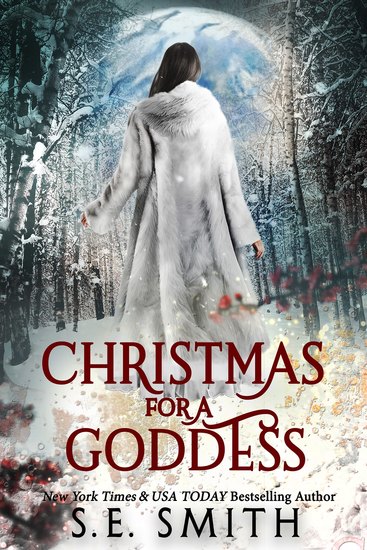
Christmas for a Goddess - cover

Christmas for a Goddess

s. e. smith

Verlag: Montana Publishing LLC

  • 0
  • 0
  • 0

Beschreibung

Sometimes, even a Goddess needs a touch of magic…
 
Aikaterina has lived since the dawn of time. Her species was born at the same time as the universe, yet she yearns for something more. Her experiences with the Valdier, Sarafin, Curizan, and especially the Dragonlings, has left her craving something she never expected—a sense of belonging.
 
Bear Running Wolf is shocked when he discovers a beautiful, alien woman standing in the snow-covered woods on Paul Groves’ Ranch. He knows that not all the visitors to the ranch are human… he just never expected to meet a woman from another world.
 
Two lonely and lost souls from different worlds have only one wish—not to be alone. Can the magic of Christmas heal them, even if it is only for a short time?
Verfügbar seit: 26.12.2022.
Drucklänge: 112 Seiten.

Weitere Bücher, die Sie mögen werden

  • Pariah Planet - cover

    Pariah Planet

    Murray Leinster

    • 0
    • 0
    • 0
    When the blue plague appeared on the planet of Dara, fear struck nearby worlds.  The fear led to a hate that threatened the lives of millions and endangered the Galactic peace. But the Med Service ship Aesculapius 20 with Calhoun and Murgatroyd the Tormal aboard are on the job and have stumbled into the horrible mess caused by unreasoning hatred, quarantine, mass starvation and worse. Calhoun must use all his medical knowledge and significant skills to even understand the situation here in neglected Sector 12. Can he and Murgatroyd untangle this Gordian's knot and live to tell the tale? Maybe and maybe not. Listen and find out. (Summary by Phil Chenevert )
    Zum Buch
  • Heptameron of the Tales of Margaret Queen of Navarre Vol 3 - cover

    Heptameron of the Tales of...

    Marguerite of Navarre

    • 0
    • 0
    • 0
    THE HEPTAMERON (here Volume 3 of 5), first published posthumously in 1558, is divided into seven complete days containing 10 stories each, and an eighth day containing only 2 stories. The stories, many of which deal with love and infidelity, resulted in "accusations of looseness" by critics of the day. The author, Margaret of Navarre (also known as Margaret of Angoulême) became an influential woman in the intellectual and cultural circles of the French Renaissance.From an 1892 essay by the translator George Saintsbury: "In so large a number of stories with so great a variety of subjects, it naturally cannot but be the case that there is a considerable diversity of tone. But that peculiarity at which we have glanced more than once, the combination of voluptuous passion with passionate regret and a mystical devotion, is seldom absent for long together...The question, What is the special virtue of the Heptameron? I have myself little hesitation in answering. There is no book, in prose and of so early a date, which shows to me the characteristic of the time as it influenced the two great literary nations of Europe so distinctly as this book of Margaret of Angoulême…" - Summary by Summary adapted from Wikipedia and excerpted from the text by lubee930)
    Zum Buch
  • Breakable Things - cover

    Breakable Things

    Cassandra Khaw

    • 0
    • 0
    • 0
    Cassandra Khaw's dynamic and vibrant debut collection, Breakable Things, explores the fragile and nebulous bonds that weave love and grief into our existence. This exquisite and cutting collection of stories showcases a bloody fusion of horrors from cosmic to psychological to body traumas. 


    Contains mature themes.
    Zum Buch
  • The Maltese Cat - Celebrated author of The Jungle Book Kipling brings another marvellous story from the perspective of an animal this time about a game of polo set in India during British rule - cover

    The Maltese Cat - Celebrated...

    Rudyard Kipling

    • 0
    • 0
    • 0
    Joseph Rudyard Kipling was born in Mumbai, India on 30th December 1865.   
     
    As was the custom in those days, he and his sister were sent back to England when he was 5.  The ill-treatment and cruelty by the Portsmouth couple they boarded with Kipling said contributed to the onset of his literary life.  
     
    At 16 he returned to India to work on a local paper where he was soon contributing and writing.  It also exposed him to the issues of identity and national allegiance which pervade much of his work.  
     
    In 1886, his ‘Departmental Ditties’, collection of verse appeared in print followed by 39 short stories for his newspaper over only 8 months.  These were then published as ‘Plain Tales from the Hills’, shortly after his 22nd birthday.  
     
    He continued his prolific pace of writing before being dismissed in a dispute and, taking his pay-off and the profits from the sale of some publishing rights, decided to return to London, travelling via Rangoon, Hong Kong, Japan and the United States, all the while writing articles, and arriving at Liverpool in October 1889. 
     
    Over the next two years he saw further works published as books and in magazines, as well as a nervous breakdown for which he was prescribed a sea voyage, to South Africa, Australia, New Zealand and India.  
     
    Happier times came with marriage to Caroline Starr Balestier in January 1892.  The honeymoon began in Vermont and ended in Yokahama where they heard their bank had failed.  They returned to Vermont and settled.  Caroline was now pregnant and he was planning the ‘Jungle Books’.  
     
    A failed arbitration between the US and England resulted in an argument between Caroline’s brother and Kipling, and then his arrest.  At the hearing he was mortified by the exposure of his private life and after settling the matter they returned to England and life in Torquay.  ‘Kim’ was published in 1902, and ‘Just So Stories for Little Children’, a year later.  
     
    In 1907 he was awarded the Nobel Prize for Literature with the citation “in consideration of the power of observation, originality of imagination, virility of ideas and remarkable talent for narration which characterise the creations of this world-famous author”.   
     
    When the Great War erupted, he scorned those who refused conscription.  His son enlisted and was killed at the Battle of Loos in September 1915, at 18, an exploding shell had ripped his face apart.  This death inspired Kipling’s writing thereafter, but the tragedy broke his life and by 1930 his prolific pen had almost ceased. 
     
    Rudyard Kipling died on 18th January 1936 from a perforated duodenal ulcer.  He was 70.  His ashes are buried at Poets’ Corner in Westminster Abbey. 
     
    In the Maltese Cat Kipling returns once more to India and the British Empire.  A polo match is being played.  The fierce competitive instincts of two social classes are fighting for dominance.  All told through the voice of the Maltese Cat, the most cunning of the horses.
    Zum Buch

  • Romantic Poetry Collection 001 - cover

    Romantic Poetry Collection 001

    Various

    • 0
    • 0
    • 0
    A collection of romatic poems for St Valentine's day.
    Zum Buch
  • Forgotten Authors The - Men - Volume 1 - J Y Ackerman to Edward Bulwer-Lytton - cover

    Forgotten Authors The - Men -...

    Juhani Aho, A J lan, Grant...

    • 0
    • 0
    • 0
    Throughout the long centuries of human history is the want, and the need, to share information, to exchange ideas and for that knowledge and experience, for curiosity and learning, to be the basis of a civil society. 
    In literature the ambition is much narrower.  In order to be known, to be popular, you had to be published.  And for that people had to know you existed and your ideas worth reading.  Obviously for most of humanity’s time people couldn’t read and texts couldn’t be published in any great number. 
    In the 15th Century Gutenberg’s printing press began the revolution to address the second and by the 19th century had gathered pace with startling speed and mass distribution.  Education for the many was brought in to help people understand more of their world and, with new skills, how to have a better place within it.  Now, if the powers that owned the presses and means of distribution agreed an audience would now be able to avail themselves of your ideas, your printed words.  
    Sadly, in the thirst for the new, the recent and the past fell from sight, relegated to dark corners and dusty shelves.   
    But the printed word is rarely without someone, somewhere busying themselves through piles of papers and books rediscovering what a good story is, whatever its age. 
    In this volume we offer up a small selection of those talents whose time has now come again.
    Zum Buch