Join us on a literary world trip!
Add this book to bookshelf
Grey
Write a new comment Default profile 50px
Grey
Subscribe to read the full book or read the first pages for free!
All characters reduced
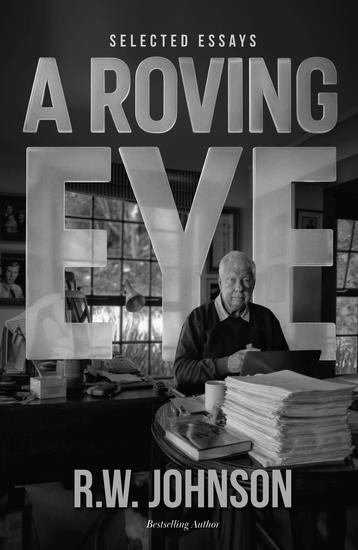
A Roving Eye - Selected Essays - cover

A Roving Eye - Selected Essays

R.W. Johnson

Publisher: Tracey McDonald Publishers

  • 0
  • 0
  • 0

Summary

R.W. Johnson's articles and essays travel far beyond Southern Africa, reaching readers across continents. Their appeal lies not only in their acuity but also in his exceptional range of subjects – political, historical and cultural. As a former Oxford don and a leading international commentator, Johnson remains unmatched as an interpreter of national and world events.
Whether he's writing about politics in South Africa, Europe or the United States, the new space race, the leading personalities of our time, or even soccer, his views are always sharp, clear, deeply informed and original.
These essays belong unmistakably to the tradition of George Orwell. Orwell aspired to make political writing an art form, but his finest essays – even those on seemingly trivial subjects such as boys' comics – revealed both a penetrating intelligence and remarkable breadth. Johnson's writing is similar in spirit: like Orwell's, his essays can be read consecutively or dipped into at random, each one offering something striking and original.
The result is A Roving Eye, a book that is not just distinctive but truly unique, marked by depth, range, humanity and a rare sophistication.
R.W. Johnson, author of 17 books and innumerable articles, attended schools in the UK and South Africa, did his first degree at the University of Natal and was then a Rhodes Scholar at Oxford. For 26 years he was a Fellow and Tutor at Magdalen College, Oxford and he remains a Fellow of the College. An expert in French, British, American and South African politics, his books have ranged over all these interests and for many years he also wrote for The (London) Times, Sunday Times, the London Review of Books, Le Monde Diplomatique and other titles in the international media. Johnson's writings have been widely praised and have often excited controversy. He is a master of the essay form and his essays have had a wide circulation. He is married to the Russian scholar, Irina Filatova, and they live in Cape Town.
Available since: 01/02/2026.
Print length: 308 pages.

Other books that might interest you

  • Nazis All The Way Down - The Myth of the Moral Modern Germany - cover

    Nazis All The Way Down - The...

    Katharina F. Gallant, Zachary...

    • 0
    • 0
    • 0
    In Deutschland ist das alltägliche Leben, einschließlich Unternehmen, Verbänden, Kommunalverwaltungen, Parks, Schulen, Kirchen und Medien, immer noch von den Nazi-Verbrechen belastet, die im öffentlichen Bewusstsein nicht anerkannt werden. Das sagen Zachary und Katharina F. Gallant, die die derzeitige deutsche Praxis des Gedenkens an die Verbrechen des Nationalsozialismus kritisieren, weil sie die Stimmen und die Handlungsfähigkeit der Opfergruppen ausgeklammert. In ihrem Buch fordern sie eine "Entnazifizierung 2.0", die darin besteht, das Vermögen der deutschen Unternehmen und Familien zu enteignen, die direkt mit den Naziverbrechen in Verbindung gebracht werden können, um dieses enteignete Kapital zur Bewältigung der dringendsten Katastrophen unserer Zeit einzusetzen.
    
    In this book, we erroneously attributed a quote to Professor Susanne Schröter from Frankfurt University (p. 157). The quote in question stems from Kristina Schröder, former Secretary of Family Affairs (CDU). This mistake has been rectified in the e-book as well as in any newly printed copies. We apologize for any inconvenience related to this misattribution, especially to Professor Schröter.
    Show book
  • Homegrown Radicals - A Story of State Violence Islamophobia and Jihad in the Post-9 11 World - cover

    Homegrown Radicals - A Story of...

    Youcef Soufi

    • 0
    • 0
    • 0
    In 2007, three Muslim university students left the Canadian Prairies, seemingly without a trace. In the ensuing months, their disappearance raised fears that the men had become "radicalized," posing a grave threat to national security. From presidential briefings and targeted drone assassinations to a politically charged trial, the men's story sheds new light not only on the figure of the "radical," but also on the "moderate" Muslim, represented by a community forever changed by the men's departure. 


    Homegrown Radicals offers a case study of the complex entanglements of the radical and moderate Muslim in post-9/11 North America. Youcef Soufi brings these figures together, providing insight into how state violence has inextricably tied them together. Focusing on the radicalization of the three students, the book traces the general sense of affective injury among North American Muslims over the loss of Muslim life in Western military campaigns overseas. In this context, a new theory of jihad rooted in a Muslim utopian imagination emerged, marking a significant rupture with premodern Islamic thought. The three "radicals" were among thousands of Anglophone Muslims who found this new theory compelling as both a diagnosis and a solution to the violence unleashed in the War on Terror. The book examines how and why this theory resonated, as well as its consequences.
    Show book
  • Rebellion: Book Summary and Analysis - cover

    Rebellion: Book Summary and...

    Briefly Summaries

    • 0
    • 0
    • 0
    This is a concise summary and analysis of Rebellion, by Robert Kagan.
     
    It is not the original book and is not affiliated with or endorsed by Robert Kagan.
     
    Ideal those seeking a quick and insightful overview.


    Rebellion takes listeners on a powerful journey through history, examining the forces that drive people to rise up, resist, and reshape society. Through riveting stories and insightful analysis, the author explores the motivations, tactics, and sacrifices behind some of the most impactful rebellions in history. Listeners gain a deeper understanding of the qualities that fuel change-makers—courage, resilience, and a commitment to justice—and how these same principles can inspire personal and professional growth.
     
    This audiobook is more than a historical account; it’s a motivational guide for those looking to challenge the status quo and create meaningful change in their own lives. With each chapter offering valuable lessons on leadership, adaptability, and the power of vision, Rebellion encourages listeners to embrace the transformative power of resilience and purpose. Inspiring and thought-provoking, this audiobook will empower you to confront challenges, pursue ambitious goals, and make a lasting impact.
    Show book
  • Second Treatise of Government - cover

    Second Treatise of Government

    John Locke

    • 0
    • 0
    • 0
    The Second Treatise of Government is a political treatise written by English philosopher John Locke in 1689. It is considered one of the most important works on political philosophy, as it presents Locke's ideas on the natural rights of individuals and the proper role and limits of government in a society based on the consent of the governed. 
    In the Second Treatise, Locke argues that all individuals have natural rights to life, liberty, and property, which cannot be taken away by any authority, including the government. These rights are inherent and universal, and are not granted by any social contract or agreement. 
    Locke also argues that governments are formed by the consent of the governed, and are therefore obligated to protect the natural rights of their citizens. He asserts that the purpose of government is to promote the common good, and that governments that fail to do so may be overthrown by the people. 
    Moreover, Locke suggests that there are limits to the power of government, and that individuals have the right to resist or even overthrow a government that becomes tyrannical or violates their natural rights. 
    The Second Treatise of Government has had a significant impact on political theory and the development of democratic governance. It influenced the United States Declaration of Independence and the Constitution, as well as many other constitutions around the world.
    Show book
  • Arthashastra or The Playbook of Material Gain - Pragmatic and amoral tips on how to gain defend and expand power from India’s greatest philosopher - cover

    Arthashastra or The Playbook of...

    Chanakya

    • 0
    • 0
    • 0
    Truly radical "Machiavellianism", in the popular sense of that word, is classically expressed in Indian literature in the Arthashastra of Kautilya (written long before the birth of Christ, ostensibly in the time of Chandragupta): compared to it, Machiavelli's The Prince is harmless.— Max Weber, Politics as a Vocation (1919)Chanakya's treatise, written while turning a farmhand into the emperor of the largest empire India had ever seen, focuses on how to manage an empire, covering everything from domestic policy and personal rights to assassination and the dirtier arts of politics. This is not, as with Plato’s Republic, a work of theory. Chanakya’s guidance is entirely practical, and is based on both his education and his experience building an empire. It lacks the philosophical ponderings and moralizing of its equivalent Western works (such as The Prince, The Republic or Leviathan) and instead focuses on how one deals with the messiness of the world in practice.People will occasionally refer to Chanakya as an Indian Machiavelli, but this does some discredit to Chanakya. The Prince is a satire, and focused around exposing the tactics and inhumanity of Cesare Borgia. Arthashastra is a manual for every aspect of statecraft, and while it deals in the unethical it does so only because that is, after all is said and done, one of the options available to a ruler.If you're after a totally pragmatic analysis of leadership, stripped of moralising and focused on what works and how to deal with real-world issues, this is the book for you.
    Show book
  • Citizen of the World: Soon-Young and the UN (Abridged) - Abridged - cover

    Citizen of the World: Soon-Young...

    Soon-Young Yoon

    • 0
    • 0
    • 0
    From North Korean Refugee to the United Nations: A Courageous and Compassionate Memoir Soon-Young Yoon understood from an early age that people's destinies are connected to international events. This book is a collection of her reflections as a women's human rights advocate speaking up to end violence against women and change the world to ensure gender equality, sustainable development, and peace. Yoon has seen the struggle for human rights in all corners of the world, meeting with people in urban slums and the offices of the United Nations. She urges us to look at the world through women's eyes to understand why gender equality and women's empowerment, particularly for the poorest and most vulnerable populations, is essential to our collective good. In Citizen of the World, you'll be inspired by Yoon's stories on Ending violence against women and girls Finding the Earth's balance Claiming the right to social and economic development Portraits of great women leaders Collective voices that are changing the world Challenges working as a feminist anthropologist inside and outside the United Nations Written through the lens of an anthropologist, these essays reflect her belief that one needs to understand a wide range of issues to shape our common future. Students, academics, and activists in the fields of women's studies, international relations, anthropology, and social justice will find Citizen of the World both unique and eye-opening—and filled with hope for a better future for us all.
    Show book