Begleiten Sie uns auf eine literarische Weltreise!
Buch zum Bücherregal hinzufügen
Grey
Einen neuen Kommentar schreiben Default profile 50px
Grey
Jetzt das ganze Buch im Abo oder die ersten Seiten gratis lesen!
All characters reduced
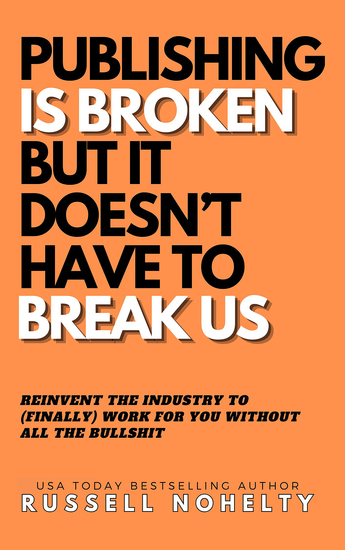
Publishing is Broken but it Doesn't Have to Break Us - cover

Publishing is Broken but it Doesn't Have to Break Us

Russell Nohelty

Verlag: Wannabe Press

  • 0
  • 0
  • 0

Beschreibung

Publishing is broken, but it doesn't have to break you. In this candid, no-holds-barred guide, USA Today bestselling author and small-press publisher Russell Nohelty reveals why the traditional publishing model is stacked against most writers, and how to make the industry work for you.
 
Drawing on decades of experience and dozens of successful book launches, Nohelty offers a blueprint for building your creative career without selling your soul or burning yourself out. You'll learn how to break free from tired industry myths, connect directly with the readers who love your work, jettison traditional gatekeepers, construct a sustainable creative life. and leverage simple tools and strategies that actually pay off without all the needless hustle.
 
Whether you're a first-time writer or a seasoned pro, this book offers real-world strategies for breaking free of the status quo. Packed with straight talk, practical insights, and actionable advice, Publishing Is Broken Publishing, But It Doesn't Have to Break Us doesn't pretend there's a one-size-fits-all answer. Instead, it hands you the keys to design a publishing path that fits your goals, your schedule, and your sanity. If you're ready to build a thriving, bullshit-free writing career, this book will show you the way forward.
Verfügbar seit: 29.12.2025.
Drucklänge: 364 Seiten.

Weitere Bücher, die Sie mögen werden

  • Summary: Never Enough - When Achievement Culture Becomes Toxic-and What We Can Do About It by Jennifer Breheny Wallace: Key Takeaways Summary & Analysis - cover

    Summary: Never Enough - When...

    Brooks Bryant

    • 0
    • 0
    • 0
    DISCLAIMER: THIS IS NOT THE OFFICIAL BOOK. 
    This is a summary & it does not accompany the official. 
    "Never Enough" by Jennifer Breheny Wallace delves into the high-pressure world of today's students, who strive relentlessly for success and often find themselves overwhelmed. This book explores the pervasive culture of toxic achievement, where students pack their schedules with activities and face intense competition, leading to rising rates of anxiety and depression. 
    Wallace investigates the origins of this culture and its deep-seated roots in society, driven by income inequality and limited opportunities. Through interviews and research, the book highlights how children are absorbing the message that their worth is solely tied to their accomplishments. 
    However, "Never Enough" offers a different perspective, emphasizing the importance of children feeling like they matter intrinsically, regardless of their external achievements. It advocates for parents and educators to adopt a mindset that values a child's sense of self-worth and contribution to a larger community. By doing so, the book argues, children can develop resilience, self-confidence, and psychological security. 
    With insightful stories and practical guidance, "Never Enough" provides an urgent and humane perspective on the challenges facing today's teenagers and offers a framework for positive change in how we nurture and support them.
    Zum Buch
  • Empower Your Best Habits - Optimize Your Performance and Cultivate Better Habits in Your Life Work and Relationships - cover

    Empower Your Best Habits -...

    Scott Allan

    • 0
    • 0
    • 0
    Reshape Your Life and Change Your Behavior with the Power of Best Habits. 
    In Empower Your Best Habits, transformational mindset strategist and peak performance trainer Scott Allan delivers key concepts to help you optimize, align and direct your actions to form the best habits necessary for developing a high-performance mindset. You will learn to create a system of good habits while breaking the bad ones. 
    Whether you are looking to get into better shape, increase your earning potential, or develop a better system for improving efficiency and productivity, your habits are built around the systems you set in place. Your level of success—or failure—will always lean on the power of your best habits. 
    In Empower Your Best Habits, you’ll discover…The science behind habit formation—which will help you understand how habits workThe framework for building good habits and breaking bad onesThe art of developing a sticky habitThe best wealth habits to help you achieve financial abundance and prosperitySpirituality habits so you develop a clear sense of direction in your life and achieve your purposePowerful habits for good health to improve your physical, mental, and emotional health 
    Empower Your Best Habits is a practical blueprint for understanding the significance of habits in your life. Now you will learn the tactics and strategies for building success, sustainable wealth, and long-term happiness while experiencing a new level of health, wealth, and spirituality. 
    With simple but effective tactics and strategies, you can now transform your life, work, health, and relationships…by cultivating one small habit at a time.
    Zum Buch
  • Idea of Justice The: Book Summary & Analysis - cover

    Idea of Justice The: Book...

    Briefly Summaries

    • 0
    • 0
    • 0
    This is a concise summary and analysis of The Idea of Justice, by Amartya Sen.
     
    It is not the original book and is not affiliated with or endorsed by Amartya Sen.
    Ideal those seeking a quick and insightful overview.
     
    The Idea of Justice offers a profound and insightful exploration of justice, challenging traditional theories that focus on creating perfectly just institutions. Instead, it emphasizes the importance of addressing real-world injustices and improving the lives of individuals through reasoned, practical solutions. Combining philosophy, economics, and political theory, the book examines key concepts like fairness, democracy, freedom, and human rights, while drawing on global perspectives and historical examples to propose a framework for achieving a more just world.
    Zum Buch
  • The Mystery and Romance of Alchemy and Pharmacy - cover

    The Mystery and Romance of...

    C. J. S. Thompson

    • 0
    • 0
    • 0
    Dr. v. Oefele states of pharmacy before the time of Hippocrates, that although the practice of medicine was not separated from pharmacy among the Greeks and Romans, there was such a separation among the ancient Egyptians, from whom the distinction was handed down to the Copts, and by them to the Arabians; and, in fact, that the term pharmacist is probably of Egyptian origin, being derived from Ph-ar-maki, which signifies the preparation of medicine from drugs. The Egyptian pharmaki who were engaged in that occupation belonged to the higher social ranks of writers or academically-educated persons, comprising also the priests, physicians, statesmen, and military commanders. The Jews were indebted to Egypt for their primary ideas of medicine, but they cast away the ideas of demonology and magic which clouded what was good in the practice of Egypt. The Talmud recommends onions for worms, and wine, pepper, and asafœtida for flatulency. The Talmudists are responsible for calling the earth, air, fire, and water elementary bodies. In the middle ages the Jews rendered service to the healing art, and had a large share in the scientific work connected with the Arab domination of Spain. In China the use of drugs goes back to a very remote age, and alchemy was practised by the Chinese long previous to its being known in Europe. For two centuries prior to the Christian era, and for four or more subsequent, the transmutation of the base metals into gold, and the composition of the elixir of immortality, were questions ardently studied by the Chinese.
    Zum Buch
  • Sociology of Social Class - Class Mobility and Inequality in Society (3 in 1) - cover

    Sociology of Social Class -...

    Fred Grandsen

    • 0
    • 0
    • 0
    This collection brings together three essential studies: Social Class and Mobility, Inequality and Society, and The Power of Social Networks, offering insights into how class and socioeconomic status influence opportunities, access to resources, and life outcomes. 
    Social Class and Mobility examines the structures that define social classes and the factors that enable or hinder upward mobility. It explores the barriers and opportunities for individuals to change their class status, focusing on the roles of education, wealth, race, and family background in determining one's ability to move across social hierarchies. 
    Inequality and Society analyzes the persistent and growing disparities in wealth, power, and opportunity. The book looks at the root causes of inequality and its societal consequences, examining how systemic structures perpetuate disparities and what can be done to address them. From income inequality to access to healthcare, this book discusses the multifaceted nature of social inequality and its effects on communities. 
    The Power of Social Networks explores the crucial role that social connections play in social mobility and life chances. It discusses how networks influence access to job opportunities, resources, and social capital, and how these networks can either reinforce or challenge existing social hierarchies. The book also looks at how digital and online networks are transforming traditional social structures. 
    Together, these three books offer a comprehensive understanding of the factors that shape social class, mobility, and inequality in contemporary society. They provide an in-depth look at how individuals and communities navigate the complex terrain of class and opportunity.
    Zum Buch
  • The Contradictions of Ageing - cover

    The Contradictions of Ageing

    Violet Taylor

    • 0
    • 0
    • 0
    The book explores the problems that may arise from an overly open mindset, and uses a story about a community organization to illustrate the paradox of tolerance, pointing out that unlimited tolerance may lead to the disappearance of tolerance. It also mentions that one should be cautious about being open-minded in personal life, especially in terms of time allocation and career choices.
    Zum Buch