Rejoignez-nous pour un voyage dans le monde des livres!
Ajouter ce livre à l'électronique
Grey
Ecrivez un nouveau commentaire Default profile 50px
Grey
Abonnez-vous pour lire le livre complet ou lisez les premières pages gratuitement!
All characters reduced
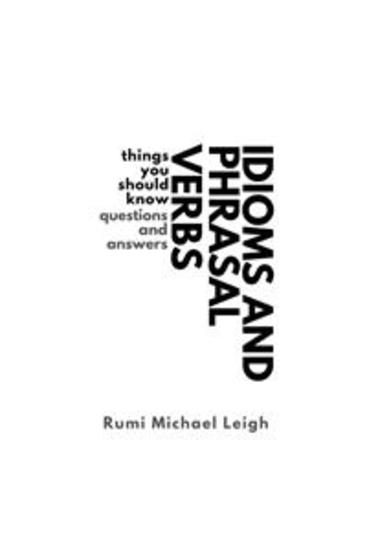
Idioms and Phrasal Verbs - Things You Should Know (Questions and Answers) - cover

Idioms and Phrasal Verbs - Things You Should Know (Questions and Answers)

Rumi Michael Leigh

Maison d'édition: BookRix

  • 0
  • 0
  • 0

Synopsis

Master the art of English language fluency with "Idioms and Phrasal Verbs: Things You Should Know (Questions and Answers)." This comprehensive guide is designed for ESL learners, students, and anyone looking to sharpen their command of idioms and phrasal verbs, essential elements in everyday English communication.
Key Features:

	Extensive Collection: Learn a wide range of idioms and phrasal verbs commonly used by native speakers in daily conversation.
	Interactive Learning: Engage in thought-provoking multiple-choice questions and exercises to deepen your understanding.
	Self-Paced Progress: Answers are provided for all exercises, allowing you to track your progress and learn at your own pace.
	Clear, Practical Examples: Discover how idioms and phrasal verbs function in real-life scenarios with relatable, everyday examples.
	Accessible for All Levels: Whether you're a beginner or an advanced learner, this book offers valuable insights for anyone aiming to improve their English skills.
	Ideal for ESL Learners: Perfect for those studying English as a second language or anyone eager to expand their vocabulary and comprehension of idiomatic expressions.

This book makes mastering idioms and phrasal verbs enjoyable and straightforward, helping you gain confidence in both formal and informal English settings. Improve your language skills today and take the next step toward fluency!
Disponible depuis: 24/09/2024.

D'autres livres qui pourraient vous intéresser

  • Third Ear - Reflections on the Art and Science of Listening - cover

    Third Ear - Reflections on the...

    Elizabeth Rosner

    • 0
    • 0
    • 0
    This illuminating book weaves personal stories of a multilingual upbringing with the latest scientific breakthroughs in interspecies communication to show how the skill of deep listening enhances our curiosity and empathy toward the world around us 


    Third Ear braids together personal narrative with scholarly inquiry to examine the power of listening to build interpersonal empathy and social transformation. A daughter of Holocaust survivors, Rosner shares stories from growing up in a home where six languages were spoken to interrogate how psychotherapy, neurolinguistics, and creativity can illuminate the complex ways we are impacted by the sounds and silences of others. 


    Drawing on expertise from journalists, podcasters, performers, translators, acoustic biologists, spiritual leaders, composers, and educators, this hybrid text moves fluidly along a spectrum from molecular to global to reveal how third-ear listening can be a collective means for increased understanding and connection to the natural world.
    Voir livre
  • The Devil's Dictionary - cover

    The Devil's Dictionary

    Ambrose Bierce

    • 0
    • 0
    • 0
    This timeless work of biting satirical wit presents an A-to-Z lexicon of common English terms, and what we actually mean by them. The renowned author Ambrose Bierce produced classic works in a range of genres, from fantasy and horror to realistic tales drawn from his experience in the Civil War. Among his most beloved books is The Devil’s Dictionary, a work of wry humor that remains one of the funniest assessments of American language and manners. Through epigrams, essays, vignettes, and verse, Bierce skewers religion, class, politics, romance, and more.  Included, you’ll find such pithy definitions as:  ·      Acquaintance, n.: A person whom we know well enough to borrow from but not well enough to lend to.  ·      Bride, n.: A woman with a great future behind her.  ·      Consult, v.: To seek another's approval of a course already decided on.  And many others.
    Voir livre
  • Learn Italian for Beginners - cover

    Learn Italian for Beginners

    Patric Noble Paul Jackson

    • 0
    • 0
    • 0
    Learning another dialect can appear to be troublesome, in the event that certainly feasible at the absolute starting point. On the off chance that you're a grown-up, it presumably appears to be considerably more terrifying. You might have had a terrible encounter attempting to get familiar with a subsequent language in school. You've needed to learn Italian for quite a while. It could simply be on the grounds that you're enamored with the language or you might reside in a space where Italian is regularly spoken. No matter what the explanation, your craving to become familiar with a subsequent language is certifiable, and it has driven you here. 
    It's more straightforward than you suspect 
    You won't take out your hair while learning Italian. Soon you stun your loved ones by communicating in Italian to them. It's far from impossible that you might hold a discussion with a local Italian speaker inside a simple matter of weeks. 
    Get familiar with the most widely recognized words expressed out in the open 
    It appears to be that learning an unknown dialect is troublesome on the grounds that there are such countless words to learn. This isn't reality by any stretch of the imagination, as a matter of fact. There are something like 2,000 words that you really want to learn. In the event that you learn only these words, having a discussion with pretty much anyone is conceivable. You'll talk outsiders in the blink of an eye, and it will try and astonish you. 
    A subsequent language opens up another universe of chances 
    Learn phrases that you'll utilize consistently 
    Address local people while voyaging 
    Place orders at your #1 eateries 
    Have relaxed discussions in Italian
    Voir livre
  • The Dunning-Kruger Effect - Why Incompetent Individuals Overestimate Their Abilities - cover

    The Dunning-Kruger Effect - Why...

    William Rands

    • 0
    • 0
    • 0
    The Dunning-Kruger effect is a cognitive bias that leads individuals with limited knowledge or ability in a particular area to overestimate their competence. Named after psychologists David Dunning and Justin Kruger, who first identified this phenomenon in 1999, the effect reveals a paradox in human cognition: the less people know, the more likely they are to believe they know everything. Conversely, experts in a field tend to underestimate their abilities, assuming that others possess the same level of expertise. This bias is not only fascinating from a psychological standpoint but also carries significant implications for personal, professional, and societal development. 
    At the core of the Dunning-Kruger effect is the misjudgment of one’s capabilities, which stems from a lack of metacognitive awareness—the ability to assess one’s own knowledge and skills accurately. Incompetent individuals, lacking the expertise required to recognize their deficiencies, are unable to discern how little they know. This lack of insight leads them to overestimate their abilities and make decisions based on flawed reasoning. As a result, they may unknowingly engage in behaviors that exacerbate their incompetence, further reinforcing their false sense of expertise. 
    One of the most compelling aspects of the Dunning-Kruger effect is its broad applicability across various fields. From everyday social interactions to high-stakes decision-making in professional environments, this cognitive bias affects people at all levels. In the workplace, for example, leaders with limited knowledge in a specific domain may make decisions that negatively impact their teams, while employees with expertise may remain silent or defer to those who appear more confident. In education, students and teachers alike may fall victim to this effect, with the former believing they fully understand a topic despite limited comprehension, and the latter overestimating their teaching efficacy.
    Voir livre
  • Philosophy of Language - Words Meaning and Reality - cover

    Philosophy of Language - Words...

    Hector Davidson

    • 0
    • 0
    • 0
    Language plays a fundamental role in human life, functioning not only as a means of communication but as a structure that shapes the way we think, perceive, and understand the world. The philosophy of language seeks to unravel the complex relationships between words, meanings, and reality, exploring how language functions, how it conveys meaning, and how it relates to the world and our experiences. This chapter serves as an introduction to these foundational issues and provides an overview of the central questions and debates within the philosophy of language. 
    At its core, language is a system of symbols—words, phrases, and sentences—that represent concepts, objects, and actions. Understanding language, however, requires more than just examining its structure. It involves questioning how words acquire meaning, how those meanings change in different contexts, and how language can both represent and distort reality. This inquiry into meaning is not limited to how words correspond to things in the world, but also explores how they function in communication, how they shape thought, and how they reflect the underlying structures of human experience. 
    The structure of language itself is another crucial aspect. Language is governed by rules—such as syntax, grammar, and semantics—that allow words to be combined in meaningful ways. Syntax provides the framework for sentence structure, while grammar dictates how words should be used within that structure. Semantics, on the other hand, deals with the meaning of words and how they combine to form meaning within a sentence. Each of these aspects must be understood in relation to each other to grasp how language functions at a deeper level.
    Voir livre
  • 100 Facts About Website Promotion - English to Spanish - cover

    100 Facts About Website...

    Science-Based Language Learning Lab

    • 0
    • 0
    • 0
    Introduction to the 100 Somethings Language Learning Series 
     
    Welcome to a revolutionary approach to language learning! This series helps you master Spanish by intertwining it with compelling topics like Website Promotion. Each book centers on a theme (art, science, history) and presents 100 carefully chosen facts in both English and Spanish. 
     
    How It Works: 
     
    - Each fact is first introduced in Spanish, encouraging you to interpret it. 
     
    - The following page provides the fact in English and then repeats it in Spanish, aiding comprehension and memorization. 
     
    - The second half flips this order—English first, then Spanish, and English again—helping you practice translation in both directions for better mastery. 
     
    Benefits: 
     
    - Concise Learning: Focuses on one-sentence facts to ensure every word learned is impactful and directly related to your interests, making them easier to remember. 
     
    - Reinforcement: Alternating languages for each fact naturally strengthens vocabulary and grammar. 
     
    - Engagement: Learning vocabulary through topics you're passionate about keeps the process dynamic and relevant. 
     
    - Dual Knowledge: You enrich your understanding of a specific subject while learning a new language. 
     
    This series is tailored for learners who thrive on clear, targeted information, making it both educational and enjoyable. Whether you’re a beginner or expanding your linguistic skills, this series promises an effective and engaging educational journey. Embrace these 100 facts and let your passions drive your progress in mastering a new language!
    Voir livre