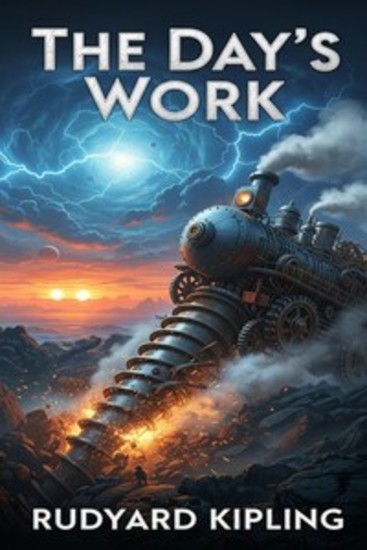
The Day's Work
Rudyard Kipling
Editorial: Bu Classics Books
Sinopsis
The intersection of professional duty and human emotion takes center stage in these stories celebrating the quiet heroism of those who build and maintain the modern world.
Editorial: Bu Classics Books
The intersection of professional duty and human emotion takes center stage in these stories celebrating the quiet heroism of those who build and maintain the modern world.
The bookshelves of American literature are incredible collections that have gathered together centuries of very talented authors. From this continent their fame spread and whilst among their number many are now forgotten or neglected their talents endure. Among them is Clark Ashton Smith.Ver libro
A journey begins. Stories are told. Human nature reveals itself in every voice. As pilgrims travel toward Canterbury, each traveler shares a tale—romantic, comic, bawdy, moral, or deeply moving. From knights and clerics to millers and merchants, Chaucer brings together a vivid cross-section of medieval life, exposing ambition, faith, hypocrisy, love, and laughter with remarkable wit and insight. Hailed as "the greatest work of Middle English literature," The Canterbury Tales shaped the English literary tradition and introduced characters so alive they still feel modern. Its storytelling is bold, humorous, and endlessly revealing of the human heart. If you love classic storytelling, sharp social satire, and literature that captures humanity in all its complexity, this essential work is a must-read. Open the book—and join a journey where every tale reflects who we are.Ver libro
Eric Arthur Blair was born on 25th June 1903 in Motihari, Bihar, in what was then British India. When Eric was one his mother took him to England and they settled at Henley-on-Thames in Oxfordshire. His education was at the nearby convent school before moving on to St Cyprian's School at Eastbourne and finally Eton where his academic studies were sidelined in favour of work on college publications. University could not be achieved without a scholarship, which depended on good grades, and so it was decided that Eric should join the Imperial Police. Now 19 he chose a posting in Burma, then a province of British India. He was appointed an Assistant District Superintendent in November 1922. In Burma, he was an outsider. However, he acquired a moustache and some local tattoos—small badly drawn blue circles on his knuckles. In 1927 he contracted dengue fever and returned to England to convalesce. At home he reappraised his life and resigned his job to become a writer. His police experiences were later used for ‘Burmese Days’. By 1932 he had a literary agent who secured him an offer to publish a non-fiction work ‘Down and Out in London and Paris’ for a £40 advance, through the radical and socialist Victor Gollancz publishing house. It was published in January 1933 as ‘by George Orwell’, it was modestly successful. ‘Burmese Days’ (1934) and ‘A Clergyman's Daughter’ (1935) were published whilst Orwell kept on with writing ‘Keep the Aspidistra Flying’. In January 1936, he set out by public transport to research life for the ordinary man and woman in Wigan. From these experiences emerged ‘The Road to Wigan Pier’. He also caught the eye of Special Branch who kept him under surveillance until the year before the release of ‘Nineteen Eighty-Four’. Later in December 1936 Orwell set out to fight in the Spanish Civil War. Initially stationed at Alcubierre 1,500 feet above sea level, in the depth of winter on the Aragon Front. Military action was scant as was the lack of munitions, food and firewood. In April, Orwell returned to Barcelona and was caught up in the Barcelona May Days and its factional in-fighting. Returning to the Aragon Front he was almost immediately hit by a sniper's bullet through the throat. The bullet barely missed the artery but he survived. His experiences were expressed in ‘Homage to Catalonia’ (1938) but, out of fashion with its times, it was a commercial failure. When World War Two started Orwell was declared ‘unfit for any kind of military service’ but finally obtained ‘war work’ with the BBC's Eastern Service. In September 1943, after two years Orwell left the BBC to concentrate on a new idea: ‘Animal Farm’. By April 1944 ‘Animal Farm’ was ready for publication. It was a huge and resounding success. Orwell left London for the island of Jura in April 1947 to work on ‘Nineteen Eighty-Four’. Once more health became an issue and in December a chest specialist was summoned from Glasgow who diagnosed tuberculosis. By the end of July Orwell was able to return to Jura to finish ‘Nineteen Eighty-Four’. It was published the following June to immediate critical and popular acclaim. By Christmas Orwell's health had again begun to decline. Early on the morning of 21st January, an artery burst in Orwell's lungs. It was fatal. He was dead at 46.Ver libro
What if ordinary language hid extraordinary secrets? Philip K. Dick’s delightfully strange short story The Eyes Have It takes a single misunderstanding and spirals it into full-blown paranoia in the way only Dick can. When an unsuspecting reader opens a simple paperback, he discovers bizarre phrases that seem to describe humans casually removing eyes, hands, and limbs as if it were nothing. Horrified, he becomes convinced he has stumbled onto a hidden truth: alien beings who can detach their body parts walk among us — and the book is their confession. What follows is a hilarious and unsettling descent into misunderstanding, speculation, and fear. With Dick’s trademark mix of satire, sci-fi curiosity, and slippery reality, the story skewers the way we interpret the world around us — and how easily imagination can outrun truth. Narrated with sharp wit and perfect comic timing by Drew Caton, this short tale delivers a punch of classic speculative weirdness in just minutes. A must-listen for fans of retro sci-fi, humor with a paranoid twist, and the early works of Philip K. Dick.Ver libro
Cassandra Khaw's dynamic and vibrant debut collection, Breakable Things, explores the fragile and nebulous bonds that weave love and grief into our existence. This exquisite and cutting collection of stories showcases a bloody fusion of horrors from cosmic to psychological to body traumas. Contains mature themes.Ver libro
Amy Levy was born in London, England in 1861, the second of seven in a fairly wealthy Anglo-Jewish family. The children read and participated in secular literary activities and became firmly integrated into Victorian life. Her education was at Brighton High School, Brighton, before studies at Newnham College, Cambridge; she was the first Jewish student when she arrived in 1879, but left after four terms. Amy’s writing career began early; her poem ‘Ida Grey’ appeared when she was only fourteen. Her acclaimed short stories ‘Cohen of Trinity’ and ‘Wise in Their Generation,’ were published by Oscar Wilde in his magazine ‘Women's World’. Her poetic writings reveal feminist concerns; ‘Xantippe and Other Verses’, from 1881 includes a poem in the voice of Socrates's wife. ‘A Minor Poet and Other Verse’ from 1884 comprises of dramatic monologues and lyric poems. In 1886, Amy began a series of essays on Jewish culture and literature for the Jewish Chronicle, including ‘The Ghetto at Florence’, ‘The Jew in Fiction’, ‘Jewish Humour’ and ‘Jewish Children’. That same year while travelling in Florence she met the writer Vernon Lee. It is generally assumed they fell in love and this inspired the poem ‘To Vernon Lee’. Her first novel ‘Romance of a Shop’, written in 1888 is based on four sisters who experience the pleasures and hardships of running a London business during the 1880s. This was followed by Reuben Sachs (also 1888) and concerned with Jewish identity and mores in the England of her time and was somewhat controversial. Her final book of poems, ‘A London Plane-Tree’ from 1889, shows the beginnings of the influence of French symbolism. Despite many friendships and an active life, Amy suffered for many years with serious depressions and this, together with her growing deafness, led her to commit suicide by inhaling carbon monoxide on September 10th, 1889. She was 27.Ver libro