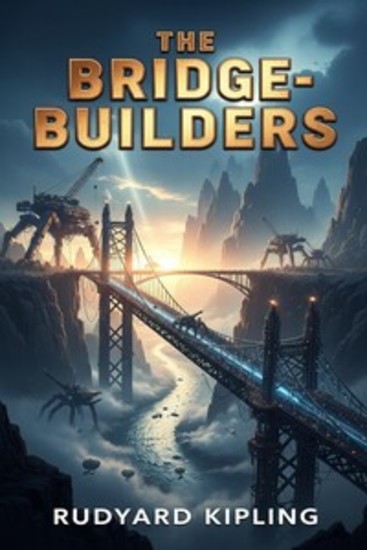
The Bridge-Builders
Rudyard Kipling
Maison d'édition: Bu Classics Books
Synopsis
Witness an epic struggle of engineering and faith as a massive Victorian bridge project faces the wrath of nature and the judgment of ancient deities.
Maison d'édition: Bu Classics Books
Witness an epic struggle of engineering and faith as a massive Victorian bridge project faces the wrath of nature and the judgment of ancient deities.
'Tis the season for classic stories! Clement Clarke Moore's timeless Christmas poem comes gloriously to life as a soundscape audiobook. Root & Twig Sound's fifth production is complete with delightful narration by Phil Dragash, festive original music by Alexander Amadeo and a guest appearance by the Virginian carolers, The Yuletides. Enjoy the Christmas season in a brand new way! +++ A Root & Twig Sounds Production Written by Clement Clarke Moore Original text published on December 23rd of 1823 Produced as a Soundscape Audiobook on December 23rd of 2024 Read and Performed by Phil Dragash Produced and Directed by Phil Dragash and A.Y. Barker Original Music Composed by Alexander Amadeo Special Thanks to Violet Virginia Mills Barker, Emma Purzycki, the families of Bedford and The Yuletides. Cover Art by Phil Dragash © Root & Twig Sounds, 2025 +++ The mission of Root and Twig Sounds is to be a beacon of classic stories spectacularly done for the modern ear, helping the world remember its great storytelling heritage. Find Root & Twig soundscape audiobooks wherever audiobooks are sold.Voir livre
We love reason, advancing through facts to reach a conclusion that explains exactly where we are at. When literary masters create their stories on this theme we are left with some quite brilliant and riveting works that help us gain fascinating insight into both author, story and the world beyond. 1 - Philosophical Stories - An Introduction 2 - In the Penal Colony by Franz Kafka 3 - Bartleby the Scrivener - Part 1 by Herman Melville 4 - Bartleby the Scrivener - Part 2 by Herman Melville 5 - The Dream of a Ridiculous Man by Fyodor Dostoyevsky 6 - Parker Adderson, Philosopher by Ambrose Bierce 7 - Dickory Cronke, The Dumb Philosopher or Great Britain's Wonder by Daniel D 8 - Plato's Dream by Voltaire 9 - The Shades, A Phantasy by Vladimir Korolenko 10 - Gods in Exile by Heinrich Heine 11 - An Evening Guest by Alexander Kuprin 12 - Bellerophon To Anteia by Mary Butts 13 - Putois by Anatole France 14 - The Lightning Rod Man by Herman Melville 15 - Moxon's Master by Ambrose Bierce 16 - A Country Doctor by Franz KafkaVoir livre
Murder Amongst Shadows is a tragic story that projects sadness, terror, and injustice. Bison is a small town with 350 people, that was situated near a grand river in the South Dakota Plains. The people of Bison had constant faceoffs with death and terror. Families frequently lose their loved ones. It became a norm in the town. People get killed, young girls go missing daily, and no one dares to ask questions to request justice for fear of becoming the next target. Detective Eddie, a daring, smart, and diligent man was the people's source of hope. He was good at his job and has a criminal instinct that enabled him to spot the bad guys easily. Eddie worked on restoring peace to South Dakota and brought justice to the families whose daughters were kidnapped. Rachael on the other hand, was the heart of the people. She brought light into the community. She is a rich, vibrant, and brave young lady who made sure everyone in Bison tapped from her blessings. Rachael and her parents, Mr. & Mrs. Lawson were good people who went all out for their community. Unfortunately, Rachael's good deeds didn't prevent them from the cold hands of death. Sadly, good things don't last; and bad things happen to good people. Tragedy befalls the family of Mr. & Mrs. Lawson as they lost their lovely daughter, Rachael. She was caught up in an evil nest and was brutally murdered by her supposed husband, Albert. Day suddenly turned night, fear crept in, tears-soaked clothes, and confusion filled the air, …it was indeed a great loss! The perpetrators of the evil act were in no time caught and faced the law. The family of the deceased sought fortitude and strength to be able to bear the loss of their daughter.Voir livre
10 Authors, 10 Stories, Endless Ways to Save the Day! The Award-Winning Supervillain Rehabilitation Project series expands with this new ten-story anthology of exciting superhero (and villain!) tales. Enter a world of superpowered heroes... and villains. Of epic adventure and hope. In this collection you'll find tales of humor, action, and suspense. Meet brave heroes, quippy villains, and desperate vigilantes. All featured stories are PG or lower, making this a great read for all ages, but especially for fans of superhero fiction, heartfelt moments, and snarky humor. Featuring New Superhero Stories from Award Winning authors as well as exciting new voices in the genre. Are you ready to save the day?Voir livre
Paulownia is a collection of seven stories by three Japanese authors from the late 19th and early 20th century. Mori Ogai was an army surgeon who was sent to study in Germany, where he developed an interest in Western literature. His most famous work is The Wild Geese (Gan). This collection contains his short stories Takase Bune, Hanako, and The Pier. Nagai Kafu's writings center mostly around the entertainment districts of Tokyo with their geisha and prostitutes. Here, his stories The bill-collecting and Ukiyo-e are presented. Shimazaki Toson was one of the representatives of Japanese naturalism, which we can see in his stories A Domestic Animal and Tsugaru Strait. Taketomo Torao, the editor and translator of this volume, translated many Western works into Japanese, for example the Rubayat, the Divine Comedy, and works by Shakespeare. He was also a writer in his own right.Voir livre
Ambrose Gwinnett Bierce was born on 24th June 1842 at Horse Cave Creek in Meigs County, Ohio. His parents were poor but they introduced him to literature at an early age, instilling in him a deep appreciation of books, the written word and the elegance of language. Growing up in Koscuisko County, Indiana poverty and religion were defining features of his childhood, and he would later describe his parents as “unwashed savages” and fanatically religious, showing him little affection but always quick to punish. He came to resent religion, and his introduction to literature appears to be their only positive effect. At age 15 Bierce left home to become a printer’s devil, mixing ink and fetching type at The Northern Indian, a small Ohio paper. Falsely accused of theft he returned to his farm and spent time sending out work in the hopes of being published. His Uncle Lucius advised he be sent to the Kentucky Military Institute. A year later he was commissioned as an Officer. As the Civil War started Bierce enlisted in the 9th Indiana Infantry Regiment. In April 1862 Bierce fought at the Battle of Shiloh, an experience which, though terrifying, became the source of several short stories. Two years later he sustained a serious head wound and was off duty for several months. He was discharged in early 1865. A later expedition to inspect military outposts across the Great Plains took him all the way to San Francisco. He remained there to become involved with publishing and editing and to marry, Mary Ellen on Christmas Day 1871. They had a child, Day, the following year. In 1872 the family moved to England for 3 years where he wrote for Fun magazine. His son, Leigh, was born, and first book, ‘The Fiend’s Delight’, was published. They returned to San Francisco and to work for a number of papers where he gained admiration for his crime reporting. In 1887 he began a column at the William Randolph Hearst’s San Francisco Examiner. Bierce’s marriage fell apart when he discovered compromising letters to his wife from a secret admirer. The following year, 1889 his son Day committed suicide, depressed by romantic rejection. In 1891 Bierce wrote and published the collection of 26 short stories which included ‘An Occurrence at Owl Creek Bridge’. Success and further works including poetry followed. Bierce with Hearst’s resources helped uncover a financial plot by a railroad to turn 130 million dollars of loans into a handout. Confronted by the railroad and asked to name his price Bierce answered “my price is $130 million dollars. If, when you are ready to pay, I happen to be out of town, you may hand it over to my friend, the Treasurer of the United States”. He now began his first foray as a fabulist, publishing ‘Fantastic Fables’ in 1899. But tragedy again struck two years later when his second son Leigh died of pneumonia relating to his alcoholism. He continued to write short stories and poetry and also published ‘The Devil’s Dictionary’. At the age of 71, in 1913 Bierce departed from Washington, D.C., for a tour of the battlefields where he had fought during the civil war. At the city of Chihuahua he wrote his last known communication, a letter to a friend. It’s closing words were “as to me, I leave here tomorrow for an unknown destination,” Ambrose Bierce then vanished without trace.Voir livre