Begleiten Sie uns auf eine literarische Weltreise!
Buch zum Bücherregal hinzufügen
Grey
Einen neuen Kommentar schreiben Default profile 50px
Grey
Jetzt das ganze Buch im Abo oder die ersten Seiten gratis lesen!
All characters reduced
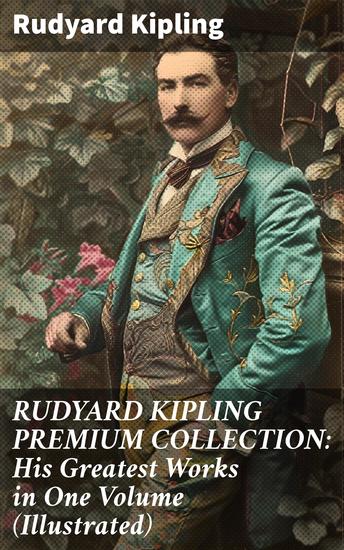
RUDYARD KIPLING PREMIUM COLLECTION: His Greatest Works in One Volume (Illustrated) - Timeless Tales and Profound Wisdom: A Literary Gem - cover

RUDYARD KIPLING PREMIUM COLLECTION: His Greatest Works in One Volume (Illustrated) - Timeless Tales and Profound Wisdom: A Literary Gem

Rudyard Kipling

Verlag: Good Press

  • 0
  • 0
  • 0

Beschreibung

Rudyard Kipling's "RUDYARD KIPLING PREMIUM COLLECTION: His Greatest Works in One Volume (Illustrated)" presents a meticulously curated anthology showcasing the author'Äôs most iconic stories, poems, and fables. With a literary style that interweaves rich narrative, lyrical prose, and vibrant illustrations, Kipling transports readers into the colonial landscapes and adventures of the British Empire. This collection highlights his distinctive storytelling techniques and his insightful commentary on imperialism, identity, and human nature, making it relevant to both historical and contemporary discussions on culture and ethics. Rudyard Kipling (1865-1936) was a British author whose experiences in colonial India profoundly influenced his writing. His upbringing amidst diverse cultures informed his exploration of themes such as loyalty, loss, and the moral dilemmas of colonial life. Kipling received critical acclaim and the Nobel Prize in Literature in 1907, establishing himself as one of the foremost literary voices of his time, renowned for works including "The Jungle Book" and "Kim." This lavishly illustrated collection invites both long-time admirers and new readers to explore Kipling's unparalleled literary achievements. Ideal for scholars, enthusiasts, and casual readers alike, this compilation not only preserves Kipling'Äôs legacy but also enhances the reading experience with exquisite visuals, ensuring a profound understanding of his timeless themes.
Verfügbar seit: 08.01.2024.
Drucklänge: 180 Seiten.

Weitere Bücher, die Sie mögen werden

  • Hunchback of Notre-Dame The (Book 11) - cover

    Hunchback of Notre-Dame The...

    Victor Hugo

    • 0
    • 0
    • 0
    Book 11: The Hunchback of Notre-Dame or Notre-Dame de Paris is a French Gothic novel by Victor Hugo, published in 1831. - The story is set in Paris in 1482 during the reign of Louis XI. The gypsy Esmeralda (born as Agnes) captures the hearts of many men, including those of Captain Phoebus and Pierre Gringoire, but especially Quasimodo and his guardian Archdeacon Claude Frollo. Frollo is torn between his obsessive lust for Esmeralda and the rules of Notre Dame Cathedral. He orders Quasimodo to kidnap her, but Quasimodo is captured by Phoebus and his guards, who save Esmeralda. Gringoire, who attempted to help Esmeralda but was knocked out by Quasimodo, is about to be hanged by beggars when Esmeralda saves him by agreeing to marry him for four years.
    Zum Buch
  • My First Flight (Unabridged) - cover

    My First Flight (Unabridged)

    H. G. Wells

    • 0
    • 0
    • 0
    Herbert George Wells (21 September 1866 - 13 August 1946) was an English writer. Prolific in many genres, he wrote dozens of novels, short stories, and works of social commentary, history, satire, biography and autobiography. His work also included two books on recreational war games. Wells is now best remembered for his science fiction novels and is often called the "father of science fiction", along with Jules Verne and the publisher Hugo Gernsback.
    MY FIRST FLIGHT: (EASTBOURNE, August 5, 1912-three years later.) Hitherto my only flights have been flights of imagination but this morning I flew. I spent about ten or fifteen minutes in the air; we went out to sea, soared up, came back over the land, circled higher, planed steeply down to the water, and I landed with the conviction that I had had only the foretaste of a great store of hitherto unsuspected pleasures.
    Zum Buch
  • A Dialogue Among Clever People - From their pens to your ears genius in every story - cover

    A Dialogue Among Clever People -...

    Leo Tolstoy

    • 0
    • 0
    • 0
    Leo Tolstoy was born in 1828 in the Russian province of Tula to a wealthy noble family. As a child, he had private tutors but he showed little interest in any formal education. When he went to the University of Kazan in 1843 to study oriental languages and law, he left without completing his courses.  Life now was relaxed and idle but with some writing also taking place.  Gambling debts forced an abrupt change of path and he joined the army to fight in the Crimean War.  He was commended for his bravery and promoted but was appalled at the brutality and loss of life.  He recorded these and other earlier experiences in his diaries which formed the basis of several of his works. 
    In 1852 ‘Childhood’ was published to immediate success and was followed by ‘Boyhood’ and ‘Youth’. 
    His experience in the army and the horrors he witnessed resulted in ‘The Cossacks’ in 1862 and the trilogy ‘Sevastopol Tales’. After the war he travelled around Europe, visiting London and Paris and meeting such luminaries as Victor Hugo and Charles Darwin.  
    It was now that Tolstoy began his masterpiece, ‘War and Peace’. Published in 1869 it was an epic work that changed literature. He quickly followed this with ‘Anna Karenina’.  
    These successes made Tolstoy rich and helped him accomplish many of his dreams but also brought problems as he grappled with his faith and the lot of the oppressed poor. These revolutionary views became so popular that the authorities now kept him under surveillance.  
    He led a life of asceticism and vegetarianism and put his socialist ideals into practice by establishing numerous schools for the poor and food programmes. He also believed in giving away his wealth, which caused much discord with his wife.  
    His writing continued to bring forth classics such as ‘The Death of Ivan Ilyich’ and many brilliant and incisive short stories such as ‘How Much Land Does A Man Need’.  
    In 1901 Tolstoy was excommunicated from the Church and controversially deselected for the Nobel Prize for Literature. 
    Whilst undertaking a pilgrimage by train in October 1910 with his daughter Aleksandra he caught pneumonia in the nearby town of Astapovo.  Leo Tolstoy died on November 9th, 1910, he was 82.
    Zum Buch
  • A Legend - From their pens to your ears genius in every story - cover

    A Legend - From their pens to...

    Alexander Kuprin

    • 0
    • 0
    • 0
    Alexander Kuprin was born in Narovchat, Penza in Russia on 7th September 1870. 
    At 3 his Father died and he and mother moved to Moscow. By 10 he was enrolled at the Second Moscow Military High School and there his interest in literature began. The Alexander Military Academy followed and two years later he was a sub-lieutenant and posted to an Infantry Regiment for a further four years. 
    Despite his duties he was a now a keen writer and published his first short story at this time. His military duties also garnered him experiences for his breakthrough work ‘The Duel’.  Leaving the military he left for Kiev to work for local newspapers.  He continued to publish both stories and novels and by 1901 he was in St Petersburg becoming part of a group that included Chekhov, Ivan Bunin, Maxim Gorky and Leonid Andreyev.  
    In the years that followed further controversial works and acclaim followed.  His comments on the regime meant he was also put under secret police surveillance.   
    As World War I erupted, Kuprin opened a military hospital but was then given command of an infantry company in Finland. He was soon discharged on grounds of ill health.  
    The October Revolution saw him praise Lenin, but he warned that the Bolsheviks threatened Russian culture and might cause further widespread suffering to the peasants.  As Civil War raged he took his family to Helsinki and then on to Paris. 
    Exile saw his talents decline further and his succumbing to alcoholism. He became lonely and withdrawn. The family's poverty increased his malaise.   
    In May 1937, the Kuprin’s returned to Moscow.  He now saw his work published but wrote almost nothing new.  In 1938 his health rapidly deteriorated.  Already suffering from a kidney problems and sclerosis, he had now developed cancer of the oesophagus.  
    Alexander Kuprin died on 25th August 1938.
    Zum Buch
  • The Alchemist - cover

    The Alchemist

    Ben Jonson

    • 0
    • 0
    • 0
    An outbreak of plague in London forces a gentleman, Lovewit, to flee temporarily to the country, leaving his house under the sole charge of his butler, Jeremy. Jeremy uses the opportunity given to him to use the house as the headquarters for fraudulent acts. He transforms himself into 'Captain Face', and enlists the aid of Subtle, a fellow conman and Dol Common, a prostitute. In The Alchemist, Jonson unashamedly satirizes the follies, vanities and vices of mankind, most notably greed-induced credulity. People of all social classes are subject to Jonson's ruthless, satirical wit. He mocks human weakness and gullibility to advertising and to "miracle cures" with the character of Sir Epicure Mammon, who dreams of drinking the elixir of youth and enjoying fantastic sexual conquests. The Alchemist focuses on what happens when one human being seeks advantage over another. In a big city like London, this process of advantage-seeking is rife. The trio of con-artists - Subtle, Face and Dol - are self-deluding small-timers, ultimately undone by the same human weaknesses they exploit in their victims.Benjamin Jonson was an English playwright and poet. Jonson's artistry exerted a lasting influence upon English poetry and stage comedy.
    Zum Buch
  • His Masterpiece - cover

    His Masterpiece

    Émile Zola

    • 0
    • 0
    • 0
    His Masterpiece is a fictional account of Zola's friendship with Paul Cezanne and a fairly accurate portrayal of the Parisian art world in the mid 19th century. The story follows painter Claude Lantier who advocates painting real subjects in real places, most notably outdoors. This is in stark contrast to the artistic establishment, where artists painted in the studio and concentrated on mythological, historical and religious subjects. His art making is revolutionary and he has a small circle of like-minded friends equally intent on shaking up the art world and challenging the establishment.
    Zum Buch