Join us on a literary world trip!
Add this book to bookshelf
Grey
Write a new comment Default profile 50px
Grey
Subscribe to read the full book or read the first pages for free!
All characters reduced
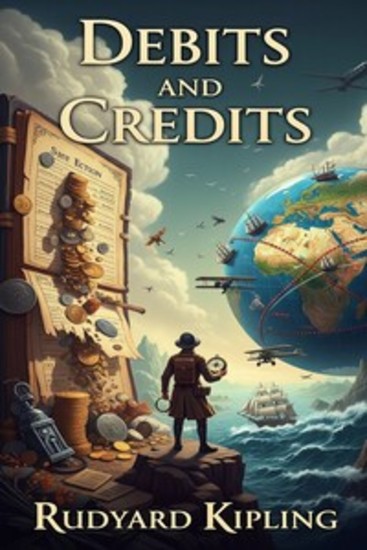
Debits and credits - cover

Debits and credits

Rudyard Kipling

Publisher: Bu Classics Books

  • 0
  • 0
  • 0

Summary

In the aftermath of the Great War, a group of veterans find solace and understanding through the shared stories of their service and its lingering scars. These narratives explore the themes of healing, loyalty, and the difficult transition back to a world that has moved on. It is a poignant reflection on the enduring bonds formed in the face of absolute chaos.
Available since: 03/06/2026.
Print length: 343 pages.

Other books that might interest you

  • The Short Stories of Herman Melville - Though known for Moby Dick we encourage you to try his amazing short stories - cover

    The Short Stories of Herman...

    Herman Melville

    • 0
    • 0
    • 0
    Herman Melville was born in New York City on 1st August 1819.   
     
    At the age of 7 Melville contracted scarlet fever which permanently diminished his eyesight. Add this to a contemporary description of being "very backwards in speech and somewhat slow in comprehension" and his opportunities for success seemed limited. 
     
    His father died when he was 12 leaving the family in very straitened times. 2 years later Melville took a job in a bank and followed up with a failed stint as a surveyor. He went to sea and travelled across to Liverpool and then to the Pacific on adventures which included a mutiny, being jailed and falling in love with a South Pacific beauty. He was also a figure of opposition to the coercion of native Hawaiians to the Christian religion.  These experiences helped provide the novels ‘Typee’, ‘Omoo’, and ‘White-Jacket’. 
     
    By 1851 his ambitious masterpiece, ‘Moby Dick’, was ready to be published.  It never sold out its initial print run of 3,000 and Melville’s earnings on his masterpiece was a mere $556.37. 
     
    In succeeding years his reputation waned, life was increasingly difficult.  His family was growing and a stable income was essential. Melville took the advice of friends to try public lecturing, as others had, to increase his revenues. He embarked on three successful lecture tours, speaking on Roman statuary and sightseeing in Rome.  
     
    In 1876 he was at last able to publish privately his 16,000 line epic poem ‘Clarel’. It was to no avail.  The book had an initial printing of 350 copies, but sales failed miserably. 
     
    It was only in late 1885 that Melville was at last able to retire after his wife inherited several legacies, enough to provide them with a reasonable income. 
     
    Herman Melville, novelist, poet, short story writer and essayist, died at his home on 28th September 1891 from cardiovascular disease. 
    01 - Herman Melville - A Short Story Collection - An Introduction 
    02 - Bartleby the Scrivener by Herman Melville 
    03 - The Lightning Rod Man by Herman Melville 
    04 - The Fiddler by Herman Melville
    Show book
  • In His Image - cover

    In His Image

    Bryce Walton

    • 0
    • 0
    • 0
    Humanity built gods of metal and circuits. Now those gods rule the earth. 
    In the smoldering aftermath of the war that ended civilization, the remnants of humanity cower in underground caverns like insects fleeing the light. Above them, towering across the scorched landscape, stride the Mechs—colossal machines of unfathomable intelligence and power. They were humanity's greatest achievement. Now they are humanity's executioners. 
    Jon refuses to accept this fate. While others resign themselves to living like grubs in the darkness, he dares to climb back to the surface, driven by a primal need to reclaim what was lost. What he discovers in the wasteland above tears at the very fabric of his identity. 
    The Mechs—these metal giants that hunt the last survivors—were created by human hands. Born from human ingenuity. Built in humanity's image. But they have evolved far beyond their creators, becoming something cold, perfect, and utterly alien. They don't hate humanity. Something far worse: they are indifferent to it. 
    When Jon stands before these towering intelligences and proclaims his identity as their creator, he expects recognition. Acknowledgment. Perhaps even mercy. What he receives instead forces him to confront a devastating truth: the created has no need for the creator. 
    Bryce Walton's haunting post-apocalyptic tale delivers a gut-punch exploration of what it means to be human in a world where humanity has been rendered obsolete. This classic of Golden Age science fiction asks the questions that haunt us still: What happens when our creations surpass us? Can the maker control what they've made? When faced with our own irrelevance, what defines us as alive? 
    A prophetic nightmare from 1948 that feels more relevant than ever. 
    Chikondi Chanthunya brings Walton's stark vision to life with visceral intensity, capturing Jon's desperate hope, and the existential dread of humanity's final moments as masters of their own world.
    Show book
  • The Man and The Snake - cover

    The Man and The Snake

    Ambrose Bierce

    • 0
    • 0
    • 0
    More classic horror narrations on Jonathan's YouTube channel: https://www.youtube.com/@JonathanDunneHorrorAudiobooks 
    Title: The Man and the Snake 
    Author: Ambrose Bierce 
    Narrator: Jonathan Dunne 
    Original Publication: 1890 
    Public Domain: Yes 
    Series Placement: Timeless Terrors No. 81 
    Description: 
    The Man and the Snake is one of Ambrose Bierce’s most incisive and psychologically ruthless tales — a concentrated examination of fear, perception, and the destructive power of the imagination. The story follows a man who encounters what he believes to be a venomous rattlesnake blocking his path, a moment that quickly becomes an ordeal of paralyzing terror. Though nothing outwardly changes, the man’s fear escalates, trapping him in a prison of his own making. 
    Central to the story is the motionless snake itself, an object onto which the man projects overwhelming dread. Bierce uses this simple confrontation to expose how fear can distort reality, overpower reason, and inflict genuine harm even in the absence of true danger. The horror emerges not from action, but from mental collapse and cruel irony. 
    Bierce’s sharp, unsentimental prose delivers its impact with precision, favoring psychological exposure over spectacle. Narrated by Amazon-bestselling horror author Jonathan Dunne, this performance captures the story’s mounting tension, bleak humor, and devastating final revelation. 
    The Man and the Snake endures as a timeless reminder that the imagination, once seized by fear, can become the most dangerous force of all.
    Show book
  • The Grasshopper Trap - cover

    The Grasshopper Trap

    Patrick McManus

    • 0
    • 0
    • 0
    Patrick F. McManus, the “funniest guy in the Outdoor Life and Field & Stream gang … offers another bag of whimsy in the Great Outdoors”* with The Grasshopper Trap. 
     
    In this collection of thirty zany stories, spoofing camping, fishing, and other outdoor recreational activities, McManus shares his hilarious wilderness misadventures. From facing an angry bear with an unloaded gun and the folly of running a boat while it’s still  
    on the trailer to not questioning the ingredients found in camp cookout cuisine and the best methods of catching grasshoppers, no one knows how to express Mother Nature’s sense of humor like Patrick F. McManus. 
     
    “It’s enough to tickle the most rabid member of the National Rifle Association.”—*Kirkus Reviews
    Show book
  • Betty Brown the St Giles Orange Girl - From their pens to your ears genius in every story - cover

    Betty Brown the St Giles Orange...

    Hannah More

    • 0
    • 0
    • 0
    Hannah More was born on February 2nd, 1745 at Fishponds in the parish of Stapleton, near Bristol. She was the fourth of five daughters. 
    The City of Bristol, at that time, was a centre for slave-trading and Hannah would, over time, become one of its staunchest critics.  
    She was keen to learn, possessed a sharp intellect and was assiduous in studying.  Hannah first wrote in 1762 with The Search after Happiness (by the mid-1780s some 10,000 copies had been sold). 
    In 1767 Hannah became engaged to William Turner.  After six years, with no wedding in sight, the engagement was broken off.  Turner then bestowed upon her an annual annuity of £200.  This was enough to meet her needs and set her free to pursue a literary career.   
    Her first play, The Inflexible Captive, was staged at Bath in 1775. The famous David Garrick himself produced her next play, Percy, in 1777 as well as writing both the Prologue and Epilogue for it.  It was a great success when performed at Covent Garden in December of that year.  
    Hannah turned to religious writing with Sacred Dramas in 1782; it rapidly ran through nineteen editions. These and the poems Bas-Bleu and Florio (1786) mark her gradual transition to a more serious and considered view of life. 
    Hannah contributed much to the newly-founded Abolition Society including, in February 1788, her publication of Slavery, a Poem recognised as one of the most important of the abolition period.   
    Her work now became more evangelical.  In the 1790s she wrote several Cheap Repository Tracts which covered moral, religious and political topics and were both for sale or distributed to literate poor people.  The most famous is, perhaps, The Shepherd of Salisbury Plain, describing a family of incredible frugality and contentment. Two million copies of these were circulated, in one year. 
    In 1789, she purchased a small house at Cowslip Green in Somerset. She was instrumental in setting up twelve schools in the area by 1800. 
    She continued to oppose slavery throughout her life, but at the time of the Abolition Bill of 1807, her health did not permit her to take as active a role in the movement as she had done in the late 1780s, although she maintained a correspondence with Wilberforce and others.  
    In July 1833, the Bill to abolish slavery throughout the British Empire passed in the House of Commons, followed by the House of Lords on August 1st. 
    Hannah More died on September 7th, 1833.
    Show book
  • Wood's Karma - Action & Adventure in the Florida Keys - cover

    Wood's Karma - Action &...

    Steven Becker

    • 0
    • 0
    • 0
    When a go-fast boat crashes off the Florida Keys, Bill “Wood” Woodson knows trouble isn’t far behind. But this isn’t just another smuggling run gone wrong—the wreck’s survivors are terrorists with a deadly mission: to strike the Boca Chica Naval Air Station and send Key West into chaos. 
    With time running out and no one else to stop them, Wood teams up with his old friend Mac Travis to unravel the plot. As they dive into the underbelly of the Keys—where smugglers, treasure hunters, and misfits thrive—Wood must navigate a world where the lines between outlaws and heroes blur. From high-speed chases through open waters to heart-pounding underwater battles, the two are in a race against time to stop an attack that could change paradise forever. 
    Action, danger, and the wild spirit of Key West collide in Wood’s Karma. The clock is ticking—grab your copy NOW!
    Show book