Rejoignez-nous pour un voyage dans le monde des livres!
Ajouter ce livre à l'électronique
Grey
Ecrivez un nouveau commentaire Default profile 50px
Grey
Abonnez-vous pour lire le livre complet ou lisez les premières pages gratuitement!
All characters reduced
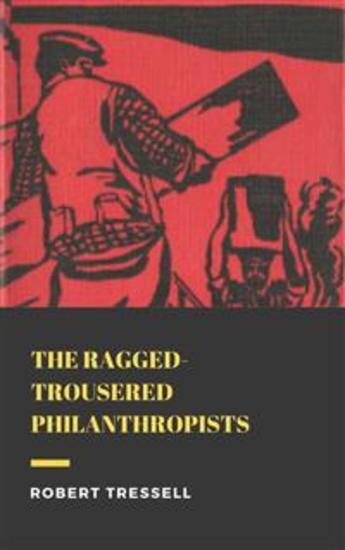
The Ragged Trousered Philanthropists - cover

The Ragged Trousered Philanthropists

Robert Tressell

Maison d'édition: CKF Publishing

  • 0
  • 0
  • 0

Synopsis

The Ragged-Trousered Philanthropists (1914) is a semi-autobiographical novel by the Irish house painter and sign writer Robert Noonan, who wrote the book in his spare time under the pen name Robert Tressell. Published after Tressell's death from tuberculosis in the Liverpool Royal Infirmary in 1911, the novel follows a house painter's efforts to find work in the fictional English town of Mugsborough (based on the coastal town of Hastings) to stave off the workhouse for himself, his wife and his son. The original title page, drawn by Tressell, carried the subtitle: "Being the story of twelve months in Hell, told by one of the damned, and written down by Robert Tressell."
Disponible depuis: 10/12/2023.

D'autres livres qui pourraient vous intéresser

  • Ram Dass - On The Bhagavad Gita - cover

    Ram Dass - On The Bhagavad Gita

    Sripad Jagannatha Das

    • 0
    • 0
    • 0
    “We're all just walking each other home.” 
     
    “The quieter you become, the more you can hear.” 
     
    “We're fascinated by the words--but where we meet is in the silence behind them.” 
     
    “It is important to expect nothing, to take every experience, including the negative ones, as merely steps on the path, and to proceed.” 
    ― Ram Dass 
     
    Dr. Richard Alpert, a former Harvard professor and Timothy Leary cohort, was an icon of the hippie, LSD-fueled revolution of the 1960s. Thereafter, on a trip to India - like Clark Kent changing into Superman - he became the much-beloved spiritual teacher Baba Ram Das. His 1970s' iconic book Be Here Now turned on a generation to the deep, non-sectarian spirituality within us all. 
     
    Author Sripad Jagannatha Dasa became friends with Ram Das in the early '70s and traveled across America, playing Indian drums at his speaking engagements. During that time, the two discussed the publication of some of his lectures, but nothing was ever done, and the two lost touch. Now, finally, after all these years, Jagannatha Dasa keeps his promise to his old friend, publishing this original audio history of one of our most inspired and cherished spiritual teachers.
    Voir livre
  • Body Horror - Capitalism Fear Misogyny Jokes - cover

    Body Horror - Capitalism Fear...

    Anne Elizabeth Moore

    • 0
    • 0
    • 0
    Whether for entertainment, under the guise of medicine, or to propel consumerism, heinous acts are perpetrated daily on women’s bodies. In Body Horror: Capitalism, Fear, Misogyny, Jokes, award-winning journalist Anne Elizabeth Moore catalogs the global toll of capitalism on our physical autonomy. Weaving together unflinching research and surprising humor, these essays range from investigative—probing the Cambodian garment industry, the history of menstrual products, or the gender biases of patent law—to uncomfortably intimate. Informed by her own navigation of several autoimmune diagnoses, Moore examines what it takes to seek care and community in the increasingly complicated, problematic, and disinterested US healthcare system. 
     
    A Lambda Literary Award finalist and a Chicago Review of Books Nonfiction Award shortlist title, Body Horror is “sharp, shocking, and darkly funny. . . . Brainy and historically informed, this collection is less a rallying cry or a bitter diatribe than a series of irreverent and ruthlessly accurate jabs at a culture that is slowly devouring us” (Publishers Weekly, starred review). Featuring an updated introduction and new essays, as well as illustrations by Xander Marro, this new edition of Body Horror is a fascinating, insightful portrait of the gore that encapsulates contemporary American politics.
    Voir livre
  • Heroic Epics - Tales of Legendary Figures (3 in 1) - cover

    Heroic Epics - Tales of...

    Julia Blacksmith

    • 0
    • 0
    • 0
    Heroic Epics brings together three of the most enduring mythological traditions in a single volume, illuminating the timeless stories of legendary figures whose deeds echo through the ages. This 3-in-1 collection explores the chivalrous world of The Arthurian Legends, the ancient struggles of The Epic of Gilgamesh, and the powerful, storm-laden sagas of Norse Myths Unveiled. Each tale reveals the values, fears, and aspirations of the cultures that gave them life—offering readers both entertainment and deep historical insight. 
    Step into the mystical realm of King Arthur and the Knights of the Round Table, where honor, love, and betrayal shape the fate of Camelot. Encounter familiar figures like Merlin, Lancelot, and Guinevere as they face trials of loyalty, power, and destiny. Then journey even further back in time to ancient Mesopotamia in The Epic of Gilgamesh, one of humanity’s oldest recorded stories. Follow the mighty king of Uruk on his quest for immortality, friendship, and meaning in a world shaped by gods and fate. 
    Finally, Norse Myths Unveiled dives into the chilling, awe-inspiring world of Viking mythology—where gods like Odin, Thor, and Loki roam among giants, monsters, and warriors. These tales pulse with prophecy, epic battles, and the ultimate fate of the cosmos: Ragnarök. Heroic Epics offers a thrilling ride through centuries of storytelling and the powerful archetypes that continue to inspire modern fantasy and heroic fiction.
    Voir livre
  • On Benefits - cover

    On Benefits

    Lucius Annaeus Seneca

    • 0
    • 0
    • 0
    The original Latin name of this important essay by Seneca, written around 60 CE, was De Beneficiis, which is why it is generally translated as ‘On Benefits’. However, it is more usefully titled ‘On Favours’, because this is what it is essentially about: the giving and receiving of favours, with all the implications of such transactions. Seneca is concerned with demonstrating that while such exchanges can be straightforward and beneficial to both parties, often there are pitfalls and hidden complications that, sooner or later, result in problems. Though some centuries later Shakespeare summed it up concisely with Polonius’s warning: ‘Neither a borrower nor a lender be,’ Seneca is well aware that in all levels and activities of society, benefits or favours play an undoubtedly crucial role. This was certainly true of Roman society, but little has changed since. Seneca deals with the subject in detail, considering the purposes of role of the giver, of which ‘kindness’, he says, is an important aspect – but not the only one by any means. Similarly, the role and attitude of the receiver, plays its part – and ‘gratitude’ is again only one response. Seneca’s background as a Stoic underpins his approach, so he warns against the inappropriate giving and receiving of benefits, which extend far beyond just material goods: it includes influence, wives, patronage and all manner of vice and immorality. In short, Seneca points out that the giving and receiving of favours can be, and often is a pernicious and dangerous affair, resulting in later disaster. Something to be exercised with caution.
    Voir livre
  • Dream States - Smart Cities and the Pursuit of Utopian Urbanism - cover

    Dream States - Smart Cities and...

    John Lorinc

    • 0
    • 0
    • 0
    John Lorinc is the Toronto nonfiction editor at Coach House. He is also the recipient of the 2020 Fellowship from the Atkinson Foundation, a prestigious honor from an organization working for social and economic justice.
    Voir livre
  • On James Baldwin - cover

    On James Baldwin

    Colm Tóibín

    • 0
    • 0
    • 0
    Acclaimed Irish novelist Colm Tóibín first read James Baldwin just after turning eighteen. He had completed his first year at an Irish university and was struggling to free himself from a religious upbringing. Inspired by the novel Go Tell It on the Mountain, Tóibín found a writer who would be a lifelong companion and exemplar. 


    From On James Baldwin: 


    Baldwin was interested in the hidden and dramatic areas in his own being, and was prepared as a writer to explore difficult truths about his own private life. In his fiction, he had to battle for the right of his protagonists to choose or influence their destinies. He knew about guilt and rage and bitter privacies in a way that few of his White novelist contemporaries did. And this was not simply because he was Black and homosexual; the difference arose from the very nature of his talent, from the texture of his sensibility. "All art," he wrote, "is a kind of confession, more or less oblique. All artists, if they are to survive, are forced, at last, to tell the whole story, to vomit the anguish up." 


    On James Baldwin is a magnificent contemporary author's tribute to one of his most consequential literary progenitors.
    Voir livre