Begleiten Sie uns auf eine literarische Weltreise!
Buch zum Bücherregal hinzufügen
Grey
Einen neuen Kommentar schreiben Default profile 50px
Grey
Jetzt das ganze Buch im Abo oder die ersten Seiten gratis lesen!
All characters reduced
Urban Neighborhoods in a New Era - Revitalization Politics in the Postindustrial City - cover

Urban Neighborhoods in a New Era - Revitalization Politics in the Postindustrial City

Robert P. Stoker, Clarence N. Stone

Verlag: The University of Chicago Press

  • 0
  • 0
  • 0

Beschreibung

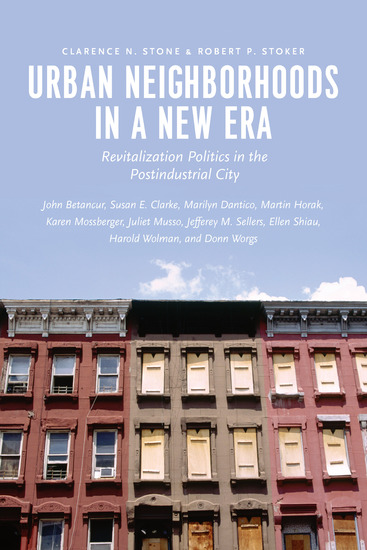
For decades, North American cities racked by deindustrialization and population loss have followed one primary path in their attempts at revitalization: a focus on economic growth in downtown and business areas. Neighborhoods, meanwhile, have often been left severely underserved. There are, however, signs of change. This collection of studies by a distinguished group of political scientists and urban planning scholars offers a rich analysis of the scope, potential, and ramifications of a shift still in progress. Focusing on neighborhoods in six cities—Baltimore, Chicago, Denver, Los Angeles, Phoenix, and Toronto—the authors show how key players, including politicians and philanthropic organizations, are beginning to see economic growth and neighborhood improvement as complementary goals. The heads of universities and hospitals in central locations also find themselves facing newly defined realities, adding to the fluidity of a new political landscape even as structural inequalities exert a continuing influence. While not denying the hurdles that community revitalization still faces, the contributors ultimately put forth a strong case that a more hospitable local milieu can be created for making neighborhood policy. In examining the course of experiences from an earlier period of redevelopment to the present postindustrial city, this book opens a window on a complex process of political change and possibility for reform.
Verfügbar seit: 18.09.2015.
Drucklänge: 316 Seiten.

Weitere Bücher, die Sie mögen werden

  • Black Power Scorecard - Measuring the Racial Gap and What We Can Do to Close It - cover

    Black Power Scorecard -...

    Andre M. Perry

    • 0
    • 0
    • 0
    From the creator of “a unified field theory of racism” (NPR’s Planet Money), a dollars-and-cents reckoning of the state of Black America and a new framework to close the power gap Historically, Black Americans’ quest for power has been understood as an attempt to gain equal protections under the law. But power in America requires more than basic democratic freedoms. It is inextricably linked with economic influence and ownership—of one’s self, home, business, and creations. Andre M. Perry draws on extensive research and analysis to quantify how much power Black Americans actually have. Ranging from property, business, and wealth to education, health, and social mobility, Black Power Scorecard moves across the country, evaluating people’s ability to set the rules of the game and calculating how that translates into the ultimate means of power—life itself, and the longevity of Black communities. Along the way, Perry identifies woefully overlooked areas of investment that could close the racial gap and benefit everyone. An expansive take on power supported by documentation and data, Black Power Scorecard is a fresh contribution to the country’s reckoning with structural inequality, one that offers a new approach to redressing it.A Macmillan Audio production from Metropolitan Books.
    Zum Buch
  • (Dis)Obedience in Digital Societies - Perspectives on the Power of Algorithms and Data - cover

    (Dis)Obedience in Digital...

    Sven Quadflieg, Klaus Neuburg,...

    • 0
    • 0
    • 0
    Algorithms are not to be regarded as a technical structure but as a social phenomenon - they embed themselves, currently still very subtle, into our political and social system. Algorithms shape human behavior on various levels: they influence not only the aesthetic reception of the world but also the well-being and social interaction of their users. They act and intervene in a political and social context. As algorithms influence individual behavior in these social and political situations, their power should be the subject of critical discourse - or even lead to active disobedience and to the need for appropriate tools and methods which can be used to break the algorithmic power.
    Zum Buch
  • The Three Sources and Three Component Parts of Marxism - cover

    The Three Sources and Three...

    Vladimir Lenin

    • 0
    • 0
    • 0
    The Three Sources and Three Component Parts of Marxism (Russian:  Три источника и три составных части марксизма ) is an article written by the Russian revolutionary Vladimir Lenin and published in 1913. The article was dedicated to the thirtieth anniversary of Karl Marx's death.
    Zum Buch
  • Social Entrepreneurship in Germany - An Analysis of the Media Discourse from 1999 to 2021 - cover

    Social Entrepreneurship in...

    Philipp Kenel

    • 0
    • 0
    • 0
    Public and political interest in social entrepreneurship (SE) is increasing while it remains a contested and ambiguous concept. Philipp Kenel traces the popular media representation of SE in Germany over time (1999—2021), making an important empirical contribution to the sociological and political understanding of the phenomenon. He shows that until 2008, SE was mainly understood as a reform of the welfare infrastructure (including public and non-profit institutions). From 2009, SE was increasingly conceptualised as part of the economy, while sometimes challenging and other times reaffirming mainstream economic logics. More recently, in somewhat competing perspectives, SE has been framed as part of the ›start-up‹ world or as a force for deeper social and ecological transformation.
    Zum Buch
  • Ministry of Truth: Book Summary and Analysis - cover

    Ministry of Truth: Book Summary...

    Briefly Summaries

    • 0
    • 0
    • 0
    This is a concise summary and analysis of Ministry of Truth, by Steve Benen.
     
    It is not the original book and is not affiliated with or endorsed by Steve Benen.
     
    Ideal those seeking a quick and insightful overview.


    In Ministry of Truth, the author takes us on a riveting journey through the power and manipulation of truth in society. This thought-provoking audiobook explores the dangerous ways in which information can be controlled and reshaped by those in power, from political regimes to the media, and the profound impact it has on individuals and societies. Through a blend of historical examples and contemporary analysis, the author reveals how truth is not just a matter of facts, but a tool used for control, and how resistance to these manipulations can come at great personal cost.
     
    This audiobook is more than a deep dive into propaganda—it is a call to action for anyone seeking to improve their productivity and reclaim their intellectual autonomy. Every chapter offers valuable insights into how we can protect our mental clarity, make informed decisions, and cultivate environments where truth can flourish. For those striving for success, this book teaches that clarity, integrity, and resilience are not just essential for personal growth—they are the keys to long-term achievement.
    Zum Buch
  • Trajectory of Power - The Rise of the Strongman Presidency - cover

    Trajectory of Power - The Rise...

    William G. Howell, Terry M. Moe

    • 0
    • 0
    • 0
    In Trajectory of Power, leading political scientists William Howell and Terry Moe provide a sweeping account of the historical rise of presidential power, arguing that it has now grown to the point where, in the wrong hands, it threatens to subvert American democracy and replace it with a de facto system of strongman rule, whether led by Donald Trump or someone else. 


    For much of the twentieth century, Republican and Democratic presidents pursued power in very similar ways and almost always within democratic bounds. But Republican presidents since Ronald Reagan, in a transformation that has grown increasingly extreme over time, have gone beyond the "normal" incentives that have traditionally shaped presidential behavior—and still shape the behavior of Democratic presidents—to pursue a presidency of such expansive unilateral power, and with such disregard for basic democratic requirements, that it puts democracy at serious risk. 


    The book traces this divergence in approach to the backlash of conservatives against the administrative state, and to their epiphany that a war on big government could only be waged through a presidency of extraordinary power. Timely, urgent, and original, Trajectory of Power reveals how the presidency has been profoundly transformed during the modern era—and why it now puts our democracy in imminent danger.
    Zum Buch