Begleiten Sie uns auf eine literarische Weltreise!
Buch zum Bücherregal hinzufügen
Grey
Einen neuen Kommentar schreiben Default profile 50px
Grey
Jetzt das ganze Buch im Abo oder die ersten Seiten gratis lesen!
All characters reduced
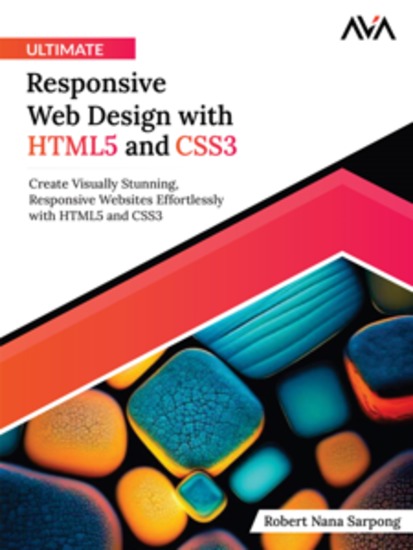
Ultimate Responsive Web Design with HTML5 and CSS3: Create Visually Stunning Responsive Websites Effortlessly with HTML5 and CSS3 - cover

Ultimate Responsive Web Design with HTML5 and CSS3: Create Visually Stunning Responsive Websites Effortlessly with HTML5 and CSS3

Robert Nana

Verlag: Orange Education Pvt Ltd

  • 0
  • 0
  • 0

Beschreibung

Transform Your Ideas into Reality with HTML and CSSKey Features● Master responsive design to create websites that adapt seamlessly across desktops, tablets, and smartphones.● Enhance your web projects by unlocking SEO-friendly design techniques and leveraging web fonts for superior visibility and aesthetics.● Gain hands-on experience through project-based learning, enabling you to build responsive websites and deliver stunning web experiences with confidence.Book DescriptionDid you know that 80% of web developers cite HTML5 and CSS3 as essential skills for creating modern web experiences? With over 40% of websites using these technologies to ensure mobile compatibility, understanding HTML5 and CSS3 is crucial for staying competitive.Master HTML5 and CSS3 with this must-have guide, designed for both beginners and experienced developers. Add powerful tools to your toolkit as you embark on a seamless learning journey, building a strong foundation in crafting visually stunning, fully responsive websites.Dive into advanced CSS3 techniques like fluid layouts, adaptive designs, and media queries to ensure your sites look flawless on any device—desktop, tablet, or smartphone. Leverage the power of Flexbox and Grid for dynamic, flexible layouts, and create engaging experiences with animations and transitions. With hands-on projects and real-world examples, you'll gain the skills to elevate your web design approach, blending creativity with cutting-edge technology. Whether you're just starting out or looking to sharpen your expertise, this ultimate guide will help you build responsive, high-performance websites that truly stand out in today’s digital world.What you will learn● Gain a solid foundation in HTML5 and CSS3 with an introduction to essential web design concepts and tools.● Learn the fundamentals of CSS, including selectors, properties, and styling techniques to enhance your web pages.● Discover how to incorporate media elements, create interactive links, and design user-friendly forms using HTML5 features.● Master advanced positioning techniques and layout strategies to create well-structured, visually appealing web designs.● Explore responsive design with media and container queries, and harness the power of Flexbox and Grid for flexible, dynamic layouts.● Dive into creating engaging animations, working with Scalable Vector Graphics (SVG), and writing custom functions to add interactive and visual flair to your sites.● Delve into more complex aspects of web design and development to refine your skills and tackle sophisticated projects.Table of Contents1. Getting Started2. Introduction to CSS3. Media Elements, Links, Forms, and HTML54. Positioning and Layout5. Media and Container Queries, Flexbox, and Grid6. Animations, SVG, and CSS Functions7. Advanced Topics8. Putting It All Together    Index
Verfügbar seit: 07.02.2025.
Drucklänge: 324 Seiten.
Weitere Bücher, die Sie mögen werden

  • How to Start a Podcast: An Essential Guide to Profitable Podcasting for Beginners - cover

    How to Start a Podcast: An...

    Elliot Shore

    • 0
    • 0
    • 0
    Everything you need to know about how to grow your own podcast today! 
    Have you been struggling to get your head wrapped around the podcasting world?  
    Do you feel you lack ideas of what to do, and has it been hard making a profit?  
    Are you finding writing for your podcast almost unbearable?  
    Do you want to have fun podcasting and get paid to do it?  
    It is time to get a new perspective on all things podcast-related. 
    In this book, you will:Understand how the podcasting world works.Learn how to develop the premise for a successful podcast.Discover how to choose the right niche and audience for you.Get insight into the business side of podcasting by learning how to start a brand.Learn all about the different equipment you may need according to your budget.Learn all you need to know about editing and post-production.Discover the best places to upload your podcast.Explore the many ways through which you can monetize your content.Master how to market your podcast.Master interviewing techniques for when you bring on guests. 
    As a content creator, your time, effort, and financial resources are too precious to be wasted on techniques that do not work. It’s time for you to take a step back and plan a new approach. This insightful book will walk you through the process of building a podcast, distributing it, and profiting from it. What are you waiting for?  
    Click the “add to cart” button and start your podcasting journey today!
    Zum Buch
  • Science and Technology in Ancient Rome: The History and Legacy of the Romans’ Technological Advances - cover

    Science and Technology in...

    Editors Charles River

    • 0
    • 0
    • 0
    The modern world has the ancient Romans to thank for the origins of many modern technologies, conveniences, and ideas, from running water, baths, and republican style government to roads. Similarly, by the 3rd century BCE, the Romans were prodigious monument builders, so much so that the memory of the great Roman Republic and the Roman Empire continues to exist within a cityscape of stone. Rome’s public spaces were filled with statues, arches, temples, and many other varieties of monumental images, and each of these structures had its own civic or religious function. At the same time, most were embedded with stories, messages, and symbolism so that they also tended to function as propaganda. These monuments allowed the leading citizens of Rome, especially its emperors, to sculpt their own self-image and embed themselves and their most memorable deeds into the very structure of the Roman city.  
    	While some of the most famous examples, like the Colosseum and Pantheon, remain striking testaments to Roman engineering and technology, many of the scientific advances the Romans ushered into the world were smaller in scope but not necessarily any less important. Indeed, the Roman Empire was not just one of the most technologically advanced civilizations within the ancient world but also proportionately one of the most prolific throughout all history. A substantial number of these innovations were lost following the eventual fall of the Western Roman Empire in 476 and the subsequent centuries of decline of the Byzantine Empire starting in the early 7th century, but rediscoveries of their advancements began during the later Middle Ages and the beginning of the Modern Era (c. 1400s). Some of their ideas and designs are only now being improved upon thanks to newer, far more advanced modern technologies.  
    Zum Buch
  • AI for Absolute Beginners: A Clear Guide to Tomorrow - cover

    AI for Absolute Beginners: A...

    Oliver Theobald

    • 0
    • 0
    • 0
    Curious about AI but feeling lost at the same time? Well, look no further! AI for Absolute Beginners is your guide to demystifying complex AI concepts and providing you with a solid foundation to step into—and stay ahead—in the new AI era. 
    In this accessible and comprehensive audiobook, we start from scratch, assuming no prior knowledge. Each chapter is carefully crafted to guide you through the fundamental concepts and practical applications of AI, including machine learning, generative AI, and deep learning. With clear and plain English explanations, you'll be surprised at how quickly you can start thinking and speaking fluently in the words and mindset of an AI expert! 
    Key knowledge points you will gain from reading this book:The three phases of AI development and what's coming nextThe "Missing Middle" theory of leveraging what humans and AI do bestGenerative AI and a preview of the data warsMachine learning and a clear introduction on how it worksDeep learning and why it unlocks progress in all fields of AINatural language processing explainedComputer vision and why it's not as easy as you thinkRecommender systems and how to train them to your advantagePrivacy and ethical considerations you must knowThe future of work and how to thrive in the new era of knowledge workThe new role of the chief intelligence officer and how they are guiding AI transformation in organizations 
    Now is a special time in the history of work and efficiency. Follow your curiosity and step confidently into the new era of AI!
    Zum Buch
  • Understanding Virtual Reality - Applications and Experiences - cover

    Understanding Virtual Reality -...

    Craig Dames

    • 0
    • 0
    • 0
    Virtual Reality, often abbreviated as VR, is a groundbreaking technology that enables users to immerse themselves in computer-generated environments that feel remarkably real. Unlike traditional media, which presents information on a flat screen, VR creates a three-dimensional space where users can look around, move, and sometimes even interact with digital elements as if they were physically present. This sense of immersion is what sets VR apart and makes it such a powerful and transformative tool. 
    The concept of virtual reality has existed for decades, with its roots stretching back to the 1960s. Early prototypes like the Sensorama and the first head-mounted displays laid the groundwork for what would eventually become modern VR systems. Over the years, technological advancements in computing power, display quality, motion tracking, and software development have allowed VR to evolve from a niche curiosity into a versatile tool with applications across numerous industries. The introduction of consumer-grade headsets in the 2010s, such as the Oculus Rift and HTC Vive, marked a turning point in accessibility and interest in VR experiences. 
    A complete VR system typically consists of several key components. At the core is the headset, which provides stereoscopic visuals and often includes built-in motion sensors to track head movements. Many headsets are paired with hand controllers, allowing users to interact with objects or navigate virtual environments more naturally. Some systems incorporate additional accessories like haptic gloves, treadmills, or external sensors to enhance realism and expand the user’s range of motion. Software is equally important, as it governs the design of virtual spaces, the behavior of virtual elements, and the overall user experience.
    Zum Buch
  • Value Stream Mapping - Optimize Your Processes and Maximize Efficiency - cover

    Value Stream Mapping - Optimize...

    Steve Abrams

    • 0
    • 0
    • 0
    Dive into the transformative world of Value Stream Mapping (VSM) with "Mastering Value Stream Mapping: Optimize Your Processes and Maximize Efficiency," your comprehensive guide to understanding, implementing, and benefiting from this powerful tool. This book is designed to cater to professionals across various sectors, including manufacturing, services, and software development, who are seeking to enhance their operational efficiency and reduce waste. 
    Starting with the basics, the book introduces you to the concept of VSM, tracing its roots from the Toyota Production System to its contemporary applications in diverse industries. The initial chapters unfold the core principles of Value Stream Mapping, providing a robust framework on how to accurately depict and analyze the current state of your processes and pinpoint inefficiencies. 
    As you progress, "Mastering Value Stream Mapping" offers a meticulous, step-by-step approach to preparing for and executing a VSM exercise. It covers essential aspects such as assembling the right team, engaging stakeholders, and the practicalities of mapping both current and future states. The book emphasizes not just the creation of these maps, but also guides you through interpreting them and developing actionable plans for sustainable improvement. 
    In later chapters, the narrative delves into advanced strategies, integrating technology with VSM, and adapting the principles to cross-functional and cross-organizational challenges. It addresses how VSM can be customized for the Agile environment and software development, enhancing its relevance in today’s digital world. 
    Real-world case studies from various industries are intricately detailed, offering readers insight into the practical application of VSM and showcasing how organizations can achieve significant results. These examples also illustrate common pitfalls and the strategies employed to overcome them. 
     
    Zum Buch
  • Reaching the Moon: The History of the NASA Programs that Led to the Successful Apollo Missions - cover

    Reaching the Moon: The History...

    Editors Charles River

    • 0
    • 0
    • 0
    The Apollo Program is the most famous and celebrated in American history, but the first successful landing of men on the Moon during Apollo 11 had complicated roots dating back over a decade, and it also involved one of NASA’s most infamous tragedies. From 1959-1963, the United States worked toward putting satellites and humans into orbit via the Mercury program, but Eisenhower’s administration was already designing plans for the Apollo program by 1960, a year before the first Russian orbited the Earth and two years before John Glenn became the first American to orbit the Earth. 
    At the same time, America would begin missions to the Moon as early as 1958. On March 27, 1958, Secretary of Defense Neil McElroy announced a lunar project for the International Geophysical Year, consisting of three Air Force launches followed by two Army launches of a JPL-designed lunar probe. ARPA directed the Air Force to launch its probes "as soon as possible consistent with the requirement that a minimal amount of useful data concerning the Moon be obtained." 
    Throughout the 1960s, NASA would spend tens of billions on missions to the Moon, the most expensive peacetime program in American history to that point, and Apollo was only made possible by the tests conducted through earlier missions, including the historic Ranger Program. Conceived as an early part of the attempt to land a man on the Moon, Ranger was designed to photograph the lunar surface in preparation for future landings. Until Ranger, images of the Moon were only available through Earth-based telescopes, which lacked the detail necessary to determine safe sites for landing a spacecraft. Ranger aimed to fill in that gap of knowledge, and like many of NASA’s missions during the 1960s, the program exemplified both the successes and the failures of the agency’s early years.
    Zum Buch