Begleiten Sie uns auf eine literarische Weltreise!
Buch zum Bücherregal hinzufügen
Grey
Einen neuen Kommentar schreiben Default profile 50px
Grey
Jetzt das ganze Buch im Abo oder die ersten Seiten gratis lesen!
All characters reduced
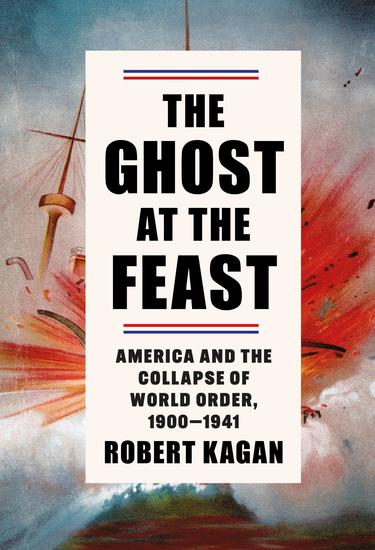
The Ghost at the Feast - America and the Collapse of World Order 1900-1941 - cover

Entschuldigung, dieses Buch ist in Ihrem Land nicht verfügbar.

The Ghost at the Feast - America and the Collapse of World Order 1900-1941

Robert Kaan

Verlag: Atlantic Books

  • 0
  • 0
  • 0

Beschreibung

An NPR Book of the Year


At the dawn of the twentieth century, the United States was one of the world's richest, most populous, most technologically advanced nations. It was also a nation divided along numerous fault lines, with conflicting aspirations and concerns pulling it in different directions. And it was a nation unsure about the role it wanted to play in the world, if any. Americans were the beneficiaries of a global order they had no responsibility for maintaining.


Many preferred to avoid being drawn into what seemed an ever more competitive, conflictual, and militarized international environment. However, many also were eager to see the United States taking a share of international responsibility, working with others to preserve peace and advance civilization. The story of American foreign policy in the first four decades of the twentieth century is about the effort to do both - "to adjust the nation to its new position without sacrificing the principles developed in the past," as one contemporary put it.


This would prove a difficult task. The collapse of British naval power, combined with the rise of Germany and Japan, suddenly placed the United States in a pivotal position. American military power helped defeat Germany in the First World War, and the peace that followed was significantly shaped by a U.S. president. But Americans recoiled from their deep involvement in world affairs, and for the next two decades, they sat by as fascism and tyranny spread unchecked, ultimately causing the liberal world order to fall apart. America's resulting intervention in the Second World War marked the beginning of a new era, for the United States and for the world.


Brilliant and insightful, The Ghost at the Feast shows both the perils of American withdrawal from the world and the price of international responsibility.
Verfügbar seit: 04.04.2024.
Drucklänge: 688 Seiten.

Weitere Bücher, die Sie mögen werden

  • Prince The (Fingerprint Classics) - cover

    Prince The (Fingerprint Classics)

    Niccolò Machiavelli

    • 0
    • 0
    • 0
    The Prince by Niccolò Machiavelli is a timeless political treatise that explores the dynamics of power, leadership, and statecraft. Written in the early 16th century, this concise yet provocative work offers pragmatic advice to rulers on how to gain, maintain, and consolidate authority, often advocating for realism over idealism. Machiavelli examines historical examples and human behavior to present strategies that prioritize effectiveness over morality, making the book both influential and controversial. Its insights into political maneuvering and the nature of authority have cemented it as a foundational text in political philosophy and realpolitik.
    Zum Buch
  • Pandemic Reckoning: Unmasking the Failures of Public Health - "Transform your comprehension of public health—immerse yourself in thought-provoking audio from 'Pandemic Reckoning' today!" - cover

    Pandemic Reckoning: Unmasking...

    Orson Brackley

    • 0
    • 0
    • 0
    Pandemic Reckoning: Unmasking the Failures of Public Health 
    ⭐⭐ Simplified Audio Guide with Explanations ⭐⭐ 
    Are you ready to advance your understanding of public health and uncover the crucial lessons learned during the pandemic? 
    Search no more!  
    This audiobook is your ultimate guide to exploring the critical insights on mental health and resilience amid public health crises. With this knowledge, you will be empowered to engage in meaningful discussions and apply what you've learned. 
    Updated for the latest insights and findings. 
    Key features of this comprehensive resource: 
    - In-depth examination of the failures of public health during the pandemic 
    - Thorough explanations of mental health implications during crises 
    - Effective strategies for resilience and coping 
    Our audiobook sets itself apart by providing extensive coverage of topics essential for grasping the complexities of public health failures. Each concept is examined with care, ensuring a deep understanding. 
    This is an independent resource, not affiliated with any official health organization, created solely for your benefit. 
    Crafted with a clear structure and accessible language, "Pandemic Reckoning" guarantees seamless flow between ideas. Say goodbye to complicated jargon; embrace clear, precise, and insightful content. 
    So, why hesitate? Click the BUY NOW button, secure your copy, and embark on a journey to enhanced awareness about public health failures!
    Zum Buch
  • In the Lion's Den - Israel and the World - cover

    In the Lion's Den - Israel and...

    Danny Danon, Nikki Haley

    • 0
    • 0
    • 0
    In the Lion's Den is a book about the life events that encouraged Danny Danon to pursue his chosen career path and take his distinct and direct approach during his time as Knesset Member and later on in his political career. It is a book that tells the story of his journey to the United Nations and the key events that occurred during the five years he served as Israel's 17th Permanent Representative to the UN. 


    In the Lion's Den draws on the unique perspective of a man who has spent his entire career in his nation's public service. Danon shares his experiences on the front lines of Israel's global presence—the successes as well as the disappointments. Danon makes a compelling case for an Israel that must be proud of its identity and faith; forge relationships with diverse peoples; make autonomous domestic decisions; and determine its own foreign policy. 


    In this book, Danon lays out a roadmap for Israel’s future on the regional and global stage and outlines the path Israel must follow in order to continue to make a positive contribution to global prosperity and peace and ensure its safety in a fraught region. As the Jewish state enters the next phase of its existence, Danon's inspiring vision will help Israel fulfill the noble vision of its founders.
    Zum Buch
  • The Populist Wave - Understanding the Rise of Populism in Modern Politics - cover

    The Populist Wave -...

    Arlo Holders

    • 0
    • 0
    • 0
    Populism, a term often used in modern political discourse, refers to movements or ideologies that seek to represent the interests of ordinary people, often contrasting with the perceived elite or establishment. Understanding the origins of populism requires exploring both its historical roots and its evolution over time. Though its contemporary forms are often associated with charismatic leaders and mass mobilization, populism has a deep and complex history that spans several centuries. 
    Historically, populism can trace its roots back to the late 19th century, when agrarian movements in the United States and Russia first used the term. The Populist Party, founded in the U.S. in 1891, advocated for the interests of farmers who felt exploited by industrial elites and urban centers. In Russia, the narodniks, or "people's movement," emerged around the same time, focusing on the belief that Russia’s future lay in the empowerment of the peasantry. These early populist movements were fueled by economic and social inequalities, with the central grievance being the concentration of wealth and power in the hands of a few. 
    The core tenet of these early populist movements was the idea of a moral divide between the "pure" common people and the corrupt elites. This populist rhetoric resonated strongly with those who felt neglected by the political establishment, emphasizing a deep distrust of centralized political systems and economic power. Populism, then, was not simply about policy disagreements but a call for a deeper cultural and moral reckoning with societal inequalities.
    Zum Buch
  • The Truce - Progressives Centrists and the Future of the Democratic Party - cover

    The Truce - Progressives...

    Hunter Walker, Luppe B. n

    • 0
    • 0
    • 0
    The Truce is a definitive history of a half-decade of upheaval in the Democratic Party in which a new generation aggressively pursued their progressive ideals while the powerful, centrist establishment adapted to remain in command. Journalists Hunter Walker and Luppe B. Luppen illuminate this story of backroom maneuvering and political strategy with new revelations about pivotal events and exclusive, on-the-record comments from activists, campaign operatives, and members of Congress. 


    The Truce explores the major fault lines that define Democratic politics today and asks big questions about the future of the party. Will economic or social justice hold primacy at the top of the Democratic agenda? Who will lead the major wings of the party after two defining figures, Biden and Sanders, exit the stage? The Truce surveys the major shifts underway, from the rise of the Squad and new Democratic leadership in the House to a complete overhaul of the primary process. By digging into the divide between left and center, Walker and Luppen expose the creeping generational and political tensions that Biden has—for the moment—kept at bay. 


    An engrossing work, and a surprising must-listen, The Truce grapples with the dangers that threaten American democracy and the complicated cast of characters who are trying to save it.
    Zum Buch
  • How America Worksand Why It Doesn't - A Brief Guide to the US Political System - cover

    How America Worksand Why It...

    William Cooper

    • 0
    • 0
    • 0
    Twenty-first-century America isn’t working the way it’s supposed to. 
    This book explains why. 
    Americans in the twenty-first century are becoming increasingly untethered from both reality and the essential principles and traditions that have shaped the nation’s historic success. A big part of why America isn’t working is because far too many Americans neither know nor care how it’s supposed to work. 
    “William Cooper presents an insightful, sensitive, and accessible account of the trials that face American democracy in the twenty-first century. This fair- and broad-minded volume makes compelling reading for those who are looking to build a better democracy.” Alexander Yen, Department of Politics and International Relations, University of Oxford 
    “Partisanship fuels personal convictions more than ever in our society, and convictions fuel mysided thinking and other cognitive biases. At no time have we needed this discussion of bias and partisan thinking more than now.” Keith E. Stanovich, author of The Bias That Divides Us 
    “William Cooper logically and authoritatively takes you step by step through all the reasons a President Trump couldn’t imprison his enemies, pardon his friends, overrule judges, weaponize the Department of Justice, prosecute Joe Biden, or order the military to enforce his unconstitutional actions” Cleveland Plain Dealer 
    “William Cooper is an insightful and thought-provoking writer about US politics. He deserves to be widely read.” Thomas Plate, former Editorial Page Editor, Los Angeles Times 
    "In How America Works . . . and Why It Doesn’t, William Cooper gives a thoughtful, readable guide to what ails American democracy. Required reading for any student of political science.” Uri Kaufman, author of Eighteen Days in October 
    "A must-read. His well-written and brief book covers a lot of important ground in a learned but accessible manner. Probably most noteworthy, though, is his astute and fair judgment―the book is not a polemic for the left or the right, but rather a fair appraisal of the strengths and weaknesses of both. I highly recommend reading it―it is an enjoyable tour of key aspects of history (as well as current events), ethics, political philosophy, constitutional law, environmental science, and cognitive psychology―all told in a lucid, efficient way." William O'Donohue, PhD, Professor, University of Nevada, Reno
    Zum Buch