Begleiten Sie uns auf eine literarische Weltreise!
Buch zum Bücherregal hinzufügen
Grey
Einen neuen Kommentar schreiben Default profile 50px
Grey
Jetzt das ganze Buch im Abo oder die ersten Seiten gratis lesen!
All characters reduced
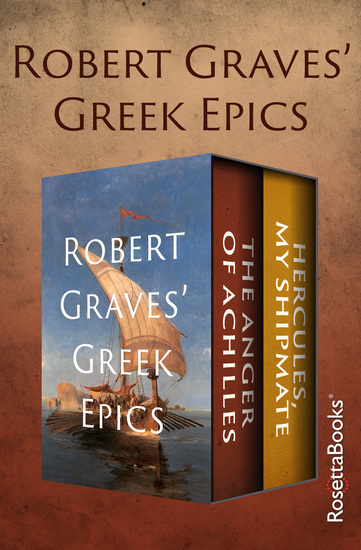
Robert Graves' Greek Epics - The Anger of Achilles and Hercules My Shipmate - cover

Robert Graves' Greek Epics - The Anger of Achilles and Hercules My Shipmate

Robert Graves

Verlag: RosettaBooks

  • 0
  • 0
  • 0

Beschreibung

Robert Graves’ Greek Epics includes the compelling war story, The Anger of Achilles, and the compelling world of Greek mythology in Hercules, My Shipmate. 
The Anger of Achilles is a novelized interpretation of Homer’s Iliad, told by noted classicist and historical novelist Robert Graves. The war between the Greeks and the Trojans has reached a fever pitch. Offended by Agamemnon, the great Greek warrior Achilles is in his tent, refusing to fight. But then Trojan prince Hector slaughters Patroclus, Achilles’ close friend. Willing or not, Achilles must take revenge for his friend’s death, even if it will result in his own.

In this innovative take on the classic tale, Achilles comes to life in all his vivid rage, bravery, passion, and lust for battle. Combining his advanced expertise in ancient Greek warfare and culture with a talent for telling a compelling story, Robert Graves is the ideal translator to bring this ancient epic of war to a modern audience.

Hercules, My Shipmate is an inventive reimagining of the story of Jason and the Argonauts, this novel by renowned poet and classicist Robert Graves brings heroic figures of Hellenistic myth to life. Graves’ Jason is belligerent, energetic, and full of life, and the society Graves builds for him is outlandish and deeply invested in ancient cults.

Against this primitive, religious backdrop, the charismatic Jason assembles a crew and sets out to retrieve the sacred gold-trimmed fleece that is sacred to Zeus, and that has been stolen by worshippers of the Triple Goddess. Accompanying him is Hercules, a brave warrior known more for his brawn, and his astonishingly good luck, than his brains. Robert Graves builds a compelling world that sets Hellenistic magic and mystery in a surprisingly gritty, realistic setting, a fascinating read for fans of Greek mythology.
Verfügbar seit: 30.05.2025.
Drucklänge: 772 Seiten.


Weitere Bücher, die Sie mögen werden

  • Edgar Allan Poe - His Poems Quotes Biography and Death - cover

    Edgar Allan Poe - His Poems...

    Kelly Mass

    • 0
    • 0
    • 0
    Perhaps you have heard of Edgar Allan Poe. Perhaps not. Either way, this 19th-century author has received quite some fame for his works and his unique style. His mystery and gruesome horror stories, comedy, and other genres have reached far into the depths of American literature. 
    Edgar Allan Poe had a life, a background worth studying. His experiences have led him to his career success, his published works, and many other honors. 
    His death, however, was and still is a mystery by itself. Many possible causes have been attributed his sudden passing, as the person who found him was still bewildered. Find out more about this fascinating author in a time we can hardly understand without knowing more about it.
    Zum Buch
  • Foundations of Our Democracy: The Documents that Made America - The Declaration of Independence The US Constitution The Federalist Papers and The US Bill of Rights - cover

    Foundations of Our Democracy:...

    Various Authors

    • 0
    • 0
    • 0
    In 1776, the United States of America was born from a document that declared all men created equal and free to choose who they serve in this world. What followed was a difficult fight against a monarchy, a fight that ended with the creation of a powerful country built on the tenets of freedom and equality. These documents are some of the foundational writings from the earliest days of the country that have shaped the United States government for centuries:The Declaration of Independence – This was the formal decree that the 13 colonies wished to separate from the rule of England. This essay declares that the rulership of England had been unjust and did not give the people living in America proper representation in the government, and declared independence from the King of Great Britain.The Constitution – The Constitution of the United States was adopted as the supreme law of the country in 1789. This document, along with its amendments, is the instruction manual for running the United States’ democracy, from outlining the three branches of government to enacting a protocol for succession of power. The Federalist Papers – The Federalist Papers were a series of articles written by Alexander Hamilton, John Jay, and James Madison. The essays present the reasoning and logic behind each article of the Constitution, and were written to garner congressional support for its ratification. Today, they are used to assist in interpreting the intentions of the original supporters of the Constitution.The Bill of Rights – The Bill of Rights is the set of the first 10 amendments added to the Constitution. These amendments outline inalienable and natural rights for individuals, as well as stating that states have the power to create their own laws for matters not addressed in the Constitution.
    Zum Buch
  • A Reading of the Inaugural Address of President John Adams - cover

    A Reading of the Inaugural...

    President John Adams

    • 0
    • 0
    • 0
    John Adams (October 30, 1735 - July 4, 1826), born in Braintree, Massachusetts, was an American Founding Father who served as the second president of the United States from 1797 to 1801. Before his presidency, he was a leader of the American Revolution that achieved independence from Great Britain. During the latter part of the Revolutionary War and in the early years of the new nation, he served the U.S. government as a senior diplomat in Europe. Adams was the first person to hold the office of vice president of the United States, serving from 1789 to 1797. The following is a reading of President Adams' inaugural address delivered on March 04, 1797.
    Zum Buch
  • Sahih Al Bukhari English Translation Volume 8 Book 78-86 Hadith 5970-6860 of 7563 - Most Authentic Hadith Audio Collection (English Translation) - cover

    Sahih Al Bukhari English...

    Imam Bukhari, Translator - Dr....

    • 0
    • 0
    • 0
    Ṣaḥīḥ al-Bukhārī is a collection of hadīth compiled by Abu Abdullāh Muhammad Ibn Ismā`īl al-Bukhārī(rahimahullāh). His collection is recognized by the overwhelming majority of the Muslim world to be one of the most authentic collections of the Sunnah of the Prophet (peace be upon him). It contains roughly 7563 hadīth (with repetitions) in 97 books. The translation provided here is by Dr. M. Muhsin Khan. 
    Volume 8 contains hadith 5970-6860 of 7563 in book 78-86: 
    78 The Book Of Good Manners (Al-Adab) Hadith 5970-6226 of 7563 English 
    79 The Book Of asking permission (to enter somebody else's dwelling place) Hadith 6227-6303 of 7563 English 
    80 The Book Of Invocations or Dua (Du'a's) Hadith 6304-6411 of 7563 English 
    81 The Book Of Softening of the hearts (Ar-Riqaq) Hadith 6412-6593 of 7563 English 
    82 The Book Of Divine Preordainment (Al-Qadar) Hadith 6594-6620 of 7563 English 
    83 The Book Of Oaths and Vows Hadith 6621-6707 of 7563 English 
    84 The Book Of Expiation of Unfulfilled Oaths Hadith 6708-6723 of 7563 English 
    85 The Book Of Laws of Inheritance (Al-Faraaid) Hadith 6724-6771 of 7563 English 
    86 The Book Of Limits and Punishments set by Allah (Hudood) Hadith 6772-6860 of 7563 English 
    Contact: For any feedback or correction please feel free to contact at qnsacademy@outlook.com
    Zum Buch
  • You Are Not a Kinesthetic Learner - The Troubled History of the Learning Style Idea - cover

    You Are Not a Kinesthetic...

    Thomas Fallace

    • 0
    • 0
    • 0
    A compelling history of the learning style concept and how it was shaped by shifting ideas in psychology, anthropology, and education. The widely embraced notion that we all process information in one of three distinct modes—visual, auditory, or kinesthetic—has informed educational practices for decades. In recent years, however, numerous studies have questioned the effectiveness of aligning instruction with the alleged learning styles of individual students. So, why is it still commonplace in the literature on beneficial teaching at all levels of education?In You Are Not a Kinesthetic Learner: The Troubled History of a Dangerous Idea, historian Thomas Fallace traces the origins, evolution, and history of the learning style idea, demonstrating its relationship to a legacy of unequal education for children of color. Fallace argues that the research supporting the learning style idea was problematic from its inception in the 1910s and that it was used to label and justify a diminished curriculum for many Black and Latine students, whose cultural differences were perceived as weaknesses. In recent years, numerous empirical studies have not found the approach to be effective. This fascinating history clearly shows the danger of sorting and labeling students with permanent style identities and makes a strong case for removing learning styles as the basis for any educators’ instructional toolkit.The first book-length history of learning styles, You Are Not a Kinesthetic Learner encourages us all to consider the research, be open to future developments and updates, and question even our most intuitive assumptions.
    Zum Buch
  • 25+ The Collected Works of Vladimir Lenin - The Dreamer in the Kremlin State and Revolution What Is to Be Done? Imperialism: The Final Stage of Capitalism and others - cover

    25+ The Collected Works of...

    Vladimir Lenin, H. G. Wells

    • 0
    • 0
    • 0
    Vladimir Ilyich Ulyanov, better known as Vladimir Lenin, was a Russian revolutionary, politician, and political theorist. He served as the first and founding head of government of Soviet Russia from 1917 to 1924 and of the Soviet Union from 1922 to 1924. Under his administration, Russia, and later the Soviet Union, became a one-party socialist state governed by the Communist Party. Ideologically a Marxist, his developments to the ideology are called Leninism.
    Russia in the Shadows is a book by H. G. Wells published early in 1921, which includes a series of articles previously printed in The Sunday Express in connection with Wells's second visit to Russia (after a previous trip in January 1914 to St. Petersburg and Moscow) in September and October 1920.
    During his visit to Russia he visited his old friend Maxim Gorky, whom he had first met in 1906 on a trip to the United States, and who arranged Wells's meeting with Lenin.
    In a chapter (The Dreamer in the Kremlin) devoted to an interview with Lenin at the Kremlin Wells describes the leader and founder of Russian communism. Wells portrays Lenin as a pragmatic leader who "has recently stripped off the last pretence that the Russian revolution is anything more than the inauguration of an age of limitless experiment."
     
    Vladimir Lenin:
    State and Revolution
    What Is to Be Done?
    Imperialism: The Final Stage of Capitalism
    The State and Revolution
    The Three Sources and Three Component Parts of Marxism
    To the Citizens of Russia!
    To Workers, Soldiers, and Peasants!
    Report on Peace
    Report on Land
    Decree on Abolishment of Capital Punishment
    Decree on Transfer of Power to the Soviets
    Decree on Establishment of the Workers' and Peasants' Government
    Decree on Elections for the Constituent Assembly
    Decree on Suppression of Hostile Newspapers
    Decree on Transfer of Food Control to Municipalities
    Decree on an Eight-Hour Working Day
    Decree on the Right to Issue Laws
    Resolution on the Right of Sovnarkom to Issue Decrees
    Decree on Social Insurance
    Declaration of the Rights of the People of Russia
    Decree on Organization of Volost Land Committees
    Decree on Transfer of Power and the Means of Production to the Toilers
    Decree Proclaiming Advertising a State Monopoly
    Decree Abolishing Classes and Civil Ranks
    Decree on Workers' Control
    Resolution on Relation of the Central Executive Committee to the Sovnarkom
    Decree on the Right to Call for Re-Elections
    Decree on Establishment of the Extraordinary Commission to Fight Counter-Revolution
    V. I. Lenin Note To F. E. Dzerzhinsky with a Draft of A Decree On Fighting Counter-Revolutionaries And Saboteurs
     
    H. G. Wells:
    The Dreamer in the Kremlin
    Zum Buch