Join us on a literary world trip!
Add this book to bookshelf
Grey
Write a new comment Default profile 50px
Grey
Subscribe to read the full book or read the first pages for free!
All characters reduced
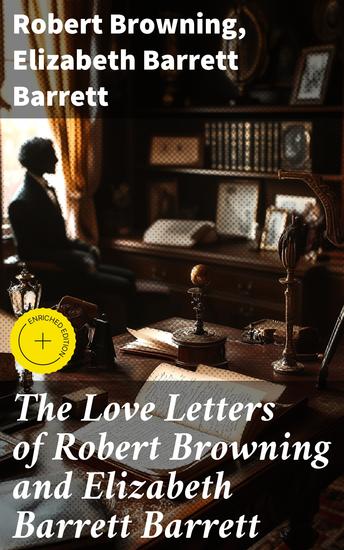
The Love Letters of Robert Browning and Elizabeth Barrett Barrett - Romantic Correspondence between two great poets of the Victorian era (Featuring Extensive Illustrated Biographies) - cover

The Love Letters of Robert Browning and Elizabeth Barrett Barrett - Romantic Correspondence between two great poets of the Victorian era (Featuring Extensive Illustrated Biographies)

Robert Browning, Elizabeth Barrett Barrett

Publisher: Good Press

  • 0
  • 0
  • 0

Summary

In 'The Love Letters of Robert Browning and Elizabeth Barrett Barrett,' readers are invited into a world of intimate communication between two of the Victorian era's most celebrated poets. This collection is a testament to both the emotive power of the written word and the intricacies of a literary romance, capturing the transformative power of love, both personally and artistically. The letters range from poignant expressions of affection to profound discussions on poetic philosophy, offering a multifaceted view into the Victorian intellectual and emotional landscape. The blend of earnest passion and erudite dialogue presents a rare mosaic of personal correspondence that facilitates a deeper appreciation for the art of letter writing. Browning and Barrett, each an illustrious figure in their own right, leave an indelible mark on the fabric of literature through their correspondence. Their letters, exchanged amidst the backdrop of a conservative society, break conventional barriers and showcase the nuances of their clandestine relationship. As torchbearers of the Romantic literary movement, their writings reflect not only personal yearning but also broader themes of self-expression and defiance against societal constraints. These missives underscore the nuanced interplay between personal sentiment and literary creativity, affording a glimpse into the evolving paradigms of 19th-century literary culture. This anthology offers an exquisite literary experience, providing readers with a unique opportunity to engage with the dynamic discourse between two legendary poets. It enriches understanding by presenting a comprehensive spectrum of human emotions and intellectual encounters, effectively opening a dialogue that spans time and space. Readers are encouraged to immerse themselves in these profound narratives, gaining both educational insights and a more profound appreciation of the tender, yet powerful, connection between Browning and Barrett. This collection stands as an essential resource for anyone seeking a deeper understanding of love, literature, and the symbiotic relationship between them.
Available since: 01/06/2024.
Print length: 520 pages.

Other books that might interest you

  • Jennifer Juniper - A must-read for fans of Daisy Jones & the Six - the people and stories that inspired Taylor Jenkins Reid's international bestseller - cover

    Jennifer Juniper - A must-read...

    Jenny Boyd

    • 0
    • 0
    • 0
    'Compelling' The Times
    'Wise and honest.' Daily Mail
    Jenny Boyd's extraordinary life is the stuff of movies and novels, a story of incredible people and places at a pivotal time in the 20th century.
    As an up-and-coming young model, Jenny found herself at the heart of Carnaby Street in London, immersed in the fashion and pop culture of the Swinging 60s. With boyfriend Mick Fleetwood, sister Pattie Boyd, George Harrison and the rest of the Beatles, she lived the London scene.
    Show book
  • My Secret Life Vol 9 Chapter 4 - cover

    My Secret Life Vol 9 Chapter 4

    Dominic Crawford Collins

    • 0
    • 0
    • 0
    My Secret Life is an anonymously penned memoir written during a period from the 1840s to the 1880s by a wealthy and sex obsessed English gentleman who refers to himself simply as ‘Walter’. Part confessional, part investigative erotic journalism, it meticulously documents every detail of the author’s prolific sexual encounters, offering us in the process an eye and thigh opening account of life behind closed doors in the Victorian age.
    
    Women, in both mind and body, were the all consuming object of Walter’s interest. From early youth through to old age his quest for erotic discovery and adventure with them was never diminished.
    
    Unlike contemporary 19th century erotic texts, such as The Pearl, whose sole object was to titillate, Walter’s interest in his subjects did not end with the extinguishing of the carnal flame. His hunger to understand the circumstances and minds of the women he encountered is never upstaged by the sex. Their potted life histories, their most intimate desires and acts were shared with him and in turn meticulously recorded by him, written down verbatim while still fresh in his mind.
    
    The resulting poignant record of a lost era and the intimate moments of the women who inhabited it offer us a remarkable insight into the 19th century that cannot be gleaned from any other source.
    
    The complete unabridged text is being released as a fully scored audiofilm (an audio book with accompanying music soundtrack) by film composer Dominic Crawford Collins.
    
    VOLUME 9 CHAPTER 4
    Nelly's servant Agnes. • Sweet sixteen. • Three nights preliminaries. • Tactics. • Baudy pictures and tickling. • Garters and champagne. • Temporary limpness. • Drawers in the way. • Virginity slaughtered. • A week's felicity. • On the wearing of drawers by women. • Some months after. • Two years later on. • She marries.
    Show book
  • Small-Town Slayings in South Carolina - cover

    Small-Town Slayings in South...

    Rita Y. Shuler

    • 0
    • 0
    • 0
    From the lowcountry through the midlands and into the upstate, criminal cases and mysterious murders cast a dark shadow on small-town South Carolina . . .  


    Ax assault, kidnapping, brutal murder: how could these things happen in a small town? Although regional crimes hardly ever make it to the national circuit, they will always remain with the families and communities of the victims and a part of the area's history. After working with the South Carolina Law Enforcement Division as special agent/forensic photographer for twenty-four years, Rita Shuler has a passion for remembering the victims. In Small-town Slayings, Shuler takes us back in time, showing differences and similarities of crime solving in the past and present and some surprising twists of court proceedings, verdicts and sentences. From an unsolved case that has haunted her for thirty years to a cold case that was solved after fifteen years by advanced DNA technology, Shuler blends her own memories with extensive research, resulting in a fast-paced, factual and fascinating look at crime in South Carolina.
    Show book
  • Dreaming of Ramadi in Detroit - Essays - cover

    Dreaming of Ramadi in Detroit -...

    Aisha Sabatini Sloan

    • 0
    • 0
    • 0
    An electric essay collection about Blackness, art, and dreaming of new possibilities in a time of constriction 


    This collection of innovative, penetrating, and lively essays features swimming pools and poets, road trips and museums, family dinners and celebrity sightings. In a voice that is at once piercing, mournful, and slyly comic, Aisha Sabatini Sloan inhabits several roles: she is an art enthusiast in Los Angeles during a city-wide manhunt; a daughter on a road trip with her father; a professor playing with puppets in the wilds of Vermont; an interloper on a police ride-along in Detroit; a collector of the dreams of scientists at a biostation. As she watches cell phone video recordings of murder and is haunted in her sleep by the news, she reflects on her formative experiences with aesthetic and spiritual discovery, troubling those places where Blackness has been conflated with death. 


    Sabatini Sloan's lively style is perfectly suited to the way she circles a subject or an idea before cinching it tight. The curiosity that guides each essay, focusing on the period between the 2016 election and the onset of the pandemic, is rooted in the supposition that there is an intrinsic relationship between the way we conceptualize darkness and our collective opportunity for awakening.
    Show book
  • After the Funeral - From their pens to your ears genius in every story - cover

    After the Funeral - From their...

    Mary Butts

    • 0
    • 0
    • 0
    Mary Frances Butts was born on 13th December 1890 in Poole, Dorset. 
    Her early years were spent at Salterns, an 18th-century house overlooking Poole Harbour.  Sadly in 1905 her father died, and she was sent for boarding at St Leonard's school for girls in St Andrews. 
    Her mother remarried and, from 1909, Mary studied at Westfield College in London, and here, first became aware of her bisexual feelings.  She was sent down for organising a trip to Epsom races and only completed her degree in 1914 when she graduated from the London School of Economics.  By then Mary had become an admirer of the occultist Aleister Crowley and she was given a co-authorship credit on his ‘Magick (Book 4)’. 
    In 1916, she began the diary which would now detail her future life and be a constant reference point for her observations and her absorbing experiences. 
    During World War I, she was doing social work for the London County Council in Hackney Wick, and involved in a lesbian relationship.  Life changed after meeting the modernist poet, John Rodker and they married in 1918. 
    In 1921 she spent 3 months at Aleister Crowley's Abbey of Thelema in Sicily; she found the practices dreadful and also acquired a drug habit.  Mary now spent time writing in Dorset, including her celebrated book of short stories ‘Speed the Plough’ which saw fully develop her unique Modernist prose style. 
    Europe now beckoned and several years were spent in Paris befriending many artists and writing further extraordinary stories.   
    She was continually sought after by literary magazines and also published several short story collections as books. Although a Modernist writer she worked in other genres but is essentially only known for her short stories.  Mary was deeply committed to nature conservation and wrote several pamphlets attacking the growing pollution of the countryside. 
    In 1927, she divorced and the following year her novel ‘Armed with Madness’ was published.  A further marriage followed in 1930 and time was spent attempting to settle in London and Newcastle before setting up home on the western tip of Cornwall.  By 1934 the marriage had failed. 
    Mary Butts died on 5th March 1937, at the West Cornwall Hospital, Penzance, after an operation for a perforated gastric ulcer. She was 46.
    Show book
  • Lost and Found - An A-Z of Neglected Writers of the Anglophone Caribbean - cover

    Lost and Found - An A-Z of...

    Alison Donnell

    • 0
    • 0
    • 0
    An A-Z of Neglected Writers of the Anglophone Caribbean makes a major contribution to providing a fuller picture of the region's rich literary history. It both restores our knowledge of writers whose lives and work have slipped out of view while heralding others whose work has never been properly recognised. Offering a fascinating insight into the worlds of these 'lost' writers, this A-Z also provides future researchers with a comprehensive bibliography of their forgotten works. An inspiring reclaiming of writers, especially women, from Antigua, Belize, Dominica, Grenada, Guyana, Jamaica, Trinidad: those who were in the wrong place at the wrong time; those disregarded by the establishment; those whose personal or professional lives stole their writing lives; those who suffered discrimination; those who wrote about the "wrong" things. All are celebrated in this brilliantly researched and compiled book.
    Show book