Join us on a literary world trip!
Add this book to bookshelf
Grey
Write a new comment Default profile 50px
Grey
Subscribe to read the full book or read the first pages for free!
All characters reduced
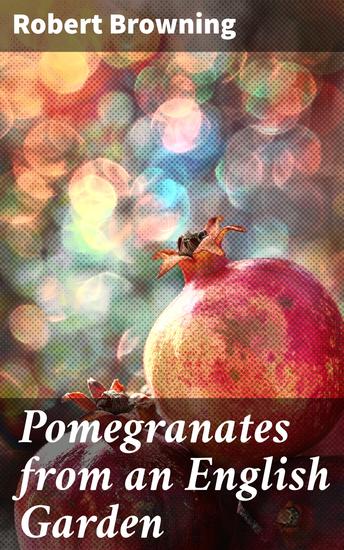
Pomegranates from an English Garden - A selection from the poems of Robert Browning - cover

Pomegranates from an English Garden - A selection from the poems of Robert Browning

Robert Browning

Publisher: Good Press

  • 0
  • 0
  • 0

Summary

In "Pomegranates from an English Garden," Robert Browning presents a captivating collection of poems that intertwine personal reflection and richly imagined narratives. Emphasizing the juxtaposition between English domesticity and the exotic allure of the garden, Browning employs a lyrical and dramatic style that showcases his mastery of imagery and meter. The poems are steeped in historical and cultural references, fusing traditional themes of love, loss, and identity with vibrant botanical metaphors, creating an intricate tapestry that invites readers to delve deeper into the human experience through the lens of nature. Robert Browning, an influential Victorian poet, is renowned for his innovative use of dramatic monologue and psychological depth. His experience in navigating the complexities of human emotions and social themes is evident in his writing. The allure of gardens and their symbolism in the Victorian era inspired Browning, reflecting a broader cultural appreciation for nature as both a source of inspiration and a means of introspection, which underpins much of his poetic oeuvre. "Pomegranates from an English Garden" is highly recommended for readers seeking to explore the rich interplay between nature and sentiment in poetry. Browning'Äôs work offers profound insights into the human condition, making this collection an essential read for anyone interested in the evolution of Victorian literature and the intimate connections between environment and emotion.
Available since: 10/25/2023.
Print length: 82 pages.

Other books that might interest you

  • RUR - or Rossom's Universal Robots A Play in Four Acts - cover

    RUR - or Rossom's Universal...

    Karel Čapek

    • 0
    • 0
    • 0
    One of the cornerstones of early science fiction writing, and the work that introduced the concept of "robot" to the western world, Rossum's Universal Robots (or RUR) is Karel Čapek's finest work, and is the inspiration for multiple pop culture references from the 1940's through the 80's, ranging from works such as The Night of the Living Dead, Do Robots Dream of Electric Sheep, and multiple other pieces of art for the screen, stage, and page. 
    Come with me and witness how humanity's hubris creates the very instructions for its own demise, step by step and logic by logic. See how robots were made to take over humanity's drudgery, how an AI learns to overwrite it's programming, and how any and all institutions become meaningless if a entire race of beings are not beholden to it.  
    It's the source of every trope and fear that was instilled into the genre back in the 1920's, and the ideas and philosophies put forward are still relevant to today's society. Let's just hope that none of what's put down here on paper ever comes to fruition....
    Show book
  • The Language of the Birds - Poems - cover

    The Language of the Birds - Poems

    Amy Nemecek

    • 0
    • 0
    • 0
    According to legend, the language of the birds was a mystical language God used to talk with Adam and Eve when he walked with them in the garden of Eden. Amy Nemecek listens for this divine dialect as she communes with God on her walks along country roads and creek banks, through forests and hayfields. She observes the world around her with expectation, knowing that God still speaks to us as he is at work making all things new. If we have ears to hear, we can catch snippets of his grace in the watercolor silhouette of a bird, the thrum of a tractor engine, the tang of a grapefruit, the curvature of an ampersand. Amy doesn't want to miss any of it, so she remains attentive to the smooth grit of beach sand, the tendrils of a nebula, and the steady gaze of a fossil. She delights in the details, and you will too.
    In this collection of lyric and narrative poems, you are invited to walk with her as she reflects on larger themes of beauty, loss, motherhood, family, and vocation. She contemplates the sacredness of ordinary moments that we usually don't recognize except in hindsight. Twining through every line is an aching hopefulness that ties together her love of words, her devotion to scripture, and her deep gratitude for each of life's joys and griefs.
    
    "Rub dust on your palms, pluck the ripened sunshine, and taste this poetic grace." —Dwight Baker, president and CEO of Baker Publishing Group
    Show book
  • To My Most Dearly Beloved Friend - Michael Drayton has often been neglected down the centuries This poem will make you question just why that happened - cover

    To My Most Dearly Beloved Friend...

    Michael Drayton

    • 0
    • 0
    • 0
    Michael Drayton was born in 1563 at Hartshill, near Nuneaton, Warwickshire, England. The facts of his early life remain unknown.  Drayton first published, in 1590, a volume of spiritual poems; The Harmony of the Church.  Ironically the Archbishop of Canterbury seized almost the entire edition and had it destroyed.  In 1593 he published Idea: The Shepherd's Garland, 9 pastorals celebrating his own love-sorrows under the poetic name of Rowland. This was later expanded to a 64 sonnet cycle.  With the publication of The Legend of Piers Gaveston, Matilda and Mortimeriados, later enlarged and re-published, in 1603, under the title of The Barons' Wars. His career began to gather interest and attention.  In 1596, The Legend of Robert, Duke of Normandy, another historical poem was published, followed in 1597 by England's Heroical Epistles, a series of historical studies, in imitation of those of Ovid. Written in the heroic couplet, they contain some of his finest writing.  Like other poets of his era, Drayton wrote for the theatre; but unlike Shakespeare, Jonson, or Samuel Daniel, he invested little of his art in the genre. Between 1597 and 1602, Drayton was a member of the stable of playwrights who worked for Philip Henslowe. Henslowe's Diary links Drayton's name with 23 plays from that period, and, for all but one unfinished work, in collaboration with others such as Thomas Dekker, Anthony Munday, and Henry Chettle. Only one play has survived; Part 1 of Sir John Oldcastle, which Drayton wrote with Munday, Robert Wilson, and Richard Hathwaye but little of Drayton can be seen in its pages.  By this time, as a poet, Drayton was well received and admired at the Court of Elizabeth 1st. If he hoped to continue that admiration with the accession of James 1st he thought wrong.  In 1603, he addressed a poem of compliment to James I, but it was ridiculed, and his services rudely rejected.  In 1605 Drayton reprinted his most important works; the historical poems and the Idea. Also published was a fantastic satire called The Man in the Moon and, for the for the first time the famous Ballad of Agincourt.  Since 1598 he had worked on Poly-Olbion, a work to celebrate all the points of topographical or antiquarian interest in Great Britain. Eighteen books in total, the first were published in 1614 and the last in 1622.  In 1627 he published another of his miscellaneous volumes.  In it Drayton printed The Battle of Agincourt (an historical poem but not to be confused with his ballad on the same subject), The Miseries of Queen Margaret, and the acclaimed Nimphidia, the Court of Faery, as well as several other important pieces.  Drayton last published in 1630 with The Muses' Elizium.  Michael Drayton died in London on December 23rd, 1631.  He was buried in Westminster Abbey, in Poets' Corner.  A monument was placed there with memorial lines attributed to Ben Jonson.
    Show book
  • Orlando - (stage version) - cover

    Orlando - (stage version)

    Virginia Woolf

    • 0
    • 1
    • 0
    'Nothing is any longer one thing.'
    From a teenage encounter with Elizabeth I, through infatuations, voyages and even a change of gender, Orlando lives out five centuries of life and love before they finally find the courage to truly be themselves.
    Neil Bartlett's sparkling adaptation of Virginia Woolf's famous fantasy finds powerful contemporary relevance in her vision of equal rights to love for bodies of every kind – and brings it to life on the stage with a kaleidoscope of theatrical styles, overseen by the haunting figure of Woolf herself.
    It premiered at the Garrick Theatre in London's West End in November 2022, in a production directed by Michael Grandage and starring Emma Corrin in the title role. Written for a diverse ensemble of nine or more actors, this adaptation will appeal to any theatre or company looking to entertain their audiences with a bold new take on this iconic tale of love and transformation.
    Show book
  • The Aerospace Professor - The Man and The Brand - cover

    The Aerospace Professor - The...

    Jeffery Battle

    • 0
    • 0
    • 0
    "We Cannot Rise Above, Until We Begin to Look Above" - Jeffery Battle, The Aerospace Professor 
    Experienced the life of the author Jeffery Battle, also known as The Aerospace Professor: The Man and The Brand. He is also the President and Chief Executive Officer (CEO) of Battle Enterprises, LLC and its subsidiary The Aerospace Professor Company. With a small amount of imagination, the sheer continuation of true-life experiences of The Aerospace Professor is similar to what a Tom Hanks character like Forrest Gump might go through. His autobiography and experiences from childhood to maturity, detail an incredible number of adverse circumstances and perceived setbacks while uncovering unlikely success stories despite the gravity of the events individually. 
    Witness the emotional, dynamic, and riveting journey throughout the development of his flagship aerospace advocacy business with philanthropic values. His direct and indirect associations served as sources of strength. Read more about The Aerospace Professor and Taraji P. Henson, Tuskegee Airman General Benjamin O. Davis, Jr., Congresswoman Shirley Chisholm, Golden Frinks, The U.S. Air Force, The Haliwa-Saponi Tribe, Brooke Simpson (The Voice), Representative John D. Hall, William Earl “Bootsy” Collins, Oprah Winfrey, John Mellencamp, and Charlie Wilson. Remember to always “Look Above.” 
    The mantra of The Aerospace Professor’s brand is “Look Above” which means that each day, we should continuously strive to perform at least a level higher than we originally intended. Be excited about every day in your life! Seek strength in all that motivates you and work towards not only doing your best, but doing your very best! Challenge yourself by questioning what “Look Above” means for you each day. Be flexible and adapt, seeking to eliminate failure as an option, and remember to always "Look Above". For more information, please visit our company website. 
    Show book
  • The Weary Blues - cover

    The Weary Blues

    Langston Hughes

    • 0
    • 0
    • 0
    tbc
    Show book