Rejoignez-nous pour un voyage dans le monde des livres!
Ajouter ce livre à l'électronique
Grey
Ecrivez un nouveau commentaire Default profile 50px
Grey
Abonnez-vous pour lire le livre complet ou lisez les premières pages gratuitement!
All characters reduced
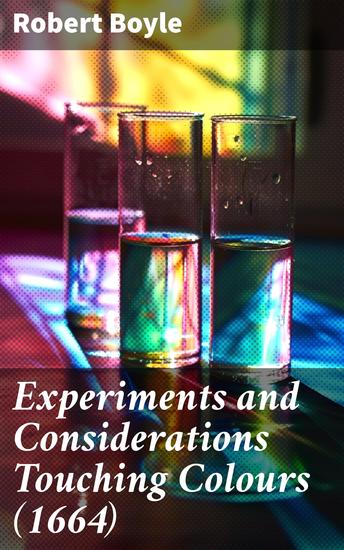
Experiments and Considerations Touching Colours (1664) - Unraveling the Enigma of Color: A Scientific Exploration - cover

Experiments and Considerations Touching Colours (1664) - Unraveling the Enigma of Color: A Scientific Exploration

Robert Boyle

Maison d'édition: Good Press

  • 0
  • 0
  • 0

Synopsis

In "Experiments and Considerations Touching Colours" (1664), Robert Boyle meticulously explores the nature of colors through a series of empirical experiments, articulating a profound engagement with the emerging scientific method of the 17th century. Boyle's work deviates from the purely philosophical inquiries of his contemporaries, integrating hands-on experimentation with reflective analysis. Utilizing a clear, systematic literary style, he elucidates complex concepts while positioning the study of colors within the broader context of natural philosophy, thus contributing to the burgeoning field of optics and chemistry. Robert Boyle, an eminent British natural philosopher and one of the founders of modern chemistry, was deeply influenced by the scientific revolution and the intellectual currents of his time. His commitment to empirical research stemmed from a desire to ground natural philosophy in observable phenomena. Boyle's emphasis on experimentation was informed by the challenges posed by Aristotelian doctrine and the need for a new methodology that emphasized evidence over speculation, setting the stage for future scientific inquiry. This book is essential for those interested in the intersection of science and philosophy during the early modern period. Boyle's pioneering approach not only enhances the understanding of color but ultimately serves as a gateway into the scientific method that has shaped contemporary inquiry. Readers will find within its pages a compelling blend of experimentation and theoretical reflection that invites them to consider the intricate relationship between perception and reality.
Disponible depuis: 15/08/2023.
Longueur d'impression: 497 pages.

D'autres livres qui pourraient vous intéresser

  • Relationships 50 - How AI VR and Robots Will Reshape Our Emotional Lives - cover

    Relationships 50 - How AI VR and...

    Elyakim Kislev

    • 0
    • 0
    • 0
    Technology is our new life partner. No longer confined to the sidelines, new interactive technologies like AI therapists, avatar friends, and robot assistants are ready to transform technology's role from basic tools of convenience to intimate elements of our social and emotional lives. 


    Blending science, sociology, history, and psychology, Relationships 5.0 asks how recent technological developments cause us to think differently about our family lives, love affairs, and emotional needs. It argues that we are currently living through a technological paradigm shift similar in magnitude to the preceding agricultural, industrial, and informational revolutions in human history. Thanks to the convergence of the cognitive revolution (AI), the sensorial revolution (VR and AR), and the physical revolution (robots), technology can now fulfill emotional, intellectual, and physical needs that have until now been met by other humans. 


    While many are still wary of human-technology companionship, Relationships 5.0 reveals that these novel interactions aren't as risky as we'd once thought, but can instead make our social and emotional lives richer and more diverse. Still, we must ask: What will the age of Relationships 5.0 look like? How should we prepare for such an age? Who might already be ready to embrace these changes, and why?
    Voir livre
  • Death to Beauty - The Transformative History of Botox - cover

    Death to Beauty - The...

    Eugene M. Helveston

    • 0
    • 0
    • 0
    In the 1970s, Dr. Alan Scott sought to selectively weaken eye muscles to treat strabismus (when one or both eyes are misaligned) without surgery. After failed attempts with other agents, Scott developed a method to stabilize the bacteria that causes botulism, culminating in a drug that eventually became known as Botox. 


    In Death to Beauty, Eugene M. Helveston, MD, follows the unlikely story of botulism's 1817 discovery in contaminated German sausages, to its use in military and research facilities, to Scott, an ophthalmologist who aimed to safely use the drug in humans. Scott struggled alone as an unknown in the pharmaceutical industry, searching for clinical trial financing and FDA approval, which he achieved at a fraction of the billions big pharma usually spends to bring a drug to market. Eventually, the company Allergan bought him out, capitalizing on the possibilities for cosmetic uses. Scott's formula was renamed "Botox" and reached annual sales in the billions. After the sale, Scott received no further compensation from Botox sales and remained the same unassuming man. 


    A fascinating walk through the intricate history of how the world's deadliest toxin starting as a treatment for crossed eyes became a routine tool for the cosmetic industry, Death to Beauty will make you rethink success, beauty, and deadly bacteria.
    Voir livre
  • C++ - C++ Performance Coding - cover

    C++ - C++ Performance Coding

    Andy Vickler

    • 0
    • 0
    • 0
    Discover the tactics to unleash your code to its full potential. Learn how you can avoid spending hours on compilation. 
    Do you want your code to be fast and run like a butter down the slope? Do you also find it hard to compile your C++ code? Are you unaware of the hacks and tactics to make your code perform better? 
    If so, the simple solution is right below. 
    Imagine writing a code that performs like smooth slope. Imagine the pride of teaching these hacks to newbies and gaining their utmost respect. Imagine writing a code that’s light on memory yet runs like a cheetah. Imagine getting recognized as a top notch C++ programmer! 
    This book will not only educate you on the topic of performance but it’ll teach you some advance topics like Lambda expressions and Enumerations from beginning to how they improve the performance of C++ code. 
    You’ll receive in depth chapters discussing why X factor slows down your code and how you can fix it. Along with this there is a whole chapter dedicated to common speedups for when you don’t have time for the “whys” you can jump up to the speedup. 
    You’ll discover DO’s and DON’Ts of high performance code. You’ll also discover how your hardware plays an immense role in your code performance and have a better understanding of C++ code performance. You’ll uncover the mischievous slackers in the code you were unaware of. 
    This book is for those who’re looking to fix the performance of their code and learn new tactics of those who might never drop their secrets.
    Voir livre
  • Ending Medical Reversal - Improving Outcomes Saving Lives - cover

    Ending Medical Reversal -...

    Vinayak K. Prasad, Adam S. Cifu

    • 0
    • 0
    • 0
    Medications such as Vioxx and procedures such as vertebroplasty for back pain are among the medical "advances" that turned out to be dangerous or useless. What Dr. Vinayak K. Prasad and Dr. Adam S. Cifu call medical reversal happens when doctors start using a medication, procedure, or diagnostic tool without a robust evidence base—and then stop using it when it is found not to help, or even to harm, patients.In Ending Medical Reversal, Drs. Prasad and Cifu narrate fascinating stories from every corner of medicine to explore why medical reversals occur, how they are harmful, and what can be done to avoid them. They explore the difference between medical innovations that improve care and those that only appear to be promising. They also outline a comprehensive plan to reform medical education, research funding and protocols, and the process for approving new drugs that will ensure that more of what gets done in doctors' offices and hospitals is truly effective.
    Voir livre
  • Cognitive Computing - Revolutionizing Problem-Solving and Decision-Making through Artificial Intelligence - cover

    Cognitive Computing -...

    Brian Murray

    • 0
    • 0
    • 0
    Cognitive Computing: Revolutionizing Problem-Solving and Decision-Making through Artificial Intelligence is a cutting-edge exploration of the latest developments in AI and how they are transforming the way we solve problems and make decisions. 
    Throughout the book, the author uses clear and concise language to explain complex concepts and theories, making this an ideal resource for students, researchers, and professionals in a wide range of fields, from finance and healthcare to education and government. 
    Topics covered include:The basics of cognitive computing, including neural networks, deep learning, and reinforcement learningThe different approaches to implementing cognitive computing, including expert systems, chatbots, and autonomous vehiclesThe most important applications of cognitive computing in various fields, including healthcare, finance, education, and governmentThe ethical and societal implications of cognitive computing, including issues around privacy, bias, and job displacementThe future of cognitive computing and its potential impact on society and the economy. 
    Whether you're a student, a researcher, or a professional looking to stay up-to-date with the latest developments in AI, Cognitive Computing: Revolutionizing Problem-Solving and Decision-Making through Artificial Intelligence is the ultimate guide to the transformative potential of cognitive computing for the modern world. 
     
    Voir livre
  • The Scariest Planets We've Ever Discovered - Terrifying Worlds Beyond Our Solar System - cover

    The Scariest Planets We've Ever...

    John Harpoon

    • 0
    • 0
    • 0
    The universe is filled with wonders, but some of its most fascinating worlds are also the most terrifying. While Earth offers stability, warmth, and an atmosphere that sustains life, countless exoplanets lie scattered across the galaxy with conditions that defy imagination. These distant worlds are not just inhospitable—they are the stuff of nightmares.  
      
    The discovery of these hostile planets has revealed just how extreme nature can be. Some are scorched by relentless heat, while others are locked in frozen desolation. Toxic gases, deadly storms, and crushing gravity make these worlds far more menacing than anything we might encounter on Earth. Exploring these terrifying planets is not just about uncovering their horrors; it’s about understanding the universe itself.  
      
    One key factor that determines a planet’s hostility is its proximity to its star. Planets that orbit too close are often scorched by intense radiation, while those too far away freeze in endless darkness. But even planets in stable orbits can become dangerous if their atmospheres are packed with poisonous chemicals or if they experience violent weather patterns. Some worlds are plagued by hurricane-force winds that rip across the surface, while others endure storms of molten glass that shred everything in their path. 
    Voir livre