Rejoignez-nous pour un voyage dans le monde des livres!
Ajouter ce livre à l'électronique
Grey
Ecrivez un nouveau commentaire Default profile 50px
Grey
Abonnez-vous pour lire le livre complet ou lisez les premières pages gratuitement!
All characters reduced
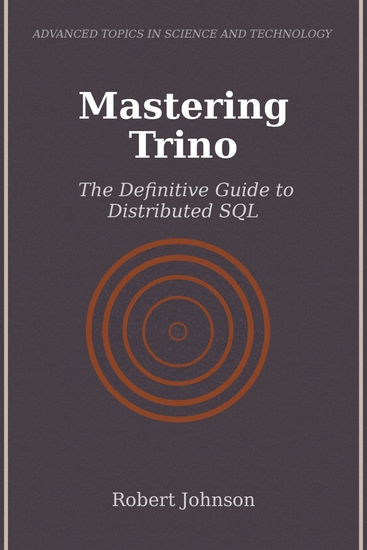
Mastering Trino - The Definitive Guide to Distributed SQL - cover

Mastering Trino - The Definitive Guide to Distributed SQL

Robert A. Johnson

Maison d'édition: HiTeX Press

  • 0
  • 0
  • 0

Synopsis

"Mastering Trino: The Definitive Guide to Distributed SQL" is an authoritative resource designed for data professionals seeking to unlock the full potential of Trino, a leading open-source SQL query engine. This comprehensive guide takes readers from foundational concepts to advanced applications, offering detailed insights into distributed SQL’s significance and Trino’s unique capabilities. Each chapter is crafted to deepen understanding, covering setup essentials, architectural insights, connector management, and the intricacies of both basic and advanced querying techniques.Readers will find invaluable guidance on performance optimization, security frameworks, and effective management strategies, ensuring they are well-equipped to implement Trino in diverse environments. Through practical use cases and best practices, the book illustrates where Trino excels, providing readers with the knowledge to leverage its power for real-world challenges. Ideal for data architects, engineers, and analysts, this book is poised to become an indispensable part of any data professional’s library, bridging the gap between raw data and actionable insights with clarity and precision.
Disponible depuis: 07/01/2025.
Longueur d'impression: 279 pages.

D'autres livres qui pourraient vous intéresser

  • Love Your Mother - 50 States 50 Stories and 50 Women United for Climate Justice - cover

    Love Your Mother - 50 States 50...

    Mallory McDuff

    • 0
    • 0
    • 0
    From elder voices opposing the Dakota Pipeline to young people running for office to advocate for change, every day we see real-life stories about how women are making a collective difference on climate justice. Women are also disproportionately impacted by climate change and thus are critical to transforming society away from dependence on fossil fuels and toward renewable energy and environmental equity. 


    As a mother and a professor of environmental education, Mallory McDuff wanted to give her two daughters and her students a roadmap to engage in climate justice in their communities, rather than be left feeling paralyzed by the enormity of the problem. She set out to find women of diverse ages, backgrounds, and vocations—one from each of the fifty US states—as inspiration for a new kind of leadership focused on the heart of the climate crisis. Love Your Mother lifts up the stories of these women working toward a viable future, from farmer and rancher Donna Kilpatrick in Arkansas to writer Latria Graham in South Carolina. 


    From Alabama to Alaska, from Wisconsin to Wyoming, these women are poets, physicians, climate scientists, students, farmers, writers, documentary filmmakers, and more. Their work lights the way for conversation and collective action in our homes and in the world. It's time we follow their lead.
    Voir livre
  • Studies About Trees - cover

    Studies About Trees

    Jacob Joshua Levison

    • 0
    • 0
    • 0
    In this work Levison aims to create a book that allows beginners to be able to understand how to identify trees, as well as to give information of their structure and uses.  Once these topics are addressed, he then moves into concepts of care, planting and forestry. - Summary by KHand
    Voir livre
  • A Hacker's Mind - How the Powerful Bend Society's Rules and How to Bend them Back - cover

    A Hacker's Mind - How the...

    Bruce Schneier

    • 0
    • 0
    • 0
    It’s not just computers—hacking is everywhere. 
     
    A hack is any means of subverting a system’s rules in unintended ways. The tax code isn’t computer code, but a series of complex formulas. It has vulnerabilities; we call them “loopholes.” We call exploits “tax avoidance strategies.” And there is an entire industry of “black hat” hackers  
    intent on finding exploitable loopholes in the tax code. We call them accountants and tax attorneys. 
     
    In A Hacker’s Mind, Bruce Schneier takes hacking out of the world of computing and uses it to analyze the systems that underpin our society: from tax laws to financial markets to politics. He reveals an array of powerful actors whose hacks bend our economic, political, and legal  
    systems to their advantage, at the expense of everyone else. 
     
    Once you learn how to notice hacks, you’ll start seeing them everywhere—and you’ll never look at the world the same way again. Almost all systems have loopholes, and this is by design. Because if you can take advantage of them, the rules no longer apply to you. 
     
    Unchecked, these hacks threaten to upend our financial markets, weaken our democracy, and even affect the way we think. And when artificial intelligence starts thinking like a hacker—at inhuman speed and scale—the results could be catastrophic. 
     
    But for those who would don the “white hat,” we can understand the hackingmindset and rebuild our economic, political, and legal systems to counter those who would exploit our society. And we can harness artificial intelligence to improve existing systems, predict and defend  
    against hacks, and realize a more equitable world.
    Voir livre
  • Where Things Touch - A Meditation on Beauty - cover

    Where Things Touch - A...

    Bahar Orang

    • 0
    • 0
    • 0
    Finalist for the 2021 Gerald Lampert Memorial Award
    
    To devote oneself to the study of beauty is to offer footnotes to the universe for all the places and all the moments that one observes beauty. I can no longer grab beauty by her wrists and demand articulation or meaning. I can only take account of where things touch.
    Part lyric essay, part prose poetry, Where Things Touch grapples with the manifold meanings and possibilities of beauty.
    Drawing on her experiences as a physician-in-training, Orang considers clinical encounters and how they relate to the concept and very idea of beauty. Such considerations lead her to questions about intimacy, queerness, home, memory, love, and other aspects of human existence. Throughout, beauty is ultimately imagined as something inextricably tied to care: the care of lovers, of patients, of art and literature, and the various non-human worlds that surround us.
    Eloquent and meditative in its approach, beauty, here, beyond base expectations of frivolity and superficiality, is conceived of as a thing to recover. Where Things Touch is an exploration of an essential human pleasure, a necessary freedom by which to challenge what we know of ourselves and the world we inhabit.
    Voir livre
  • 5 Books for Every DevOps Professional - cover

    5 Books for Every DevOps...

    Tom Henricksen

    • 0
    • 0
    • 0
    If you want to jump into the DevOps space you need to understand the lingo. Here are 5 you must be familiar with:The GoalThe Phoenix ProjectContinuous DeliveryThe DevOps HandbookAccelerate  
    These five are summarized here to give you the DevOps terminology and understanding.
    Voir livre
  • On Natural Capital - The Value of the World Around Us - cover

    On Natural Capital - The Value...

    Partha Dasgupta

    • 0
    • 0
    • 0
    From the man that the New York Times calls “the most important person you’ve never heard of,” renowned Cambridge University economist Sir Partha Dasgupta, comes a paradigm shifting treatise, asking a simple yet profound question—what if we put a value on nature, just as we put a value on everything else? Narrated by Sid Sagar. 
    For just about everything of value in life, there is an economic model. If it matters to us, we have found a way to put a dollar amount on it—to quantify its importance in our lives and society. These models and metrics tell us that our economies are healthy because they are growing. And yet for as long as they have existed, our economic models have served us an incomplete picture; they fail to account for the fact that our growth is driven by a resource that we take for free and treat as infinite: nature. Indeed, for centuries we have been using nature as if it were limitless, but more than ever, we are recognizing that our demands on the natural world are unsustainable. 
    In On Natural Capital, award-winning Cambridge University economist Sir Partha Dasgupta lays out a seminal new approach to economics that asks, what if we were to put a value on nature just as we value everything else? Rooted in mankind’s struggle against climate change, Dasgupta’s approach examines the existential need to rethink our relationship to nature and see its preservation as an economic imperative. Challenging much of economic thought that has come before, Dasgupta presents an urgent call to transform the focus and structures of global economics with a profound new model—one so radical that only an economist of his stature could make the world take it seriously. On Natural Capital is a bold and groundbreaking book that could, truly, change everything.
    Voir livre