Join us on a literary world trip!
Add this book to bookshelf
Grey
Write a new comment Default profile 50px
Grey
Subscribe to read the full book or read the first pages for free!
All characters reduced
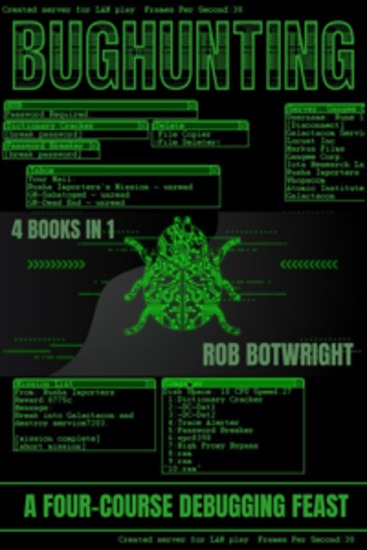
Bughunting - A Four-Course Debugging Feast - cover

Bughunting - A Four-Course Debugging Feast

Rob Botwright

Publisher: Rob Botwright

  • 0
  • 0
  • 0

Summary

🔥 Discover Bughunting: A Four-Course Debugging Feast! 🔥Are you ready to transform the way you tackle software defects? 🍽️ Dive into Bughunting, a mouthwatering series of four “courses” designed to make you a debugging master. Each book is packed with practical recipes, real-world examples, and powerful techniques to conquer even the trickiest bugs. Whether you’re a junior developer or a seasoned engineer, this feast will satisfy your appetite for reliable, robust code. 💻🛠️🥘 Book 1 – Recipe for a Heisenbug: Techniques for Tracking Elusive Defects• Unravel the mystery of Heisenbugs—those impossible bugs that vanish when you look at them. 🔍• Master deterministic replay, log reduction, and controlled environments to capture fleeting failures. 🐞• Follow step-by-step kitchen-style recipes to set up reproducible test cases and isolate erratic behavior.• Gain confidence by learning how to trap non-deterministic issues before they escape into production. 📈🍲 Book 2 – Memory Leak Stew: Identifying and Fixing Resource Drains• Dig into the simmering world of memory mismanagement and resource leaks. 💧• Learn to profile allocations, inspect heap usage, and decode garbage-collector outputs. 📊• Apply systematic tools and code reviews to prevent subtle leaks from simmering into system crashes.• Whip up quick fixes and long-term strategies that keep your applications healthy and leak-free. 🌿🥣 Book 3 – Race Condition Ragout: Synchronization Recipes for Stable Code• Conquer concurrency with iron-clad recipes that tame threads, locks, and atomic operations. ⚙️• Understand deadlocks, livelocks, and thread starvation—and apply the right seasoning (mutexes, semaphores, lock-free algorithms) to avoid them. 🧂• Use formal reasoning and practical examples to guarantee your code behaves predictably under pressure.• Boost performance and maintainability with well-balanced synchronization strategies. 🚀🍛 Book 4 – Assertion Gumbo: Spicing Up Your Testing Strategies• Spice up your test suites by bundling functional, performance, and integration checks into cohesive “gumbo pots.” 🍤• Group related assertions, streamline test maintenance, and catch regressions before they spoil the release. 🛡️• Integrate command-line tools and CI pipelines to automate testing at scale. Example:gumbo test --config assertion_gumbo.json• Learn from real-world case studies showing how teams improved code quality with “Assertion Gumbo.” 📋✨ Why Bughunting?• Comprehensive & Practical: Each book delivers hands-on, bite-sized recipes you can apply immediately.• Real-World Focus: Examples from e-commerce, IoT firmware, multi-threaded services, and more.• Scalable Techniques: From individual developers to large teams—these recipes grow with you.• Mindset Shift: Treat bugs as ingredients to analyze, not enemies to eliminate in panic. 🌟🎉 Ready to Feast on Debugging Excellence?Don’t let elusive defects spoil your project. Grab your apron and join the feast! Whether you start with a Heisenbug or finish with Assertion Gumbo, you’ll emerge with newfound confidence and a robust toolkit. Get Bughunting today and turn every bug into a recipe for success! 📚👨‍🍳👩‍🍳👉 Order now and unlock the secrets of debugging mastery! 🚀🛒
Available since: 06/07/2025.

Other books that might interest you

  • Together Through the Postpartum Period: How You as Parents Can Confidently Face the Postbirth Phase Enjoy the Postpartum Period Together and Build a Close Bond with Your Child – Including the Best Postpartum Recipes - cover

    Together Through the Postpartum...

    Helena Weber

    • 0
    • 0
    • 0
    The Baby is Here! – Now What? For many women and men alike, this is the most important moment in life: The new family member is finally here! You've been waiting for this moment for months – and then realize: It's not all just pink happiness. The postpartum phase is a time of recovery, reorganization, and often a time of uncertainty – for both mom and dad: Are we doing everything right? Is the baby hungry or in pain? How can the body recover? Are digestive issues normal? How does the father find his role? How can we start building a close bond with our baby? And when will pleasure & sexuality return? This book answers these and many other questions compassionately, openly, and without false shame, and is a competent guide through the first weeks of new family life.
    Show book
  • Planting Our World - cover

    Planting Our World

    Stefano Mancuso

    • 0
    • 0
    • 0
    It all begins and ends with plants. From the chance to live on this planet to the pleasure of listening to the sound of a violin—every story begins with a plant. 


    We animals account for a paltry 0.3% of the planet's biomass while plants add up to 85%. It is obvious that every story on this planet has a plant as its protagonist. Our world is a green world; Earth is the planet of plants. And when, with just a little training, we are able to look at the world without seeing it solely as humanity's playground, we cannot help but notice the ubiquity of plants. They are everywhere and their stories are inevitably wound up with ours. Not to see this plan, or even worse, to ignore its existence, is one of the most serious threats to the survival of our species. 


    Neurobiologist Stefano Mancuso is back with a book to tell us about the greenprint of our world. He does it through unforgettable stories starring plants; stories combining an inimitable narrative style and remarkable scientific rigor. From the story of the red spruce that gave Stradivarius the wood for his fourteen violins, to the Kauri tree stump, kept alive for decades by the interconnected root system of nearby trees. From the story of the slipperiness of the banana skin to the plant that solved the "crime of the century," the Lindbergh kidnapping, by way of wooden ladder rungs.
    Show book
  • Dark Energy - Puzzles from the Cosmic Deep (3 in 1) - cover

    Dark Energy - Puzzles from the...

    Dirk Fallon

    • 0
    • 0
    • 0
    Dark Energy – Puzzles from the Cosmic Deep explores the most profound and unsolved mysteries of the universe. This 3-in-1 volume pulls you into the heart of modern astrophysics and cosmology, where scientists are wrestling with forces that defy all expectations. At the center of it all is dark energy — the invisible phenomenon that’s not only real but accelerating the expansion of the universe itself. 
    In The Dark Energy Puzzle, you’ll trace the history of its discovery, from unexpected observations of distant supernovae to the revolutionary idea that empty space may not be empty at all. You'll learn how this unknown force challenges Einstein’s theories and leaves physicists grasping for answers that lie beyond current scientific frameworks. 
    Dark Forces dives deeper into the nature of the unseen universe, examining how dark energy interacts with gravity, time, and the structure of space itself. Could there be hidden dimensions? Is dark energy connected to the quantum vacuum? This section explores the weird and wondrous possibilities at the intersection of general relativity and quantum mechanics. 
    Finally, Cosmic Paradoxes brings the biggest questions to the forefront. Why is the universe accelerating? Will it expand forever—or rip itself apart in a catastrophic end? How can something we can't see or directly measure dominate the fate of everything? These paradoxes don’t just challenge our understanding of space—they force us to rethink the foundations of reality. 
    Perfect for curious minds fascinated by astronomy, cosmology, and the frontiers of theoretical physics, this book offers a rich and readable journey through one of the greatest puzzles in modern science. As you peer into the deep cosmos, you’ll uncover not just answers, but bigger and stranger questions.
    Show book
  • Ultimate Java for Data Analytics and Machine Learning - Unlock Java's Ecosystem for Data Analysis and Machine Learning Using WEKA JavaML JFreeChart and Deeplearning4j - cover

    Ultimate Java for Data Analytics...

    Abhishek Kumar

    • 0
    • 0
    • 0
    Empower Your Data Insights with Java's Top Tools and Frameworks. 
    Book Description
    This book is a comprehensive guide to data analysis using Java. It starts with the fundamentals, covering the purpose of data analysis, different data types and structures, and how to pre-process datasets. It then introduces popular Java libraries like WEKA and Rapidminer for efficient data analysis. 
    The middle section of the book dives deeper into statistical techniques like descriptive analysis and random sampling, along with practical skills in working with relational databases (JDBC, SQL, MySQL) and NoSQL databases. It also explores various analysis methods like regression, classification, and clustering, along with applications in business intelligence and time series prediction. 
    The final part of the book gives a brief overview of big data analysis with Java frameworks like MapReduce, and introduces deep learning with the Deeplearning4J library. Whether you're new to data analysis or want to improve your Java skills, this book offers a step-by-step approach with real-world examples to help you master data analysis using Java. 
    
    Table of Contents
    
    1. Data Analytics Using Java
    2. Datasets
    3. Data Visualization
    4. Java Machine Learning Libraries
    5. Statistical Analysis
    6. Relational Databases
    7. Regression Analysis
    8. Classification?Analysis
    9. Sentiment Analysis
    10. Cluster Analysis
    11. Working with NoSQL Databases
    12. Recommender Systems
    13. Applications of Data Analysis
    14. Big Data Analysis with Java
    15. Deep Learning with Java   
    Index
    Show book
  • The Genetics Revolution – How CRISPR and DNA Editing Will Reshape Humanity - The Science Ethics and Future of Genetic Engineering - cover

    The Genetics Revolution – How...

    David Moses

    • 0
    • 0
    • 0
    Genetic engineering is no longer science fiction—it’s here. But should we edit the code of life? 
    This audiobook takes you inside the revolutionary world of CRISPR and DNA editing, explaining how scientists are rewriting genetics to cure diseases, enhance human traits, and transform industries. Discover: 
    ✅ How CRISPR works and why it’s considered the most powerful genetic tool ever created 
    ✅ The medical breakthroughs in gene therapy, from curing blindness to treating cancer 
    ✅ The ethical debate: Should we allow human enhancement and designer babies? 
    ✅ How genetically modified crops could solve world hunger and climate change challenges 
    ✅ The future of synthetic biology and the risks of playing with evolution 
    The Genetics Revolution – How CRISPR & DNA Editing Will Reshape Humanity is a must-listen for *science enthusiasts, futurists, medical professionals, and anyone curious about the power and limits of genetic engineering.
    Show book
  • The Shortest History of AI - The Six Essential Ideas That Animate It - cover

    The Shortest History of AI - The...

    Toby Walsh

    • 0
    • 0
    • 0
    Since Alan Turing first posed the question "Can machines think?" artificial intelligence has evolved from a speculative idea to a transformative force. The Shortest History of AI traces this evolution, from Ada Lovelace's visionary work to IBM's groundbreaking defeat of the chess world champion and the revolutionary emergence of ChatGPT. It also explores AI's cultural journey, touching on classics such as Frankenstein, A Hitchhiker's Guide to the Galaxy, and 2001: A Space Odyssey. 
     
    Revealing how many "overnight" successes were decades in the making, this accessible and illuminating book helps us to understand how AI functions by explaining the six key ideas that animate it: it searches for answers using predetermined symbols and means-end analysis; it bases its answers on what sort of response it thinks it will get; it follows a set of rules in order to simulate human expertise; it copies the human brain by learning from experience; it uses reinforcement learning, rewarding its own successes and punishing itself for its failures; and it uses Bayes' theorem to calculate the probability of a cause based on its effect. 
     
    Fast-paced and rich with facts, The Shortest History of AI equips listeners to understand where we've been—and where we're headed.
    Show book