Begleiten Sie uns auf eine literarische Weltreise!
Buch zum Bücherregal hinzufügen
Grey
Einen neuen Kommentar schreiben Default profile 50px
Grey
Jetzt das ganze Buch im Abo oder die ersten Seiten gratis lesen!
All characters reduced
Folk Law Origins - cover

Folk Law Origins

River Stone

Übersetzer A AI

Verlag: Publifye

  • 0
  • 0
  • 0

Beschreibung

Folk Law Origins explores the fascinating realm of unwritten laws and their crucial role in shaping early societies. It examines how communities maintained order and resolved disputes through folk law, relying on oral tradition to transmit legal norms across generations. Cultural enforcement mechanisms, such as social pressure and ritual practices, ensured compliance, highlighting the sophisticated social regulation present even without formal legal systems.

 
The book argues that these unwritten laws, far from being primitive, represent a highly adaptable framework for social order. It presents case studies from diverse cultures and historical periods to demonstrate how these laws shaped social interactions. For example, storytelling and community leaders played key roles in preserving and enforcing folk law.

 
The book progresses from introducing fundamental concepts like oral tradition and cultural enforcement to exploring their legacies in contemporary legal systems. Through its interdisciplinary approach, drawing on anthropology, history, and legal studies, Folk Law Origins offers a unique perspective on the origins of law. It sheds light on customary law, indigenous rights, and dispute resolution, making it valuable for those interested in the history of legal systems and social sciences.
Verfügbar seit: 06.05.2025.
Drucklänge: 60 Seiten.
Weitere Bücher, die Sie mögen werden

  • Capitalism and Global Power - The Role of Capitalism in Shaping Global Relations (3 in 1) - cover

    Capitalism and Global Power -...

    Arlo Holders

    • 0
    • 0
    • 0
    This book contains these three titles: 
      - Capitalism and Inequality: Capitalism, as an economic system, is based on private ownership of the means of production and the creation of goods or services for profit. In capitalist societies, market forces—supply and demand—determine the distribution of resources and wealth. This system is characterized by competition, limited government intervention, and the pursuit of profit. Over time, capitalism has evolved in response to global events, technological advancements, and changes in social and political structures. However, a fundamental aspect of capitalism that persists is the inherent inequality it creates. 
      - Economic Impacts of Imperialism: Imperialism, as a driving force in global history, established the foundation for much of the modern world's economic and political systems. The roots of imperialism stretch back to ancient civilizations, where conquest and control of territories provided the resources and labor necessary for expansion and prosperity. Over time, the concept evolved, shaped by cultural ambitions, geopolitical competition, and economic incentives. By the late 15th century, the age of exploration began a new phase of empire building, marked by the European powers seeking wealth and influence beyond their borders. 
      - Global Capitalism: The roots of global capitalism can be traced to the rise of industrial capitalism in the 18th and 19th centuries, which laid the foundation for an interconnected global economy. With the expansion of imperialism, the development of transportation technologies like steamships and railways, and the establishment of international financial institutions, economic activity increasingly transcended national boundaries.
    Zum Buch
  • Music and Globalization - Critical Encounters - cover

    Music and Globalization -...

    Bob W. White

    • 0
    • 1
    • 0
    "World music" emerged as a commercial and musical category in the 1980s, but in some sense music has always been global. Through the metaphor of encounters, Music and Globalization explores the dynamics that enable or hinder cross-cultural communication through music. In the stories told by the contributors, we meet well-known players such as David Byrne, Peter Gabriel, Sting, Ry Cooder, Fela Kuti, and Gilberto Gil, but also lesser-known characters such as the Senegalese Afro-Cuban singer Laba Sosseh and Raramuri fiddle players from northwest Mexico. This collection demonstrates that careful historical and ethnographic analysis of global music can show us how globalization operates and what, if anything, we as consumers have to do with it.
    Zum Buch
  • The Permanent Husband - A Gripping Tale of Betrayal Guilt and the Burden of the Past - cover

    The Permanent Husband - A...

    Fyodor Dostoevsky, Tim Zengerink

    • 0
    • 0
    • 0
    What if the man you wronged refused to let you forget? 
    The Permanent Husband unfolds as a taut confrontation between suave Ivan Velchaninov and brooding Pavel Trusotsky, who arrives bearing the ghost of betrayal—and perhaps a child conceived in that very betrayal.  
    Their conversations crackle with hidden barbs, exposing wounds neither is willing to heal. Dostoevsky’s concise masterpiece becomes an immersive listening experience, rich with irony, tension, and unexpected flashes of dark humor. 
    What you’ll hear inside: 
    - A Psychological Chess Match – Every word a move, every pause a threat. 
    - Portraits of Guilt and Jealousy – Voices that reveal trembling pride and desperate vulnerability. 
    - A Modern Performance – Clear, dynamic narration that brings nineteenth-century St. Petersburg to life. 
    - A Story That Haunts Long After the Final Sentence – Perfect for listeners who crave moral complexity in under three hours. 
    Total listening time: approximately 2 hours 30 minutes—ideal for a single suspense-filled evening.
    Zum Buch
  • A Path with Psychedelics - A Journal of Journeys - cover

    A Path with Psychedelics - A...

    Chris Becker

    • 0
    • 0
    • 0
    How did we get here and where are we going? How do we heal our wounds, grow and mature as human beings? Good questions! We weren’t born with a road map, so we have to figure this out ourselves—if we are up to the challenge. It does help to have a friend who is a few steps ahead on the path to guide us when needed. Chris writes about his own astonishing journey of psychic healing and spiritual exploration with the aid of mind-changing medicines. Although this is the story of his personal path, it is a useful example of the universal human journey; entertaining, encouraging and enlightening. 
    Zum Buch
  • Queer Arrangements - Billy Strayhorn and Midcentury Jazz Collaboration - cover

    Queer Arrangements - Billy...

    Lisa Barg

    • 0
    • 0
    • 0
    Winner of the 2024 Philip Brett Award, sponsored by the LGBTQ Study Group of the American Musicological Society (AMS)The legacy of Black queer composer, arranger, and pianist Billy Strayhorn (1915–1967) hovers at the edge of canonical jazz narratives. Queer Arrangements explores the ways in which Strayhorn's identity as an openly gay Black jazz musician shaped his career, including the creative roles he could assume and the dynamics between himself and his collaborators, most famously Duke Ellington, but also iconic singers such as Lena Horne and Ella Fitzgerald. This new portrait of Strayhorn combines critical, historically-situated close readings of selected recordings, scores, and performances with biography and cultural theory to pursue alternative interpretive jazz possibilities, Black queer historical routes, and sounds. By looking at jazz history through the instrument(s) of Strayhorn's queer arrangements, this book sheds new light on his music and on jazz collaboration at midcentury.
    Zum Buch
  • Walls of Constantinople The: The History of the Fortifications that Made the Byzantine Capital Nearly Impregnable - cover

    Walls of Constantinople The: The...

    Charles River Editors

    • 0
    • 0
    • 0
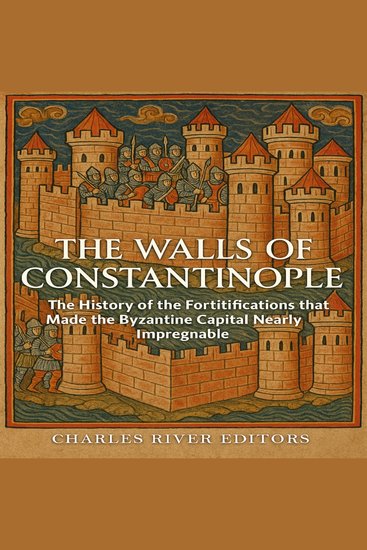
    In terms of geopolitics, perhaps the most seminal event of the Middle Ages was the successful Ottoman siege of Constantinople in 1453. Naturally, the Ottoman Empire would also use Constantinople as the capital of its empire after their conquest effectively ended the Byzantine Empire, and thanks to its strategic location, it has been a trading center for years and remains one today under the Turkish name of Istanbul. The end of the Byzantine Empire had a profound effect not only on the Middle East but Europe as well. Constantinople had played a crucial part in the Crusades, and the fall of the Byzantines meant that the Ottomans now shared a border with Europe. The Ottomans were viewed as a threat by the predominantly Christian continent to their west, and it took little time for different European nations to start clashing with them. In fact, the Ottomans would clash with Russians, Austrians, Venetians, Polish, and more before collapsing as a result of World War I, when they were part of the Central Powers.  
    Of course, it wasn’t an accident that Constantinople survived for so long. Since ancient times, settlements have been protected by walls, ranging from simple earth fortifications, mounds, and ditches to sophisticated structures incorporating gates and watchtowers. The globe is replete with famous walls such as that built by Hadrian in the north of England and the Great Wall of China, which spans hundreds of miles across a vast landscape. Some of the earliest evidence of defensive walling can be found in Africa, and the Bible includes references to the walls of Jericho, dating back to at least the 8th century BCE. Walls have protected great civilizations and occasionally been their downfall, and the Byzantine Empire relied on Constantinople’s extensive, sophisticated walls, among the greatest engineering achievements of the ancient world and Early Middle Ages, to survive as long as it did. 
    Zum Buch