Begleiten Sie uns auf eine literarische Weltreise!
Buch zum Bücherregal hinzufügen
Grey
Einen neuen Kommentar schreiben Default profile 50px
Grey
Jetzt das ganze Buch im Abo oder die ersten Seiten gratis lesen!
All characters reduced
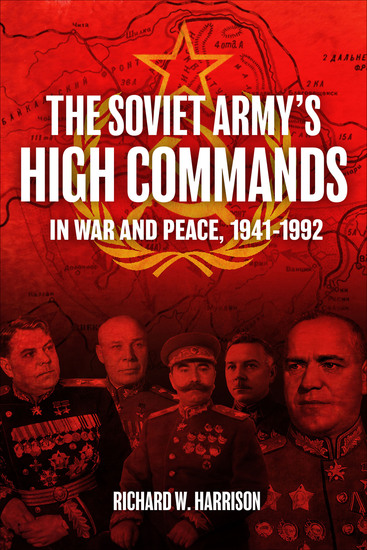
The Soviet Army's High Commands in War and Peace 1941–1992 - cover

The Soviet Army's High Commands in War and Peace 1941–1992

Richard W. Harrison

Verlag: Casemate Academic

  • 0
  • 0
  • 0

Beschreibung

The first full history of the Soviet Army’s High Commands during World War II and the Cold War—“Provides valuable and original research that reveals a great deal about the Soviet Union’s military command structure during World War II, with a few important insights into the almost fifty years that followed” (Journal of Military History).The war on the Eastern Front during 1941–45 was an immense struggle, running from the Barents Sea to the Caucasus Mountains. The vast distances involved forced the Soviet political-military leadership to resort to new organizational expedients in order to control operations along the extended front. These were the high commands of the directions, which were responsible for two or more fronts (army groups) and, along maritime axes, one or more fleets.In all, five high commands were created along the northwestern, western, southwestern, and North Caucasus strategic directions during 1941–42. However, the highly unfavorable strategic situation during the first year of the war, as well as interference in day-to-day operations by Stalin, severely limited the high commands' effectiveness. As a consequence, the high commands were abolished in mid-1942 and replaced by the more flexible system of supreme command representatives at the front. A High Command of Soviet Forces in the Far East was established in 1945 and oversaw the Red Army's highly effective campaign against Japanese forces in Manchuria.The Far Eastern High Command was briefly resurrected in 1947 as a response to the tense situation along the Korean peninsula and the ongoing civil war in China, but was abolished in 1953, soon after Stalin's death. Growing tensions with China brought about the recreation of the Far Eastern High Command in 1979, followed a few years later by the appearance of new high commands in Europe and South Asia. However, these new high commands did not long survive the collapse of the Soviet Union in 1991 and were abolished a year later.The book relies almost exclusively on Soviet and post-communist archival and other sources and is the first unclassified treatment of this subject in any country, East or West.
Verfügbar seit: 28.07.2022.
Drucklänge: 480 Seiten.


Weitere Bücher, die Sie mögen werden

  • Narcissistic Women The Concrete Healing Guide for Abused Men - How to Handle a Narcissist Divorcing and Co-parenting After a Destructive Marriage Thriving and Dating Again After Narcissistic Abuse - cover

    Narcissistic Women The Concrete...

    Caroline Foster

    • 0
    • 0
    • 0
    Did the girl of your dreams turn into your worst nightmare? Recognize the signs of a narcissistic partner and learn what you can do today! 
    Get your copy of Narcissistic Women and discover how to:Spot a narcissistic woman before starting a relationship with her.Recognize a narcissistic wife, manage the divorce, and navigate co-parenting.Protect your children from parental alienation.Recognize financial abuse and recover from it.Heal from codependency and narcissistic abuse syndrome.Break old toxic relationship patterns and learn to appreciate healthy, empathetic, balanced adult women. 
    ...and much more. 
    It can be extremely difficult for men to recognize and admit when a woman has abused them. This is due to a cultural stigma: in our society, admitting abuse is considered shameful for men. 
    Therefore, when experiencing an abusive relationship, men face an additional obstacle - lack of understanding and resources. Since the mental health industry is hyper-feminized, men are often left alone with their problems, feeling like they have no way out. Their suffering is often neither acknowledged nor addressed. 
    Prior to this book's publication, male victims of narcissistic women didn't receive the recognition they deserved, and the issue of female narcissists was regularly downplayed. 
    If you're an empathetic man suffering from narcissistic abuse, it can be especially hard to seek and obtain help due to social stigma. 
    Caroline Foster wrote this book to help you escape your toxic relationship, begin healing, and regain control of your life - so you can find your true soulmate.Ready to turn a new page in your life story? Start listening now!
    Zum Buch
  • The Three Wise Monkeys of Research - Epistemology Ontology Methodology - cover

    The Three Wise Monkeys of...

    Tara Brabazon

    • 0
    • 0
    • 0
    Research is anchored by assumptions.  How do we complete research - and why?  This book - The Three Monkeys of Research - explores epistemology, ontology and methodology.  Tara Brabazon explores how ideas become knowledge, and how arguments are verified, believed and disseminated to scholars, stakeholders and citizens.
    Zum Buch
  • NASA’s Space Race Programs: The History and Legacy of NASA Missions in the 1950s and 1960s - cover

    NASA’s Space Race Programs: The...

    Editors Charles River

    • 0
    • 0
    • 0
    Today the Space Race is widely viewed poignantly and fondly as a race to the Moon that culminated with Apollo 11 “winning” the Race for the United States. In fact, it encompassed a much broader range of competition between the Soviet Union and the United States that affected everything from military technology to successfully launching satellites that could land on Mars or orbit other planets in the Solar System. Moreover, the notion that America “won” the Space Race at the end of the 1960s overlooks just how competitive the Space Race actually was in launching people into orbit, as well as the major contributions the Space Race influenced in leading to today’s International Space Station and continued space exploration. 
    The Apollo space program is the most famous and celebrated in American history, but the first successful landing of men on the Moon during Apollo 11 had complicated roots dating back over a decade. Landing on the Moon presented an ideal goal all on its own, but the government’s urgency in designing the Apollo program was actually brought about by the Soviet Union, which spent much of the 1950s leaving the United States in its dust (and rocket fuel). In 1957, at a time when people were concerned about communism and nuclear war, many Americans were dismayed by news that the Soviet Union was successfully launching satellites into orbit. 
    Throughout the 1960s, NASA would spend tens of billions on missions to the Moon, the most expensive peacetime program in American history to that point, and Apollo was only made possible by the tests conducted through earlier missions. Of course, by the time it was all done, Americans sure felt the cost was worth it as they watched the first live shots of astronauts Neil Armstrong and Buzz Aldrin walking on the Moon. As he left his first footprint on the Moon, Armstrong transmitted one of the 20th century’s most famous phrases: “That’s one small step for man, one giant leap for mankind.”
    Zum Buch
  • A True Statesman - George H W Bush and the 'Indispensable Nation' - cover

    A True Statesman - George H W...

    Robin Renwick

    • 0
    • 0
    • 0
    "What we have been missing" – Henry Kissinger
    ***
    'If the United States does not lead, there will be no leadership. If the US instead turns inward, there will be a price to be paid later.' – George H. W. Bush
    Marking thirty years since the end of George H. W. Bush's presidency, Robin Renwick paints a warm, affectionate portrait of a President who sought to unify rather than divide his country, and whose staunch belief in diplomacy strengthened cooperation around the world.
    A True Statesman explores Bush's core belief in the United States as the 'indispensable nation' in helping to deal with world crises, charting his efforts to end the Cold War, secure the reunification of Germany and drive Saddam Hussein out of Kuwait.
    Extending beyond Bush's time in office, it also reflects on US foreign policy over the past three decades, examining the consequences of his successors' differing approaches to America's role on the world stage.
    Incisively written by a former British Ambassador to Washington, this insider account offers fresh insights into both the 41st President and America's foreign policy from Iran–Contra to Russia's invasion of Ukraine.
    Zum Buch
  • Earth Shapers - How We Mapped and Mastered the World from the Panama Canal to the Baltic Way - cover

    Earth Shapers - How We Mapped...

    Maxim Samson

    • 0
    • 0
    • 0
    The globetrotting story of how humans have harnessed the geographical landscape and written ourselves onto our surroundings.Mountains, meridians, rivers, and borders—these are some of the features that divide the world on our maps and in our minds. But geography is far less set in stone than we might believe, and, as Maxim Samson’s Earth Shapers contends, in our relatively short time on this planet, humans have become experts at fundamentally reshaping our surroundings.From the Qhapaq Ñan, the Inca’s “great road,” and Mozambique’s colonial railways to a Saudi Arabian smart city, and from Korea’s sacred Baekdu-daegan mountain range and the Great Green Wall in Africa to the streets of Chicago, Samson explores how we mold the world around us. And how, as we etch our needs onto the natural landscape, we alter the course of history. These fascinating stories of connectivity show that in our desire to make geographical connections, humans have broken through boundaries of all kinds, conquered treacherous terrain, and carved up landscapes. We crave linkages, and though we do not always pay attention to the in-between, these pathways—these ways of “earth shaping,” in Samson’s words—are key to understanding our relationship with the planet we call home.An immense work of cultural geography touching on ecology, sociology, history, and politics, Earth Shapers argues that, far from being constrained by geography, we are instead its creators.
    Zum Buch
  • The Illusion of Control - Why Financial Crises Happen and What We Can (and Can't) Do About It - cover

    The Illusion of Control - Why...

    Jon Danielsson

    • 0
    • 0
    • 0
    A challenge to the conventional wisdom surrounding financial risk, providing insight into why easy solutions to control the financial system are doomed to fail 


    Finance plays a key role in the prosperity of the modern world—but it also brings grave dangers. We seek to manage those threats with a vast array of sophisticated mathematical tools and techniques of financial risk management. Too often, though, we fail to address the greatest risk—the peril posed by our own behavior. 


    Jón Daníelsson argues that critical risk is generated from within, through the interactions of individuals and perpetuated by their beliefs, objectives, abilities, and prejudices. He asserts that the widespread belief that risk originates outside the financial system frustrates our ability to measure and manage it, and the likely consequences of new regulations will help alleviate small-scale risks but, perversely, encourage excessive risk taking. Daníelsson uses lessons from past and recent crises to show that diversity is the best way to safeguard our financial system.
    Zum Buch