Begleiten Sie uns auf eine literarische Weltreise!
Buch zum Bücherregal hinzufügen
Grey
Einen neuen Kommentar schreiben Default profile 50px
Grey
Jetzt das ganze Buch im Abo oder die ersten Seiten gratis lesen!
All characters reduced
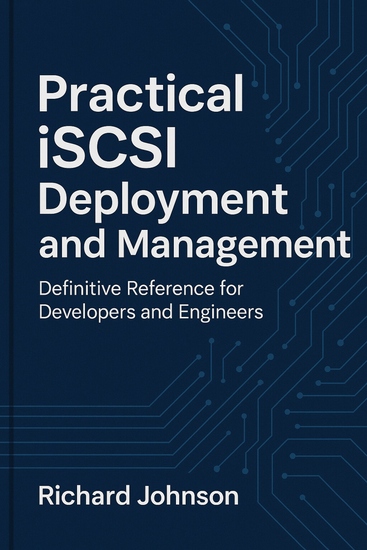
Practical iSCSI Deployment and Management - cover

Practical iSCSI Deployment and Management

Richard Johnson

Verlag: HiTeX Press

  • 0
  • 0
  • 0

Beschreibung

"Practical iSCSI Deployment and Management""Practical iSCSI Deployment and Management" is an authoritative guide for storage, network, and system professionals seeking to master the deployment and ongoing management of iSCSI-based infrastructures. The book delivers a structured exploration of the iSCSI protocol, from fundamental principles and architecture to nuanced comparisons with alternative storage technologies. Readers will gain deep insight into protocol operations—including session multiplexing, advanced naming conventions, and endpoint relationships—setting a strong technical foundation for designing and implementing robust iSCSI environments.With a clear emphasis on real-world applicability, this volume covers critical aspects of network design, target and initiator configuration, performance engineering, and advanced security strategies. It presents actionable blueprints for optimizing enterprise-scale networks, implementing high-availability and disaster recovery, tuning TCP/IP for optimal throughput, and ensuring compliance with regulatory mandates. Granular topics such as multipathing, dynamic provisioning, and API-driven orchestration are addressed alongside modern requirements for virtualization, containers, and multi-tenant cloud architectures.Drawing from a wealth of case studies, operational playbooks, and capacity planning models, the book equips IT leaders with the know-how to tackle complex scaling, automation, and interoperability challenges in heterogeneous environments. Whether integrating legacy storage, managing disaster recovery workflows, or future-proofing against emerging standards like NVMe/TCP, this comprehensive resource ensures practitioners are equipped to deliver resilient, high-performance iSCSI solutions that align with both technical and business objectives.
Verfügbar seit: 22.05.2025.
Drucklänge: 250 Seiten.

Weitere Bücher, die Sie mögen werden

  • Ultimate Robotics Programming with ROS 2 and Python - Design Develop and Implement Intelligent Robotics Applications with Advanced Navigation Simulation and Computer Vision for Mobile and Industrial Robots - cover

    Ultimate Robotics Programming...

    Jonathan Cacace

    • 0
    • 0
    • 0
    Learn Robotics and ROS 2 with Practical Examples
    Book Description
    Robot Operating System (ROS) and Python are essential tools for developing advanced robotics applications, offering reliability and scalability for both research and industrial solutions. Ultimate Robotics Programming with ROS 2 and Python introduces readers to ROS 2 without requiring prior experience in robotics. It blends theoretical explanations with practical exercises, empowering readers to solve specific robotics problems while understanding the reasoning behind various approaches.
    The book covers a broad spectrum of robotics topics, including mobile robots, industrial manipulators, and aerial robots. These systems are simulated using the modern Gazebo simulator and programmed with ROS 2’s out-of-the-box tools and custom solutions using the ROS 2 API. The book also delves into computer vision, generative AI, and machine learning, providing hands-on examples of real-world applications.
    Table of Contents
    1. Introduction to Robot Operating System
    2. Hands-on ROS 2 Programming Using Python
    3. Supplementary Tools for ROS
    4. Robot Visualization and Simulation
    5. Writing Tests Using Pytest for ROS 2 Nodes
    6. Controlling an Inverted Pendulum with a PID Controller
    7. Laser-based Obstacle Avoidance with a Wheeled Mobile Robot
    8. ROS 2 Behaviour Trees Using Python
    9. Surveillance System Using Behaviour Trees
    10. Robot Navigation Using ROS 2 Navigation Stack (Nav2)
    11. Robot Arm Control Using MoveIt
    12. Programming Aerial Robots Using ROS
    13. Computer Vision Using ROS
    14. Object Detection Using ROS
    15. Using Large Language Models with ROS
    16. Deep Reinforcement Learning Using ROS 2       
    
    Index
    Zum Buch
  • Gaia Wakes - Earth's Emergent Consciousness in an Age of Environmental Devastation - cover

    Gaia Wakes - Earth's Emergent...

    Topher McDougal

    • 0
    • 0
    • 0
    Gaia Wakes presents a compelling new framework for understanding the past, present, and future of our planet. Starting from a strong foundation in economics and drawing on a vast range of multidisciplinary scholarship, Topher McDougal explores the possibility of a fifth transition towards an upgraded Earth: the development of a technologically enabled planetary brain capable of coordinating ecological functions and peering far into the future and universe. 
    Gaia Wakes endows the emergence of a planetary brain with both a plausible economic mechanism and a historical context in which that mechanism has operated over the course of 3.8 billion years of life on Earth. It argues that the global environmental devastation we are beginning to experience and rapid recent advancements in artificial intelligence may jointly be part of a naturally recurring cycle of “upgrades” that has driven the increasing complexity of life on Earth. 
    Ambitious and provocative, the author combines economics with a breathtaking range of subjects including futurism, technology, philosophy, ecology and planetary and environmental sciences to offer new insights into questions that have long challenged us about the relationship between humankind and the world in which we live. Gaia Wakes stands out as a bold and original perspective on the future of our planet.
    Zum Buch
  • Impasse - Climate Change and the Limits of Progress - cover

    Impasse - Climate Change and the...

    Roy Scranton

    • 0
    • 0
    • 0
    A Next Big Idea Club "Must Read" for August 2025! 
     
    Extreme heat, fires, floods, and storms are transforming our planet. Yet we get increasing emissions, divisive politics, and ersatz solutions that offer more of the same: more capitalism, more complexity, more "progress." 
     
    The impasse we face is not only political and institutional, but cognitive, existential, and narrative. We're incapable of grasping the scale, speed, and impact of global warming. And we optimistically cling to a narrative that promises a better tomorrow if we just keep doing what we're doing. 
     
    It's past time to free ourselves from our dangerous and dogmatic faith. Such unwarranted optimism will accelerate our disintegration. If we want to have hope for the future, it must be grounded in a recognition of human limits—a view Scranton calls ethical pessimism. 
     
    Scranton describes the challenges we face in making sense of our predicament, from problems in communication to questions of justice, from the inherent biases in human perception to the difficulties of empirical knowledge. What emerges is a challenging but hopeful proposition: if we have the courage to accept our limits, we may find a way to embrace our future.
    Zum Buch
  • The Digital Revolution - Transforming Society - cover

    The Digital Revolution -...

    Nova Ashford

    • 0
    • 0
    • 0
    The origins of the digital revolution can be traced back to several key developments in technology, many of which were shaped by visionary thinkers and groundbreaking innovations. At the heart of this transformation was the invention of the computer, a device that would later evolve into the complex machines that now permeate every aspect of modern life. Early computing, which began in the 1930s and 1940s, was initially limited to large, cumbersome machines used by governments and research institutions. These machines, like the ENIAC and the UNIVAC, were monumental in size and expensive to maintain, but they laid the groundwork for the digital age that would follow. 
    The true revolution, however, began with the development of the microprocessor in the 1970s. This small, powerful component allowed computers to shrink in size, becoming affordable for individuals and small businesses. Companies like Intel and AMD played pivotal roles in creating chips that would power everything from personal computers to smartphones. The release of the first microprocessor-powered personal computers in the late 1970s and early 1980s, such as the Apple II and the IBM PC, marked the beginning of a new era in computing. 
    Parallel to the rise of personal computing was the development of the internet, which would fundamentally change how people connect with one another and access information. The internet's roots can be traced to the 1960s, when the U.S. Department of Defense developed ARPANET, a network designed to share information across computers in a decentralized manner. As the internet expanded during the 1990s, it transformed from a tool for academic and government use into a platform for businesses and individuals alike. The introduction of the World Wide Web, developed by Tim Berners-Lee in 1991, made the internet more accessible and user-friendly, leading to the explosion of online content and services that would define the digital age.
    Zum Buch
  • Carbon Technocracy - Energy Regimes in Modern East Asia - cover

    Carbon Technocracy - Energy...

    Victor Seow

    • 0
    • 0
    • 0
    A forceful reckoning with the relationship between energy and power through the history of what was once East Asia’s largest coal mine. 
     
    The coal-mining town of Fushun in China’s Northeast is home to a monstrous open pit. First excavated in the early twentieth century, this pit grew like a widening maw over the ensuing decades, as various Chinese and Japanese states endeavored to unearth Fushun’s purportedly “inexhaustible” carbon resources. Today, the depleted mine that remains is a wondrous and terrifying monument to fantasies of a fossil-fueled future and the technologies mobilized in attempts to turn those developmentalist dreams into reality. 
     
    In Carbon Technocracy, Victor Seow uses the remarkable story of the Fushun colliery to chart how the fossil fuel economy emerged in tandem with the rise of the modern technocratic state. Taking coal as an essential feedstock of national wealth and power, Chinese and Japanese bureaucrats, engineers, and industrialists deployed new technologies like open-pit mining and hydraulic stowage in pursuit of intensive energy extraction. But as much as these mine operators idealized the might of fossil fuel–driven machines, their extractive efforts nevertheless relied heavily on the human labor that those devices were expected to displace. Under the carbon energy regime, countless workers here and elsewhere would be subjected to invasive techniques of labor control, ever-escalating output targets, and the dangers of an increasingly exploited earth. 
     
    Although Fushun is no longer the coal capital it once was, the pattern of aggressive fossil-fueled development that led to its ascent endures. As we confront a planetary crisis precipitated by our extravagant consumption of carbon, it holds urgent lessons. This is a groundbreaking exploration of how the mutual production of energy and power came to define industrial modernity and the wider world that carbon made.
    Zum Buch
  • Why Trust Is Dying and What We Can Do About It - "Transform Your Perspective on Trust! Unlock powerful audio lessons that illuminate solutions to pressing concerns" - cover

    Why Trust Is Dying and What We...

    Arden Carrington

    • 0
    • 0
    • 0
    Why Trust Is Dying and What We Can Do About It 
    ⭐⭐ A Simplified Guide with Insights and Explanations ⭐⭐ 
    Are you eager to advance your career and deepen your understanding of trust in today's society? 
    Searching for a comprehensive resource that offers everything you need to foster trust and transform your relationships? 
    Look no further! 
    This guide is your ultimate companion for enhancing your knowledge, applying practical techniques, and engaging in meaningful exercises. With it, you're prepared to make a significant impact. 
    Updated to reflect the latest insights on trust in 2024. 
    Key Features of This Enhanced Guide: 
    - In-depth exploration of trust and its implications for personal and professional growth 
    - Detailed discussions about the dynamics of trust in various contexts 
    - Effective strategies for building and sustaining trust in relationships 
    Our guide stands out through its thorough examination of critical concepts, ensuring you don’t just skim the surface but truly understand the underlying principles. 
    Please note that this guide operates independently and is not affiliated with any official entity. 
    Crafted with a clear structure and accessible language, our guide ensures smooth transitions across topics. Say farewell to complicated jargon and embrace clear, concise, and accurate content. 
    So, why delay? Click the BUY NOW button, secure your copy, and embark on your journey to understanding and reviving trust in 2024!
    Zum Buch