Begleiten Sie uns auf eine literarische Weltreise!
Buch zum Bücherregal hinzufügen
Grey
Einen neuen Kommentar schreiben Default profile 50px
Grey
Jetzt das ganze Buch im Abo oder die ersten Seiten gratis lesen!
All characters reduced
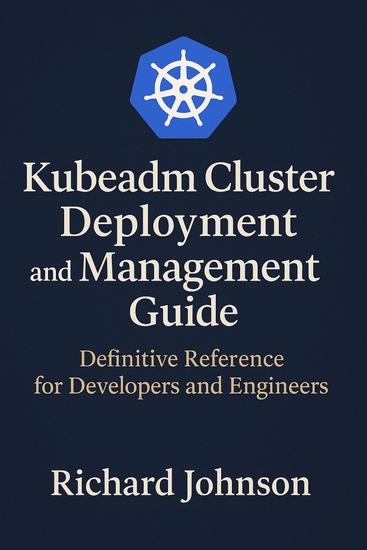
Kubeadm Cluster Deployment and Management Guide - Definitive Reference for Developers and Engineers - cover

Kubeadm Cluster Deployment and Management Guide - Definitive Reference for Developers and Engineers

Richard Johnson

Verlag: HiTeX Press

  • 0
  • 0
  • 0

Beschreibung

"Kubeadm Cluster Deployment and Management Guide"The "Kubeadm Cluster Deployment and Management Guide" is a comprehensive, in-depth resource designed for infrastructure engineers and platform operators who seek to confidently deploy, scale, and maintain Kubernetes clusters using kubeadm. The book opens by establishing a clear understanding of Kubernetes’ underlying architecture and explores kubeadm’s unique features, design principles, and security considerations. It offers clear comparisons between kubeadm and alternative cluster management tools, ensuring readers understand where kubeadm excels and how to align their infrastructure choices to best practices in security and reliability.With meticulous attention to real-world operational needs, this guide delves into every stage of the cluster lifecycle—from infrastructure preparation and high-availability designs to advanced bootstrapping, scaling, and day-2 operations. Readers will gain practical knowledge in network and storage planning, robust node and cluster initialization, advanced add-on deployments, and seamless cluster upgrades. Each chapter presents detailed methodologies encompassing resource sizing, automation using modern DevOps tools, secure configuration of networking and authentication, disaster recovery protocols, and compliance with regulatory frameworks such as PCI, HIPAA, and NIST.The text stands out for its treatment of troubleshooting, diagnostics, and ecosystem integration, arming readers with systematic guidance for diagnosing complex failures, optimizing observability, and implementing resilient, scalable systems. It also provides pathways for automation with Infrastructure as Code, GitOps, CI/CD, and multi-cluster management, ensuring organizations are equipped for evolving operational realities. Concluding with timely insights into the kubeadm project ecosystem and community innovation, this guide positions itself as an essential reference for both Kubernetes newcomers and advanced practitioners determined to master production-grade cluster management.
Verfügbar seit: 29.05.2025.
Drucklänge: 250 Seiten.


Weitere Bücher, die Sie mögen werden

  • Unlocking Blockchain: Answers to 150+ Common Questions About Cryptocurrency Tokens and NFTs - From Smart Contracts to STOs: Everything You Need to Know About Digital Assets - cover

    Unlocking Blockchain: Answers to...

    MICHAEL STORMEDA

    • 0
    • 0
    • 0
    In this question-and-answer guide, I’ve created a comprehensive resource that provides listeners with clear answers to every newcomer's many questions about this fascinating yet often elusive technological paradigm. In just a few hours, you’ll gain straightforward insights into the very questions I asked myself when I first explored blockchain. Covering complex topics that span fields like economics and cryptography, blockchain can initially feel overwhelming, even frustrating. Unfortunately, this complexity is often exploited by bad actors promoting questionable products and ventures, hoping to mislead those less familiar with the space. With the foundational knowledge you’ll gain from this audiobook, you’ll develop a keen eye for evaluating crypto projects, helping you avoid common pitfalls and sidestep misleading or risky ventures—an area where even seasoned professionals can struggle. By the end, you’ll be ready to navigate the crypto world with confidence and clarity.
    Zum Buch
  • COVID WARS - America's Struggle Over Public Health and Personal Freedom - cover

    COVID WARS - America's Struggle...

    Ronald Gruner

    • 0
    • 0
    • 0
    A sweeping, deeply researched chronicle of the COVID-19 pandemic, weaving together science, politics, and personal freedoms. 
    Ronald Gruner, with the precision of a historian and the curiosity of a citizen, takes the listener from the roots of virology in the 19th century to the chaotic pandemic years of 2020–2022. The book doesn’t just tell the story of a virus—it lays bare the cultural and political divide that shaped America’s uneven and often painful response. 
    Gruner’s writing is crisp, and he breaks down complex topics without dumbing them down. The opening chapters—“Contagium” and “The Warning”—build a compelling backstory on pandemics past, from the 1918 Spanish Flu to the eerie predictions of the Bush and Obama administrations. 
    COVID WARS isn’t shy about calling out failures. Politicians, conspiracy theorists, media figures, and even some public health leaders get held accountable. The chapter “The Divide” lays it all out—how the pandemic morphed from a health emergency into a political food fight. Gruner points fingers but backs it all up with evidence, charts, and historical comparisons. 
    What listeners will appreciate most, though, is Gruner’s balance. He’s clearly frustrated with misinformation and poor leadership, but he doesn’t come across as bitter or one-sided. The chapter “Lockdowns” captures this tone perfectly. He acknowledges the economic devastation and emotional toll, especially on children and small business owners, while also recognizing that something had to be done to slow the rising death counts. If you’re curious about what really happened, how we got here, and how it could have been different—COVID WARS will be worth your time. 
    COVID WARS is not just a book about the pandemic. It’s a mirror, and what it reflects is both sobering and necessary.
    Zum Buch
  • Mastering Data Science and Big Data Analytics - Mastering Big Data: Strategies and Tools for Effective Analysis - cover

    Mastering Data Science and Big...

    Maxine Chen

    • 0
    • 0
    • 0
    Are you prepared to transform your knowledge of the digital landscape and unleash the power of data-driven insights? Explore the world of data science and big data analysis by diving into the pages of "Mastering Data Science and Big Data Analytics: Mastering Big Data- Strategies and Tools for Effective Analysis," an insightful book. This book is your key to understanding the intricacies of data analysis, regardless of whether you're an experienced practitioner looking to improve your abilities or a novice keen to learn the basics. 
    Using big data to extract insights in this era of excess information is more important than ever. This book breaks down the ideas of structured, semi-structured, and unstructured data, giving you a thorough grasp of the complexities of data analysis. Explore the meaning of the three Vs of big data: volume, velocity, and variety, and discover how these influence data analysis practices in various businesses. 
    Are you excited to see instances of big data applications in the real world that have revolutionized specific industries? This book walks you through case studies demonstrating the practical applications of data analysis across various sectors, including marketing, entertainment, finance, and healthcare. Learn how data scientists use the CRISP-DM framework to traverse the data science lifecycle, from analyzing and preparing data to evaluating and deploying models. 
    Equip yourself with the methods and tools that lead to insights as you become an expert in big data analysis. Examine feature engineering, data transformation, and preprocessing techniques to ensure your studies are precise and insightful. Dive into the realm of artificial intelligence and machine learning, utilizing algorithms to reveal trends and connections that influence markets and spur creativity.
    Zum Buch
  • The Impact of Technology on Employment - Opportunities and Challenges - cover

    The Impact of Technology on...

    Craig Dames

    • 0
    • 0
    • 0
    Technology has long been a driving force in shaping the nature of employment. From the Industrial Revolution to the digital age, advancements in technology have continuously altered the way people work, the skills required, and the overall structure of industries. In today's fast-evolving world, the relationship between technology and employment is more complex than ever. While technological progress brings efficiency, innovation, and new job opportunities, it also presents significant challenges such as job displacement, skill gaps, and the need for constant adaptation. Understanding this dynamic is crucial for individuals, businesses, and policymakers as they navigate the ever-changing landscape of work. 
    The evolution of technology in the workforce has been marked by transformative shifts that redefine how labor is performed. Historically, the introduction of machines, automation, and digital tools has led to the replacement of certain manual and repetitive tasks. However, rather than eliminating jobs entirely, these changes have often resulted in the creation of new roles that require different skill sets. For example, while the rise of automated assembly lines reduced the need for traditional factory workers, it also increased demand for engineers, technicians, and software developers to maintain and improve these systems. Similarly, the widespread adoption of computers and the internet revolutionized industries by enabling remote work, e-commerce, and data-driven decision-making, further expanding employment opportunities in the digital sector.
    Zum Buch
  • Called by the Wild - The Dogs Trained to Protect Wildlife - cover

    Called by the Wild - The Dogs...

    Conraad De Rosner, Graham...

    • 0
    • 0
    • 0
    The thrilling story of a pioneering conservationist working with dogs to protect wildlife from poachers 
    Conraad de Rosner is a pioneering game ranger, working with dogs to protect wildlife against poachers – both ‘bushmeat’ poachers, who use cruel snares to trap animals, and criminal syndicates killing for rhinoceros horn and capturing critically endangered pangolins, the most trafficked animal in the world. 
    Con’s life – constantly at risk from poachers, wildlife and even his own fellow rangers – has been saved on numerous occasions by his devoted canine companions. His first dog, Zingela, a Weimaraner, saved Con from near certain death at the hands of two fellow rangers; on another occasion, Zingela alerted Con to a concealed wounded buffalo, one of Africa’s most dangerous animals, about to charge. When Zingela was tragically killed, hit by a car while Con was away, the only meagre consolation was that Con had kept Landa, one of the nine puppies sired by Zingela. Landa followed in his father’s footsteps as the leader of the canine anti poaching team that is still operating today. 
    Con’s story is an epic of modern-day African wildlife conservation, filled with courage, adventure and romance. 
    Contains descriptions of violence
    Zum Buch
  • Echoes of the Cosmos - Tracing the Impact of Dark Matter - cover

    Echoes of the Cosmos - Tracing...

    Dirk Fallon

    • 0
    • 0
    • 0
    The universe is vast, filled with mysteries that challenge our understanding of reality. Among these, dark matter stands out as one of the most elusive and significant components of the cosmos. It is an invisible force that cannot be seen directly, yet it exerts a profound influence on the structure and behavior of galaxies, stars, and the universe as a whole. This chapter delves into the concept of dark matter, exploring its nature, how it was first theorized, and why it remains one of the most intriguing puzzles in modern physics and astronomy. 
    Dark matter was first proposed as a solution to an anomaly in the way galaxies rotate. In the 1930s, astronomer Fritz Zwicky observed that galaxies in the Coma Cluster were moving much faster than expected, based on the visible matter in those galaxies. He suggested the existence of an unseen mass, which he called "dark matter," to account for the gravitational pull that would explain these high speeds. This groundbreaking idea, however, was met with skepticism at the time. Over the decades that followed, evidence continued to accumulate, pointing to the presence of dark matter in the universe. 
    Dark matter is not something we can detect with traditional instruments because it does not emit, absorb, or reflect light. It is essentially invisible to electromagnetic radiation, which makes it very different from the ordinary matter that makes up stars, planets, and everything we can see in the universe. Despite its invisibility, dark matter’s presence is inferred through its gravitational effects on visible matter. For example, when we observe the rotation of galaxies, the stars at the outer edges are moving faster than they should, based on the amount of visible matter in the galaxy. This suggests that there is additional mass, unseen but detectable through its gravitational pull, holding these galaxies together.
    Zum Buch