Rejoignez-nous pour un voyage dans le monde des livres!
Ajouter ce livre à l'électronique
Grey
Ecrivez un nouveau commentaire Default profile 50px
Grey
Abonnez-vous pour lire le livre complet ou lisez les premières pages gratuitement!
All characters reduced
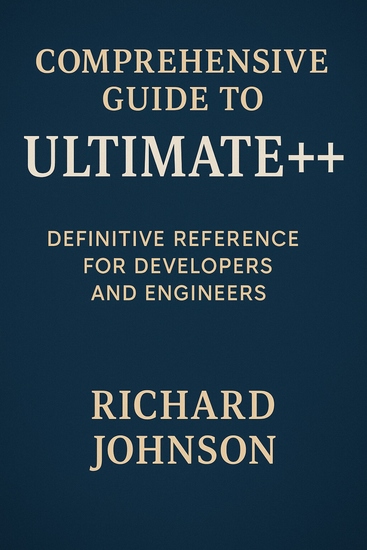
Comprehensive Guide to Ultimate++ - Definitive Reference for Developers and Engineers - cover

Comprehensive Guide to Ultimate++ - Definitive Reference for Developers and Engineers

Richard Johnson

Maison d'édition: HiTeX Press

  • 0
  • 0
  • 0

Synopsis

"Comprehensive Guide to Ultimate++"The "Comprehensive Guide to Ultimate++" is a definitive resource for developers, architects, and software engineers seeking to master the Ultimate++ (U++) framework—a modern, high-performance C++ toolkit for cross-platform application development. Beginning with a thorough exploration of the Ultimate++ ecosystem, design philosophy, and its evolution, this guide meticulously compares U++ against leading frameworks such as Qt, wxWidgets, and MFC, providing readers with critical insights into its minimalist design, modular architecture, and unique approach to open-source governance and version management.Delving into the heart of application development, the book systematically covers U++’s robust system architecture, advanced platform integrations, and distinguished developer tools such as TheIDE. Readers gain in-depth knowledge of cross-platform abstractions, build system strategies, native API bridging, optimization, and diagnostic infrastructure. Core library functionalities—including advanced data structures, memory management, concurrency strategies, error handling, and state persistence—are explained with clarity, while graphical user interface design, from event dispatching to custom widget creation and accessibility, is addressed in detail to empower both newcomers and experienced programmers.Encompassing advanced topics such as serialization, database integration, high-performance networking, and comprehensive DevOps practices, this guide offers best-in-class patterns, refactoring techniques, extensibility models, and security practices. The book concludes with practical insights into testing automation, continuous integration, and effective contribution to the Ultimate++ ecosystem. Whether readers are building enterprise-grade desktop solutions, contributing to open-source, or seeking to optimize cross-platform apps, this book serves as an indispensable companion for maximizing productivity and code quality in Ultimate++.
Disponible depuis: 01/06/2025.
Longueur d'impression: 250 pages.


D'autres livres qui pourraient vous intéresser

  • The Essential Book of Black Holes - Master the Mysteries of Black Holes in 12 Short Chapters - cover

    The Essential Book of Black...

    Sten Odenwald

    • 0
    • 0
    • 0
    Explore the incredible science behind of black holes in this guide, written by NASA astronomer and educator, Sten Odenwald. 
     
    Black holes are some of the most fascinating phenomena in the natural universe. In this beautiful pocket volume, Odenwald explores the science behind black holes in simple and accessible language. He explains what black holes are, how they come into existence, and how they affect the universe around us. Taking into consideration subjects such as gravity, quantum mechanics, the holographic principle and thermodynamics along the way, The Essential Book of Black Holes provides the perfect starting point for anyone interested in the subject. 
     
    ABOUT THE SERIES: Arcturus Concepts is a series of titles diving into some of the most compelling subjects in modern science. Written by a variety of experts, these editions provide a perfect starting point to a range of fascinating topics.
    Voir livre
  • The Abundance Code - A Complete System for Nervous System Regulation Elemental Balance and Conscious Manifestation - cover

    The Abundance Code - A Complete...

    Anonyme

    • 0
    • 0
    • 0
    This audiobook is narrated by an AI Voice.   
    Your mind has been trying to manifest abundance, but your body has been blocking it. For decades, people have repeated affirmations, visualized dream lives, and read every Law of Attraction book they could find—only to ask the same question: why isn’t it working for me? The Abundance Code reveals the missing piece—the state of your nervous system. When your body is trapped in survival mode, every “I am abundant” affirmation is drowned out by the deeper frequency of fear. True manifestation begins not in the mind, but in the body that holds your deepest patterns of safety, emotion, and energy. 
    This groundbreaking book by Baron Erwin Pitsch et de Jerusalem bridges modern neuroscience with ancient wisdom, showing how nervous system regulation and elemental balance create the biological and energetic foundation for abundance. It takes you beyond positive thinking into embodiment, teaching you to work with your natural rhythms instead of against them. Drawing from decades of study in Yoga, Daoist alchemy, Rosicrucian initiation, and trauma science, the author delivers a complete system for transforming your state from survival to thriving. 
    Inside you’ll discover the Four Elemental Equilibrium—Earth, Water, Fire, and Air—as a living map for balance and power. You’ll learn how breathwork, movement, sound, and daily coherence practices can rewire your body to feel safe, grounded, and open to receive. Through nervous system regulation, emotional intelligence, and the cultivation of inner stillness, you’ll unlock the state of being where abundance naturally flows to you. 
    The Abundance Code is not another book about wishful thinking—it’s a blueprint for embodied wealth. It’s for the seeker who has done the work, practiced the mantras, meditated for years, and still feels something missing. It’s for the ones who know that abundance is more than money—it’s energy, creativity, peace, and the freedom to live in alignment with your highest self.
    Voir livre
  • Database Management Systems for Beginners - From Foundations to Functional Applications - cover

    Database Management Systems for...

    Vincent Berry

    • 0
    • 0
    • 0
    "Database Management Systems for Beginners: From Foundations to Functional Applications" is the essential guide for anyone looking to grasp the fundamentals of database technology. Whether you're a student stepping into the world of databases, a business professional seeking to manage data more efficiently, or a curious individual eager to understand how database systems power the digital age, this book is your starting point. 
    Structured as a comprehensive introduction, this book takes you through the basics of databases and database management systems (DBMS), exploring both theory and practical applications. You'll begin with a clear definition of what databases are and why they are critical in today’s data-driven environment. From there, delve into various types of databases such as relational, NoSQL, and NewSQL, understanding their specific functions and when to use each. 
    As you progress, you will learn about the architecture and components of a DBMS and the critical role they play in effective data management. The book covers key topics such as SQL, data modeling, database design, and introduces the fundamentals of database security, administration, and maintenance. Practical, real-world examples and hands-on projects enhance your learning experience, providing you with the skills to design your own databases and even integrate them with web applications.
    Voir livre
  • International Space Station The: The History and Legacy of the Multinational Space Research Lab - cover

    International Space Station The:...

    Editors Charles River

    • 0
    • 0
    • 0
    Much has been written about the Space Race, which is still taught across America today, but the story of human space exploration is mostly one of cooperation. Even in the summer of 1969, the Soviets had given the United States the flight plan for its Luna 15 mission, allowing Apollo 11 to avoid it.  
    	That was the first of many examples of cooperation in space between the United States and the Soviet Union during the Cold War, and ultimately, their research and cooperation helped lead to the construction of the International Space Station (ISS), a large space station assembled in Earth’s orbit that represents the most ambitious international space project in history.  
    	Thanks to the various components that have been put together, the International Space Station is bigger and brighter than all other artificial satellites. With relatively low power magnification, people can see the solar panels radiating outward from the numerous international modules which make up the ISS. The reality of that platform, at the edge of the ocean of space, is pretty astounding when looked at from the perspective of history. Only 120 years ago, mankind did not know if it was possible to fly in a heavier-than-air vehicle. Constructed with over 30 different modules and pieces that were carried into orbit by dozens of different launches, the ISS is already over 150 feet long, 300 feet wide and 60 feet tall. Astronauts from 10 nations have spent time on the space station as long-term crew. 
    	In addition, the International Space Station can truly be held as a sign that the Space Age is maturing quite nicely, at least on a social and personal level. A total of 34 women have visited the space station, eight tourists have paid for the privilege of taking the trip to the station, and there have been many who have made multiple trips to the ISS.
    Voir livre
  • The Things We Make - The Unknown History of Invention from Cathedrals to Soda Cans - cover

    The Things We Make - The Unknown...

    Bill Hammack

    • 0
    • 0
    • 0
    Discover the secret method used to build the world . . . 


    For millennia, humans have used one simple method to solve problems. Whether it's planting crops, building skyscrapers, developing photographs, or designing the first microchip, all creators follow the same steps to engineer progress. But this powerful method, the "engineering method", is an all but hidden process that few of us have heard of—let alone understand—but that influences every aspect of our lives. 


    Bill Hammack, a Carl Sagan Award–winning professor of engineering and viral "The Engineer Guy" on YouTube, has a lifelong passion for the things we make, and how we make them. Now, for the first time, he reveals the invisible method behind every invention and takes us on a whirlwind tour of how humans built the world we know today. From the grand stone arches of medieval cathedrals to the mundane modern soda can, Hammack explains the golden rule of thumb that underlies every new building technique, every technological advancement, and every creative solution that leads us one step closer to a better, more functional world. Spanning centuries and cultures, Hammack offers a fascinating perspective on how humans engineer solutions in a world full of problems.
    Voir livre
  • Value Stream Mapping - Optimize Your Processes and Maximize Efficiency - cover

    Value Stream Mapping - Optimize...

    Steve Abrams

    • 0
    • 0
    • 0
    Dive into the transformative world of Value Stream Mapping (VSM) with "Mastering Value Stream Mapping: Optimize Your Processes and Maximize Efficiency," your comprehensive guide to understanding, implementing, and benefiting from this powerful tool. This book is designed to cater to professionals across various sectors, including manufacturing, services, and software development, who are seeking to enhance their operational efficiency and reduce waste. 
    Starting with the basics, the book introduces you to the concept of VSM, tracing its roots from the Toyota Production System to its contemporary applications in diverse industries. The initial chapters unfold the core principles of Value Stream Mapping, providing a robust framework on how to accurately depict and analyze the current state of your processes and pinpoint inefficiencies. 
    As you progress, "Mastering Value Stream Mapping" offers a meticulous, step-by-step approach to preparing for and executing a VSM exercise. It covers essential aspects such as assembling the right team, engaging stakeholders, and the practicalities of mapping both current and future states. The book emphasizes not just the creation of these maps, but also guides you through interpreting them and developing actionable plans for sustainable improvement. 
    In later chapters, the narrative delves into advanced strategies, integrating technology with VSM, and adapting the principles to cross-functional and cross-organizational challenges. It addresses how VSM can be customized for the Agile environment and software development, enhancing its relevance in today’s digital world. 
    Real-world case studies from various industries are intricately detailed, offering readers insight into the practical application of VSM and showcasing how organizations can achieve significant results. These examples also illustrate common pitfalls and the strategies employed to overcome them. 
     
    Voir livre