Rejoignez-nous pour un voyage dans le monde des livres!
Ajouter ce livre à l'électronique
Grey
Ecrivez un nouveau commentaire Default profile 50px
Grey
Abonnez-vous pour lire le livre complet ou lisez les premières pages gratuitement!
All characters reduced
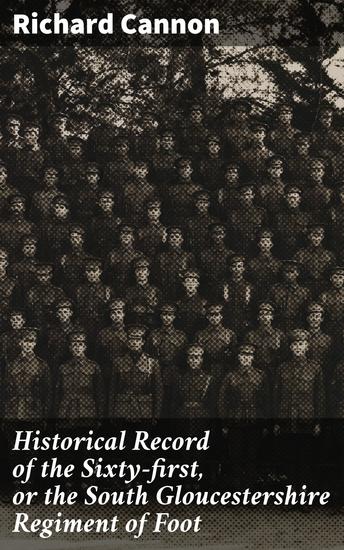
Historical Record of the Sixty-first or the South Gloucestershire Regiment of Foot - Unveiling the Glorious Legacy of a Storied Regiment - cover

Historical Record of the Sixty-first or the South Gloucestershire Regiment of Foot - Unveiling the Glorious Legacy of a Storied Regiment

Richard Cannon

Maison d'édition: Good Press

  • 0
  • 0
  • 0

Synopsis

In 'Historical Record of the Sixty-first, or the South Gloucestershire Regiment of Foot,' Richard Cannon meticulously chronicles the rich history and military engagements of one of England's storied regiments. Written in the mid-19th century, Cannon employs a precise and formal literary style indicative of military historiography of the era. His narrative balances detailed accounts of regimental campaigns, personal anecdotes, and the socio-political context surrounding the regiment's formation and operations, offering valuable insights into the military practices and national sentiments of Victorian England. Richard Cannon, a distinguished military historian and officer, was profoundly influenced by his own experiences within the British Army and his keen interest in military history. His writings not only serve to memorialize the contributions of various regiments but also reflect his commitment to ensuring that the sacrifices and exploits of soldiers were preserved for future generations. Cannon's scholarly approach was characterized by extensive research and a desire to convey both factual history and the human element of military service. This book is a recommended read for historians, military enthusiasts, and anyone interested in the evolution of British armed forces. Cannon's detailed approach provides an engaging and enlightening perspective on military heritage, making it a valuable addition to both personal and academic libraries. Readers will find themselves immersed in the trials and triumphs of the Sixty-first Regiment, gaining a deeper appreciation for the legacy of infantry service in Britain.
Disponible depuis: 17/01/2022.
Longueur d'impression: 53 pages.
D'autres livres qui pourraient vous intéresser

  • Liberalism - Individual Liberty and the Modern State - cover

    Liberalism - Individual Liberty...

    Hector Davidson

    • 0
    • 0
    • 0
    Liberalism is a political and philosophical ideology rooted in the principles of individual liberty, equality, and limited government. At its core, liberalism emphasizes the autonomy of the individual, arguing that each person has the right to pursue their own life and happiness, free from unnecessary interference by the state or society. Emerging in the Enlightenment period, liberalism challenged the traditional structures of monarchies and feudal systems, advocating for the rights of the individual and the importance of reason, tolerance, and democratic participation. 
    The roots of liberal thought can be traced back to the works of early modern philosophers such as John Locke, whose ideas on natural rights and government by consent laid the foundation for liberal political theory. Locke’s assertion that individuals possess inherent rights to life, liberty, and property formed the basis for much of liberal thought, influencing the development of constitutionalism and democratic governance. Over time, thinkers like Montesquieu, Rousseau, and later John Stuart Mill contributed to the evolution of liberalism, expanding its focus to issues of civil liberties, political freedoms, and social equality. 
    A defining characteristic of liberalism is its emphasis on individual freedom. This includes both personal liberty—the freedom to make choices about one’s own life—and political liberty—the right to participate in the democratic process and have a say in the laws and policies that govern society. Classical liberals advocated for minimal government interference in the economy and individual affairs, emphasizing free markets, private property, and limited state power. The role of the state, in this view, is to protect the rights of individuals and maintain social order, but not to intervene in the private lives or economic transactions of citizens.
    Voir livre
  • Underground City of Derinkuyu The: The History and Mystery of the Ancient Subterranean City in Turkey - cover

    Underground City of Derinkuyu...

    Editors Charles River

    • 0
    • 0
    • 0
    Among all the early Iron Age people from the Near East who inherited the geopolitical vacuum of power left by the Sea Peoples invasions, the Phrygians are perhaps one of the most misunderstood. They built a powerful and wealthy kingdom, but were overshadowed by their more powerful and wealthier neighbors, the Lydians. From the early 7th century BCE until the middle of the 6th century BCE, the Lydians played an important role in the history of the eastern Mediterranean region as they took on the role of middleman between the empires of the Near East and the emerging Hellenic civilization in Greece. From their capital in Sardis, the Lydian kings traded and made alliances and war with numerous kings, tyrants, and generals, which ultimately cemented their role as a brief but historically important people and kingdom in the ancient world.  
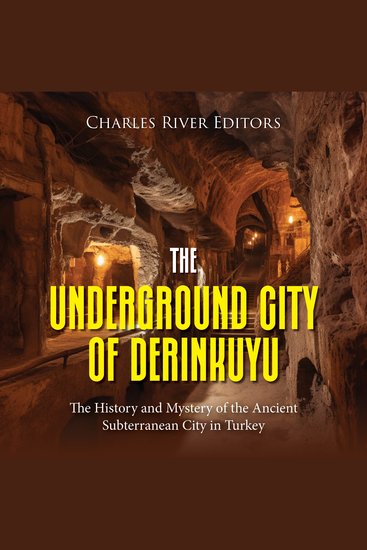
    	It seems that around this time, one of the most unique sites in antiquity was being constructed in central Turkey, an archaeological mystery modern scholars have only recently begun to uncover. Known as Derinkuyu in the Turkish language, the archaeological site is as expansive as any other in Turkey, but its expanse is more vertical than horizontal, which is what makes it so unusual. The lost city of Derinkuyu descends to depths of nearly 300 feet under the wind-swept cliffs and rock formations of the otherwise desolate region known as Cappadocia. Cappadocia’s landscape looks otherworldly, windswept, and unlivable in places, and if not for modern technologies, including electricity, sanitation, and irrigation, it surely would be considered inhabitable by many people.  
    	More recently, Derinkuyu has caught the attention of tourists, while academics have started to ask serious questions about this important site. Recent studies of Derinkuyu have helped illuminate how a city able to house 20,000 or more people could exist in antiquity, particularly with regard to logistics.
    Voir livre
  • Rome’s Legacy - Enduring Impacts on the World (3 in 1) - cover

    Rome’s Legacy - Enduring Impacts...

    Rogan Fish

    • 0
    • 0
    • 0
    This book bundle is a captivating exploration of the cultural and intellectual legacy of one of history’s most influential civilizations. The first section delves into the art of ancient Rome, from vivid frescoes that adorned villa walls to intricate mosaics that decorated public spaces. It also covers sculpture and portraiture, showcasing how Roman artists blended Greek traditions with their own flair to immortalize emperors, gods, and everyday citizens in marble and bronze. 
    The second part of the book is a deep dive into Roman architecture, one of the most enduring hallmarks of the empire. You’ll explore the design and engineering behind iconic structures like the Colosseum, the Pantheon, and massive bathhouses. This section breaks down the architectural innovations—such as arches, domes, and the groundbreaking use of concrete—that enabled Rome to construct buildings that still awe the world today. It also covers city planning and how Rome influenced future Western architecture. 
    The final section turns to Roman innovation, highlighting practical inventions that supported the empire's growth and efficiency. Learn how aqueducts transported water across miles, how paved roads unified the empire, and how engineering marvels enabled a high standard of urban life. From glass blowing to heating systems and even early newspapers, Roman ingenuity touched every corner of society. Cultural Achievements is a richly illustrated and accessible guide to the brilliance of Roman creativity—and how it shaped the world we live in today.
    Voir livre
  • The Highway Code UK - For All Road Users - cover

    The Highway Code UK - For All...

    Department for Transport

    • 0
    • 0
    • 0
    This Highway Code UK applies to England, Scotland and Wales. The Highway Code is essential reading for everyone. The aim of The Highway Code is to promote safety on the road, whilst also supporting a healthy, sustainable and efficient transport system.  Many of the rules of the Code are legal requirements and road users that do not comply may be fined, given points on driving licence, disqualified, or in serious cases, sent to prison.   This Highway Code audiobook includes the Highway Code that contains twenty free chapters that cover traffic regulations, laws and penalties. The text was sourced from the latest edition of The Official Highway Code, and reproduced under the terms of the Open Government Licence.
    Voir livre
  • Forbidden - A 3000-Year History of Jews and the Pig - cover

    Forbidden - A 3000-Year History...

    Jordan D. Rosenblum

    • 0
    • 0
    • 0
    Jews do not eat pig. This (not always true) observation has been made by both Jews and non-Jews for more than three thousand years and is rooted in biblical law. Though the Torah prohibits eating pig meat, it is not singled out more than other food prohibitions. Horses, rabbits, squirrels, and even vultures, while also not kosher, do not inspire the same level of revulsion for Jews as the pig. The pig has become a symbol for people to signal their Jewishness, non-Jewishness, or rebellion from Judaism. 


    Starting with the Hebrew Bible, Jordan D. Rosenblum historicizes the emergence of the pig as a key symbol of Jewish identity, from the Roman persecution of ancient rabbis, to the Spanish Inquisition, to Shakespeare's writings, to modern memoirs of those leaving Orthodox Judaism. The pig appears in debates about Jewish emancipation in eighteenth-century England and in vaccine conspiracies; in World War II rallying cries, when many American Jewish soldiers were "eating ham for Uncle Sam;" and in recent deliberations about the kosher status of Impossible Pork. 


    All told, there is a rich and varied story about the associations of Jews and pigs over time, both emerging from within Judaism and imposed on Jews by others. Expansive yet accessible, Forbidden offers a captivating look into Jewish history and identity through the lens of the pig.
    Voir livre
  • Children's Home - A Short Documentary - cover

    Children's Home - A Short...

    Paul Ieson

    • 0
    • 0
    • 0
    This short story is about the facts that have to deal with The Miami Children's Home. Some things that went on there are quite shocking and you may find quite interesting. This was written so that people would not forget about the home and the things that went on there. The story is dedicated to all the kids who lived there over the years.
    Voir livre