Begleiten Sie uns auf eine literarische Weltreise!
Buch zum Bücherregal hinzufügen
Grey
Einen neuen Kommentar schreiben Default profile 50px
Grey
Jetzt das ganze Buch im Abo oder die ersten Seiten gratis lesen!
All characters reduced
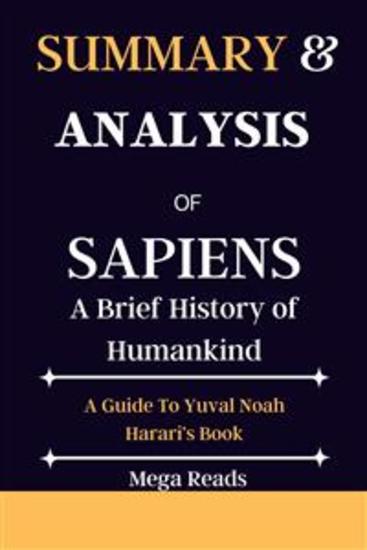
Summary And Analysis of Sapiens - A Brief History of Humankind - cover

Summary And Analysis of Sapiens - A Brief History of Humankind

Reads Mega

Verlag: Mega Reads

  • 0
  • 0
  • 0

Beschreibung

Discover the fascinating story of humanity's past and present in Yuval Noah Harari's bestselling book, "Sapiens: A Brief History of Humankind." From the emergence of Homo sapiens to the challenges facing humanity in the 21st century, Harari takes readers on a captivating journey through the key moments in human history, uncovering the pivotal events and individuals that have shaped our world.

With a fresh and insightful perspective, Harari shows us how humans have been able to create complex societies, develop language, religion, and science, and dominate the planet. At the same time, he raises important questions about our future, exploring the challenges we face in a rapidly changing world of artificial intelligence, biotechnology, and environmental destruction.

"Sapiens" is not just a history book; it is a gripping and thought-provoking exploration of what it means to be human. With its engaging and accessible style, this book is perfect for anyone looking to deepen their understanding of the world and the people who inhabit it. Whether you are a student, a scholar, or simply someone curious about life's big questions, "Sapiens" is a must-read that will leave you with a newfound appreciation for the power and potential of human beings.

DISCLAIMER:

This Is Not A Book By The Yuval Noah Harari, Nor Is It Affiliated With Him. Instead, it Is An Independent publishing by Mega Reads That Summarizes His Book In Detail.

Please note that this summary book cannot replace The Yuval Noah Harari's book or serve as the main book.

This is a detailed analysis and summary of His book.
Verfügbar seit: 19.02.2023.

Weitere Bücher, die Sie mögen werden

  • The AI Revolution - Impact on Project Management and How to Reinvent Yourself - cover

    The AI Revolution - Impact on...

    Torsten J. Koerting

    • 0
    • 0
    • 0
    Welcome to the world of project management in the age of AI. The revolution is here, and it's time to embrace it. As project managers, we are living in a world of constant change and disruption, and AI technology is transforming the way we work. We need to adapt, evolve, and embrace the opportunities that AI technology presents.    The potential of AI technology in project management is immense. It can help us to automate repetitive tasks, streamline processes, and deliver insights that were previously inaccessible. By leveraging AI technology, project managers can unlock new growth opportunities, increase profitability, and stay ahead of the competition.    However, the rise of AI technology also presents challenges for project managers. As project managers, we need to learn how to manage complex AI projects, collaborate with AI teams, and interpret AI-generated insights. We need to develop new skills, embrace new technologies, and adopt a growth mindset to succeed in the age of AI.    The challenge of managing AI projects requires project managers to learn new skills and approaches. For example, project managers need to understand how to manage projects with AI-driven analytics, such as machine learning algorithms, and how to integrate these insights into their project plans. Additionally, project managers need to be able to manage the complexity of AI projects, which often involve large amounts of data and multiple stakeholders.    To overcome these challenges, project managers need to adopt a growth mindset and embrace new technologies. This means being willing to learn new skills, experiment with new tools, and collaborate with AI teams. Project managers also need to be able to interpret AI-generated insights and incorporate them into their project plans effectively.    In this book, we explore the challenges facing project managers in the AI revolution and the specific needs project managers have to succeed in the age of AI. We provide strategies, tools, and resources for project managers to leverage AI technology to create value-based propositions and intellectual property.    We also share case studies and examples of successful AI projects, as well as stories of project managers overcoming challenges in the AI revolution. These examples illustrate the impact of AI technology on project management and provide lessons learned to help project managers understand how to apply these strategies and insights to their own projects.    Our goal is to help project managers unlock the full potential of AI technology and take their projects and organizations to the next level. We encourage the reader to reflect on their own skills and recognize the growth potential that AI technology presents. We want to inspire and motivate project managers to embrace the challenges and opportunities of the AI revolution.    So, are you ready to step into the unknown and embrace the growth potential of your company through AI-driven project management? Let's begin this journey together and unlock the power of AI technology.
    Zum Buch
  • There Is Life After the Nobel Prize - cover

    There Is Life After the Nobel Prize

    Eric R. Kandel

    • 0
    • 0
    • 0
    One day in 1996, the neuroscientist Eric R. Kandel took a call from his program officer at the National Institute of Mental Health, who informed him that he had been awarded a key grant. Also, the officer said, he and his colleagues thought Kandel would win the Nobel Prize. "I hope not soon," Kandel's wife, Denise, said when she heard this. Sociologists had found that Nobel Prize winners often did not contribute much more to science, she explained. 


    In this book, Kandel recounts his remarkable career since receiving the Nobel in 2000—or his experience of proving to his wife that he was not yet "completely dead intellectually." Kandel relates how the Nobel Prize gave him the opportunity to reach a far larger audience, which in turn allowed him to discover and pursue new directions. He describes his efforts to promote public understanding of science and to put brain science and art into conversation with each other. Kandel also discusses his return to Austria, which he had fled as a child, and observes Austria's coming to terms with the Nazi period. Showcasing Kandel's accomplishments, erudition, and wit, There Is Life After the Nobel Prize is a candid account of the working life of an acclaimed scientist.
    Zum Buch
  • Selfish Gene The: Book Summary & Analysis - cover

    Selfish Gene The: Book Summary &...

    Briefly Summaries

    • 0
    • 0
    • 0
    This is a concise summary and analysis of The Selfish Gene, by Richard Dawkins. It is not the original book and is not affiliated with or endorsed by Richard Dawkins. Ideal for those seeking a quick and insightful overview.
    The Selfish Gene explores the concept that evolution operates at the level of genes rather than individuals or species. It presents the idea that organisms are vehicles for the propagation of their genetic material, with natural selection favoring genes that enhance their chances of survival and replication. The book delves into the role of behavior, cooperation, and altruism, offering a new perspective on evolution that emphasizes the selfish nature of genes in shaping life.
    Zum Buch
  • Why the Dose Matters - Assessing the Health Risk of Exposure to Toxicants - cover

    Why the Dose Matters - Assessing...

    Urs A. Boelsterli

    • 0
    • 0
    • 0
    Each day we are exposed to a myriad of natural and human-made chemicals in our food, drinking water, air, soil, at home or at the workplace—pesticide residues, food additives, drugs, household products—but how can we gauge the human health risk posed by these chemicals? Should we believe the somber headlines that depict a serious threat for humans and the environment, or should we follow the reassuring voices of others who claim that the angst is totally unfounded? 


    Why the Dose Matters: Assessing the Health Risk of Exposure to Toxicants uses a rational, science-based approach to explain in plain language that a quantitative view is key for understanding and predicting potentially toxic effects of chemicals. 


    Key Features: 


    ● Explains the basics of toxicology in easily understandable terms. 


    ● Includes numerous examples. 


    ● Clears up common misconceptions and dispels myths. 


    ● Provides take-home messages for each chapter.
    Zum Buch
  • Primordium - cover

    Primordium

    Lucas Schrader

    • 0
    • 0
    • 0
    A New Myth for a New Age!Enjoy the origins of the universe from a new perspective, combining aspects of Christian, Norse, Egyptian, and Greek cosmology.*Primordium, Latin for the first beginning and used in Biology to mean the earliest developmental stage for an organic substructure. These same Latin roots are combined to describe the theoretical swamp where life first began, the primordial soup.
    Zum Buch
  • Grass-Fed Beef for a Post-Pandemic World - How Regenerative Grazing Can Restore Soils and Stabilize the Climate - cover

    Grass-Fed Beef for a...

    Ridge Shinn, Lynn Pledger

    • 0
    • 0
    • 0
    The COVID-19 pandemic exposed the vulnerabilities of our globalized food system and highlighted the desperate need for local and regional supplies of healthy meat. We must replace corn-based feedlots, which are responsible for significant climate emissions, nitrogen pollution, and animal suffering. Grass-Fed Beef for a Post-Pandemic World outlines a hopeful path out of our broken food system via regional networks of regeneratively produced meat. In 2017, Ridge Shinn and Lynne Pledger went to market with Big Picture Beef, a company that partners with farmers across the Northeast to increase access to wholesale markets while promoting holistic grazing management techniques. The result? Increased health benefits for consumers, the environment, and livestock. This book compiles information from the fields of ecology, climate science, nutrition, and animal welfare, along with on-the-farm stories from Ridge’s travels as a consultant all over the world. It reveals that regenerative grazing can restore degraded farmland, protect against droughts and floods, increase biodiversity, combat climate change by reducing emissions and sequestering carbon, contribute to regional economic development, and produce nutrient-dense meat for consumers. This book is for anyone wondering how our farmers and ranchers can raise cattle while also caring for the local and global environment. It includes a foreword by Gabe Brown, the bestselling author of Dirt to Soil.
    Zum Buch