Join us on a literary world trip!
Add this book to bookshelf
Grey
Write a new comment Default profile 50px
Grey
Subscribe to read the full book or read the first pages for free!
All characters reduced
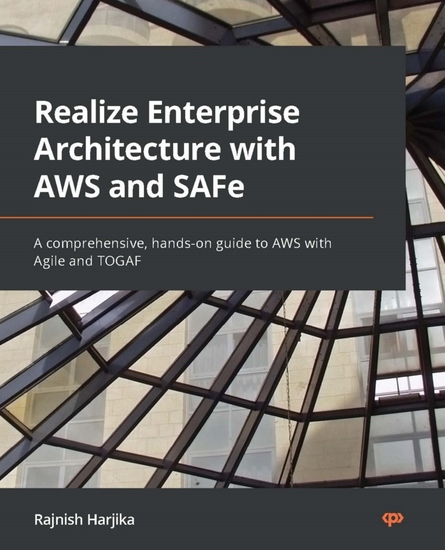
Realize Enterprise Architecture with AWS and SAFe - A comprehensive hands-on guide to AWS with Agile and TOGAF - cover

Realize Enterprise Architecture with AWS and SAFe - A comprehensive hands-on guide to AWS with Agile and TOGAF

Rajnish Harjika

Publisher: Packt Publishing

  • 0
  • 0
  • 0

Summary

Agile implementation of enterprise architecture (EA) in the cloud is a powerful organizational tool, but it is challenging, particularly for architects who are used to on-premises environments. This in-depth guide will tell you all you need to know to reap the benefits of applying EA in your organization to achieve operational efficiency.
Starting with an overview of the foundations of enterprise architecture, you'll see how it can be applied to AWS as well as explore the frameworks AWS provides for EA, such as the AWS Well-Architected Framework. That's not all – the book shows you how these frameworks align with The Open Group Architecture Framework (TOGAF) architecture development method (ADM) and the Zachman Framework so that you can choose the right fit for your organization. As you advance, you'll learn how to apply SAFe to make your organization agile as well as efficient. Once you've gotten to grips with the theory, you can explore use cases and take a quiz at the end of the book to test yourself and see how EA is applied in practice.
By the end of this enterprise architecture book, you'll have the skills and knowledge required to apply EA in the cloud with AWS and drive your organization to become super-efficient and agile.
Available since: 09/16/2022.
Print length: 304 pages.

Other books that might interest you

  • Cosmic Inflation - Gravitational Waves and the Physics of Expansion - cover

    Cosmic Inflation - Gravitational...

    Steff Jaywan

    • 0
    • 0
    • 0
    The story of our universe begins with one of the most profound and complex questions ever posed: How did it all begin? For centuries, humanity has sought to understand the origins of the cosmos, leading to an ever-evolving tapestry of ideas, theories, and discoveries. 
    In the early 20th century, the concept of the Big Bang emerged as a groundbreaking model, suggesting that the universe had a finite beginning—a singular moment in time when all matter, energy, and space itself erupted from an incredibly hot and dense state. This theory not only provided a framework for understanding the expansion of the universe but also posed new questions about the very nature of existence. 
    However, as scientists delved deeper into the implications of the Big Bang, they encountered puzzling anomalies. The uniformity of the cosmic microwave background radiation, the distribution of galaxies, and the large-scale structure of the universe seemed to suggest that something more profound had occurred in the first moments after the universe's birth.
    Show book
  • Bridging Spirit and Science - Integrating Spiritual Abilities with Technology for a New Human Future - cover

    Bridging Spirit and Science -...

    Martin K. Ettington

    • 0
    • 0
    • 0
    Spirit and Science are viewed as opposing views. I have lived my life in the middle of this divide. Trained as an engineer and scientist, I was taught to trust logic, mathematics, and experimental proof.  
    Yet my personal experiences — from moments of prophecy to direct awareness of subtle energies — convinced me that there is more to reality than conventional science admits.  
    For years I tried to keep the two worlds separate: the rational and the mystical. But over time, the boundary dissolved. I realized that both perspectives describe the same universe from different vantage points.  
    My work, and this book in particular, is about restoring the unity that once existed between them. 
    The purpose of this book is not to replace science with mysticism, nor to reduce spiritual experience to chemistry or neurology. Rather, it aims to show that consciousness, energy, and matter are aspects of a single integrated system.
    Show book
  • The Complete Handbook of Physical Therapy - Rehabilitation Techniques and Modalities - cover

    The Complete Handbook of...

    Ava Westwood

    • 0
    • 0
    • 0
    Physical therapy is a healthcare profession dedicated to improving movement, restoring function, and alleviating pain in individuals affected by injury, illness, or disability. It plays a crucial role in rehabilitation, preventing further complications, and enhancing overall quality of life. By employing evidence-based techniques, physical therapists help patients regain mobility, reduce discomfort, and achieve optimal physical health. 
    The origins of physical therapy can be traced back to ancient civilizations, where massage and exercise were used for healing. However, modern physical therapy emerged during the early 20th century, particularly in response to the need for rehabilitating soldiers injured in World War I. Since then, the field has evolved significantly, incorporating advanced scientific principles, innovative treatment modalities, and a multidisciplinary approach to patient care. 
    A physical therapist is a highly trained healthcare professional specializing in diagnosing and treating movement disorders. Their role extends beyond rehabilitation, encompassing injury prevention, pain management, and patient education. Physical therapists work in diverse settings, including hospitals, private clinics, sports facilities, rehabilitation centers, and home healthcare services. They collaborate with physicians, occupational therapists, and other healthcare professionals to develop comprehensive treatment plans tailored to individual patient needs.
    Show book
  • Cosmic Frontiers - The New Questions of 21st Century Astronomy - cover

    Cosmic Frontiers - The New...

    Ylia Callan

    • 0
    • 0
    • 0
    This audiobook is narrated by an AI Voice.   
    In the 21st century, astronomy has entered a new age—not just of discovery, but of wonder. 
    Cosmic Frontiers journeys through the most profound questions now emerging from modern science: 
    Why do galaxies form earlier than they should? What is dark matter, dark energy, and the quantum fabric of reality? Is life common among the stars—or is consciousness itself a cosmic phenomenon? 
    From the James Webb Space Telescope’s revelations of ancient galaxies to the search for biosignatures on distant exoplanets, from the detection of gravitational waves to the mysteries of quantum gravity and the multiverse, this book weaves together science, philosophy and the human spirit into a single cosmic narrative. 
    Written in vivid, poetic prose, Cosmic Frontiers is not only about what we have discovered—it is about what we still don’t understand and why those unanswered questions may be the most important of all. 
    For readers who loved Astrophysics for People in a Hurry, The Order of Time, or Cosmos, this is a visionary exploration of where science meets meaning — at the edge of the known universe.
    Show book
  • Addictions and the Future - The Challenges Our Young Generation Is Facing (4 in 1) - cover

    Addictions and the Future - The...

    Valerie Vogue

    • 0
    • 0
    • 0
    This book contains the following 4 titles: 
    Hooked on Tomorrow - The rapid pace of technological and social change has become the defining characteristic of modern life. We live in an age where innovation is constant, and the desire to keep up with it is almost addictive. From the devices we use daily to the way we communicate, everything is designed to keep us moving forward, often faster than we can comprehend. The term "progress" is no longer just about improvement but about a relentless drive toward the future, regardless of the consequences. 
    Narcissism -  At its core, narcissism is a defense mechanism that helps individuals maintain an exaggerated sense of self-worth. This inflated self-image may stem from deep insecurities or past trauma, and it can be a way for individuals to shield themselves from feelings of inadequacy or vulnerability. Narcissists often rely on external validation—through admiration, praise, and attention—to affirm their worth, which means their sense of self is fragile and dependent on how others perceive them. 
    The Future with Gen Z - Generation Z, often referred to as Gen Z, comprises individuals born roughly between 1997 and 2012. This cohort represents a unique blend of cultural, social, and technological influences, making it distinct from previous generations. Growing up in an era defined by rapid technological advancements and global interconnectedness, Gen Z is the first true generation of digital natives. 
    The Singularity Paradox - Artificial intelligence (AI) has evolved from the realm of science fiction to become an integral part of modern society, influencing nearly every aspect of human life. This transformative technology, once envisioned as futuristic and far-fetched, is now a driving force behind innovations in industries ranging from healthcare to transportation, and it continues to reshape the way we live and work.
    Show book
  • The Great River - The Making and Unmaking of the Mississippi - cover

    The Great River - The Making and...

    Boyce Upholt

    • 0
    • 0
    • 0
    A sweeping history of the Mississippi River—and the centuries of human meddling that have transformed both it and America. 


    Over thousands of years, the Mississippi watershed was home to millions of Indigenous people who regarded "the great river" with awe and respect, adorning its banks with astonishing spiritual earthworks. But European settlers and American pioneers had a different vision: the river was a foe to conquer. In this landmark work of natural history, Boyce Upholt tells the epic story of human attempts to own and contain the Mississippi River, from Thomas Jefferson's expansionist land hunger through today's era of environmental concern. He reveals how an ambitious and sometimes contentious program of engineering—government-built levees, jetties, dikes, and dams—has not only damaged once-vibrant ecosystems, but may not work much longer, and explores how scientists are scrambling to restore what's been lost. Rich and powerful, The Great River delivers a startling account of what happens when we try to fight against nature instead of acknowledging and embracing its power.
    Show book