Join us on a literary world trip!
Add this book to bookshelf
Grey
Write a new comment Default profile 50px
Grey
Subscribe to read the full book or read the first pages for free!
All characters reduced
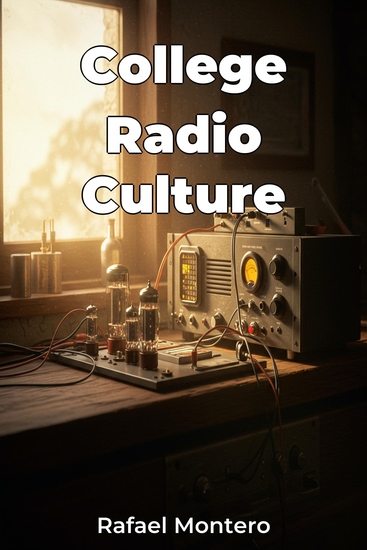
College Radio Culture - cover

College Radio Culture

Rafael Montero

Translator A Ai

Publisher: Publifye

  • 0
  • 0
  • 0

Summary

College Radio Culture explores the vibrant and often overlooked world of college radio, revealing its significant role in shaping the music industry and media landscape. More than just broadcasting, college radio serves as a crucial incubator for independent music, offering a platform for artists marginalized by commercial stations. Interestingly, these stations often operate as tastemakers, introducing influential bands and genres to wider audiences. The book argues that college radio fosters creativity, innovation, and community engagement, standing as a unique cultural phenomenon.

 
The book examines how college radio provides invaluable media training for students, translating into successful careers in broadcasting, journalism, and related fields. It further analyzes the unique social dynamics within these stations, emphasizing the sense of community and DIY ethos. Using archival materials, interviews, and surveys, the book provides a comprehensive look at college radio's impact on media consumption, cultural production, and community formation.

 
By examining college radio, the book sheds light on the challenges and opportunities facing independent media in the digital age.
Available since: 03/31/2025.
Print length: 67 pages.

Other books that might interest you

  • Book Summary and Analysis of Big Dumb Eyes by Nate Bargatze - cover

    Book Summary and Analysis of Big...

    Briefly Summaries

    • 0
    • 0
    • 0
    This is a concise summary and analysis of Big Dumb Eyes, by Nate Bargatze. It is not the original book and is not affiliated with or endorsed by Nate Bargatze. Ideal for those seeking a quick and insightful overview.
     
    Big Dumb Eyes is a sharp, observationally driven comedic exploration of life’s everyday absurdities. Through a collection of anecdotes, reflections, and punchlines, it navigates the strange intersections of modern adulthood, social expectations, and the hilariously mundane. Whether dissecting childhood misunderstandings, irrational fears, or the quirks of relationships and technology, the book offers a disarmingly honest and often self-deprecating look at how bewildering the world can be through a certain set of eyes—big, dumb, and wide open to life’s most ridiculous moments.
    Show book
  • Alex Code Mission (Bengali) - A collection of science fiction stories - cover

    Alex Code Mission (Bengali) - A...

    Pabitra Adhikary

    • 0
    • 0
    • 0
    A collection of science fiction stories
    Show book
  • The Master of Drums - Gene Krupa and the Music He Gave the World - cover

    The Master of Drums - Gene Krupa...

    Elizabeth J. Rosenthal

    • 0
    • 0
    • 0
    From the early 1930s onward, Gene Krupa was a drum-centric rarity in the jazz world. Never before had a drummer been in the forefront as a solo artist. His galvanizing, unrestrained passion for percussion demanded it. Rocking the rafters, Gene thrilled audiences in ballrooms, nightclubs, and movies. 


    Seemingly born jazz-drum crazy in 1909 to a Polish-immigrant working-class family in South Chicago, Gene was a professional by the age of thirteen and soon made his first recordings. By the early 1930s, he was New York City's most in-demand drummer, and in 1934, joined brilliant clarinetist Benny Goodman's band, helped inaugurate the Swing Era, and played the first-ever swing concert at Carnegie Hall. He formed his own band and shattered racial boundaries by sharing the spotlight with the African-American trumpeter Roy Eldridge. But after a skyrocketing ride to the top, Gene experienced a rollercoaster ride of good and bad luck, emotional highs, and devastating depths. 


    In The Master of Drums, biographer Elizabeth J. Rosenthal crafts a celebratory, honest, and exhaustively researched portrait of a twentieth-century music legend. When he died, Gene Krupa may have left behind a world of grieving friends, colleagues, fans, students, and progeny, but as The Master of Drums proves, his dynamic musical and cultural influences live on.
    Show book
  • As you like it - cover

    As you like it

    William Shakespeare

    • 0
    • 0
    • 0
    As You Like It is a pastoral comedy by William Shakespeare believed to have been written in 1599 and first published in the First Folio in 1623. The play's first performance is uncertain, though a performance at Wilton House in 1603 (the house having been a focus for literary activity under Mary Sidney for much of the later 16th century) has been suggested as a possibility. 
    As You Like It follows its heroine Rosalind as she flees persecution in her uncle's court, accompanied by her cousin Celia to find safety and, eventually, love, in the Forest of Arden. In the forest, they encounter a variety of memorable characters, notably the melancholy traveller Jaques, who speaks one of Shakespeare's most famous speeches ("All the world's a stage") and provides a sharp contrast to the other characters in the play, always observing and disputing the hardships of life in the country.
    Show book
  • A Rare Recording of Film Icon Buster Keaton - cover

    A Rare Recording of Film Icon...

    Buster Keaton

    • 0
    • 0
    • 0
    Joseph Frank "Buster" Keaton (October 4, 1895 - February 1, 1966), born in Piqua, Kansas, was an American actor, comedian and filmmaker. He is best known for his silent films during the 1920s, in which he performed physical comedy and inventive stunts. He frequently maintained a stoic, deadpan facial expression that became his trademark and earned him the nickname "The Great Stone Face." In the following recording, from an April 17, 1964 television interview, Keaton reflects on his sixty-year career in show business.
    Show book
  • Art History Romanesque art - cover

    Art History Romanesque art

    Victoria Charles, Klaus H. Carl

    • 0
    • 0
    • 0
    In art history, the term Romanesque art distinguishes the period between the beginning of the 11th and the end of the 12th-century. This era showed a great diversity of regional schools each with their own unique style. In architecture as well as in sculpture, Romanesque art is marked by raw forms. Through its rich iconography and captivating text, this work reclaims the importance of this art which is today often overshadowed by the later Gothic style.
    Show book