Join us on a literary world trip!
Add this book to bookshelf
Grey
Write a new comment Default profile 50px
Grey
Subscribe to read the full book or read the first pages for free!
All characters reduced
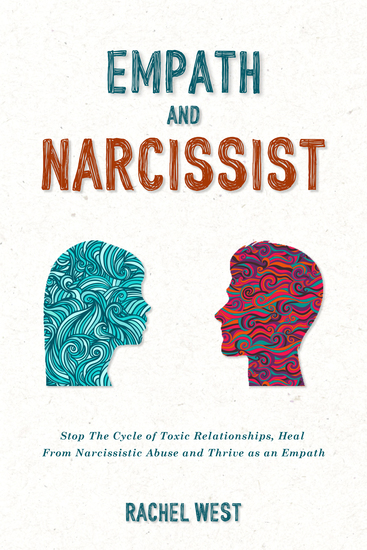
Empath and Narcissist - Stop the Cycle of Toxic Relationships Heal From Narcissistic Abuse and Thrive as a Sensitive Person - cover

Empath and Narcissist - Stop the Cycle of Toxic Relationships Heal From Narcissistic Abuse and Thrive as a Sensitive Person

Rachel West

Publisher: Publishdrive

  • 0
  • 0
  • 0

Summary

Do your relationships leave you feeling drained, unseen, or emotionally manipulated?
 
Many empaths are pulled into deep, confusing dynamics with narcissists—drawn by intense emotion, stuck in cycles of giving too much, and unsure how to break free. This book explores the emotional patterns that fuel these relationships and offers practical guidance to reclaim your power, rebuild your self-worth, and protect your emotional energy.
 
You Might Relate If:
 
- You feel emotionally depleted after every conversation
 
- You often second-guess your feelings or instincts
 
- You tolerate disrespect, hoping for love or validation
 
- You hide parts of yourself to avoid conflict
 
- You’ve noticed patterns of emotional highs and lows
 
- You’ve lost touch with your needs, voice, or joy
 
Imagine for a second, what if you could…
 
- Regain your sense of self-worth and confidence, no longer overshadowed by your partner's needs.
 
- Establish healthy boundaries that protect your emotional well-being.
 
- Understand the dynamics of empath-narcissist relationships and why you're drawn to them.
 
- Heal from the trauma of narcissistic abuse and rebuild a stronger, more resilient you.
 
- Learn to trust your instincts and perceptions again, reclaiming your reality.
 
- Develop strategies to avoid toxic relationships in the future.
 
- Experience the freedom and joy of being in a relationship that nurtures and respects you.
 
- Empower yourself with knowledge and tools to thrive, not just survive, in your relationships.
 
But first, a warning…
 
This book is not a quick fix. It's not for those looking for an easy solution without putting in the work. Healing from narcissistic abuse and breaking free from toxic cycles requires honesty, self-reflection, and a commitment to personal growth. If you're ready to embark on this journey, to face the hard truths and do the necessary work, then this book will guide you towards lasting change and healing.
 
Here's a little sneak preview of what you’ll get:
 
- Understanding Narcissistic Behavior
 
- Why Empaths and Narcissists are Drawn Together
 
- Breaking Free from the Abuse Cycle
 
- Recognizing and Responding to Red Flags
 
- Why You Should Never Ignore Red Flags
 
- The Cost of Remaining in a Toxic Relationship
 
- Differentiating Empathy from Codependency
 
- Strategies to Break Free from Codependent Patterns
 
- Narcissists Claiming To Be Empaths
 
- Setting Boundaries with Narcissists
 
- Life Beyond Narcissistic Influence
 
- The Art of Saying “NO”
 
- Healing from Past Relationship Traumas
 
- Finding Joy and Purpose After Abuse
 
- Trusting and Rebuilding After Toxic Relationships
 
This guide is designed for sensitive individuals who want to understand toxic dynamics and gain tools to grow through them. Whether you're in a difficult relationship or healing from one, you’ll find reflection, clarity, and strategies to protect your peace and emotional future.
 
Reclaim your energy, trust your intuition, and create relationships built on honesty, respect, and balance.
Available since: 06/12/2025.
Print length: 157 pages.

Other books that might interest you

  • The Problem of Democracy - America the Middle East and the Rise and Fall of an Idea - cover

    The Problem of Democracy -...

    Shadi Hamid

    • 0
    • 0
    • 0
    What happens when democracy produces "bad" outcomes? Is democracy good because of its outcomes or despite them? This "democratic dilemma" is one of the most persistent, vexing problems for America abroad, particularly in the Middle East—we want democracy in theory but not necessarily in practice. 


    When Islamist parties rise to power through free elections, the United States has too often been ambivalent or opposed, preferring instead pliable dictators. With this legacy of democratic disrespect in mind, and drawing on new interviews with top American officials, Shadi Hamid explores universal questions of morality, power, and hypocrisy. Why has the United States failed so completely to live up to its own stated ideals in the Arab world? And is it possible for it to change? 


    In The Problem of Democracy, Hamid offers an ambitious reimagining of this ongoing debate and argues for "democratic minimalism" as a path to resolving democratic dilemmas in the Middle East and beyond. In the seemingly eternal tension between democracy and liberalism, recognized by the ancient Greeks and the American founders alike, it may be time to prioritize one over the other, rather than acting as if the two are intertwined when increasingly they are not.
    Show book
  • Roman and Byzantine Armies The: The History of the Militaries in the Western Roman Empire and Eastern Roman Empire - cover

    Roman and Byzantine Armies The:...

    Editors Charles River

    • 0
    • 0
    • 0
    The Roman army is one of the most famous fighting forces in history. Through its power and prowess, a once obscure Italian city forged an empire that encircled the Mediterranean and covered half of Europe. The physical remains of its presence can be traced from the mountainous borders of Scotland to the arid deserts of Egypt, but its legacy is far greater and more enduring, as Rome's influence continues to shape the political, legal, and cultural landscape of Europe to this very day. 
    While the Roman army is rightly famed as an institution, the image of the individual legionary is also an iconic one. The uniformed, disciplined soldier of the late Republic and early Empire is one of the first things many people imagine when they think of Rome. They are the ultimate image of the ancient soldier, their arms and armor instantly recognizable. Their abilities, not only as warriors but also as engineers and administrators, have made them role models for other soldiers through the centuries. In the same vein, their commanders are still celebrated and studied, and generals the world over have tried to emulate the likes of Julius Caesar. 
    The Byzantine Empire was the heir to two great cultures that cradled and nurtured European civilization: Greece and Rome. Constantinople, now called Istanbul, became a center of power, culture, trade, and technology poised on the edges of Europe and Asia, and its influence was felt not only throughout Europe but the Middle East, Africa, Central Asia, and the Far East. In reality, Byzantium was a strong, organized, highly effective and adaptable civilization for most of its long history. It owed its success in no small part to its military, which, in contrast to the feudal armies of Western Europe and the tribally based forces of the Middle East, operated with a high level of discipline, strategic prowess, efficiency, and organization.
    Show book
  • Holocaust - World War 2 History of Its Causes and Consequences - cover

    Holocaust - World War 2 History...

    Kelly Mass

    • 0
    • 0
    • 0
    Most people know what the Holocaust was. They have at least a vague image of what transpired in Europe during the 1940s. Still, the details may be blurry. So, let’s take a look at history and the events that shocked the world. And even though this was clearly not the first genocide in the world, it was one of particular proportions and scale, and therefore noteworthy. 
    At the time of The Second World War, the Holocaust, also referred to as the Shoah, was a genocide of European Jews. Between 1941 and 1945, Nazi Germany and its allies killed around 6 million Jews in German-occupied Europe, representing about two-thirds of Europe's Jewish population. The killings happened in pogroms and mass shootings, and also through a technique of extermination by labor in prisoner-of-war camp and in gas chambers and gas vans in German extermination camps, mostly Auschwitz-Birkenau, Majdanek, Sobibór, Beec, Chemno, and Treblinka in occupied Poland. 
    The Holocaust is one of those things that people remember as something they want to “never again” happen to humanity. Let’s hope that they can hold up to this ideal. Either way, let’s dive into the past and explore what led up to it, the magnitude of the murders and the methods the Nazis used.
    Show book
  • The Nazi Escape - How Catholic Clergy Intelligence Agencies and Perón's Regime Helped the Third Reich Survive - cover

    The Nazi Escape - How Catholic...

    Davis Truman

    • 0
    • 0
    • 0
    This audiobook is narrated by an AI Voice.   
    What if the fall of Hitler was only the beginning? 
    In The Nazi Escape, uncover the shocking, meticulously researched story of how a secretive global alliance, spanning Vatican corridors, Allied intelligence networks, and Argentina’s highest political ranks, engineered one of history’s most chilling cover-ups. With the Third Reich in ruins, elite Nazi war criminals vanished without a trace. But they didn’t disappear... they were helped. 
    This gripping exposé reveals how Catholic clergy operated covert escape routes known as “ratlines,” how Western intelligence agencies turned a blind eye, or lent a hand, and how Juan Perón’s Argentina became a haven for some of the most notorious figures of World War II. 
    From shadowy monasteries in Rome to the pampas of South America, The Nazi Escape reads like a thriller, but every word is true. Packed with declassified documents, firsthand accounts, and shocking revelations, this is the untold story the world wasn’t supposed to know.
    Show book
  • History of the Caribbean: A Captivating Guide to Caribbean History Starting from Christopher Columbus through the Wars of Religion Slavery and Colonial Laws to the Present - cover

    History of the Caribbean: A...

    Captivating History

    • 0
    • 0
    • 0
    Almost everyone knows The Bahamas and Jamaica are in the Caribbean. But what do you really know about those countries? 
    The history of the Caribbean is an exciting ride, but few outside of the region know much about it in depth beyond Columbus’s discovery. This audiobook will lead you through the history of the region, which witnessed some of the world’s most important events. We will begin with Christopher Columbus’s accidental discovery and the race for control over the islands of the Caribbean. 
    The land grabs led to war and colonization, making this once-peaceful region a more violent place. In time, most of the Caribbean islands pushed back, declaring independence. But did that make things better for these island nations? Or is there still much work to be done? 
    If you are curious about learning the answers to these questions and more about the exciting history of this beautiful region, keep listening. This audiobook has a ton of interesting information, including: 
    What happened when Christopher Columbus discovered the Caribbean and the chain of events that happened afterward;The pirates who made their living in the Caribbean region and Central AmericaHow mainland Europe had an effect on the Caribbean colonies, with a closer look at the wars of religion, the American and French Revolutions, and the Napoleonic WarsWhat happened when Caribbean nations yearned to break free from their colonial powers to become independentThe United States’ involvement in the Caribbean, including the Spanish-American WarThe dictatorships in some of the Caribbean nations that left behind brutality and financial ruinThe struggles the Caribbean is facing today and what its future might look like 
    So, what are you waiting for? Scroll up and click the “add to cart” button to begin your journey of the Caribbean’s past today!
    Show book
  • Communication Craft - Simple Ways To Improve Your Personal and Professional Relationships - cover

    Communication Craft - Simple...

    Christian Gilbert

    • 0
    • 0
    • 0
    You do not have to be born a great communicator to be a great communicator. Communication skills are learned. Learn some of the most useful lessons from research to improve your close relationships, group interactions, and your public speaking skills. 
    Topics include 
    - What causes misunderstanding? 
    - How does misunderstanding spread? 
    - What makes people attracted to each other? 
    - How can you maintain a happy relationship? 
    - How can you predict divorce? 
    - How do you prevent breakups? 
    - What kinds of lies do people tell? 
    - How might you detect lies? 
    - How do you read body language? 
    - Why do some controversies get so heated? 
    - How can you keep happy relationships despite deep disagreements? 
    - What causes presentation stage fright? 
    - How do you start a presentation strong? 
    - How do you sound credible to an audience? 
    - What should you say to end a presentation? 
    - How do you become a confident speaker? 
    And much more!
    Show book