Rejoignez-nous pour un voyage dans le monde des livres!
Ajouter ce livre à l'électronique
Grey
Ecrivez un nouveau commentaire Default profile 50px
Grey
Abonnez-vous pour lire le livre complet ou lisez les premières pages gratuitement!
All characters reduced
You'll Never Be Anyone Else - cover

You'll Never Be Anyone Else

Rachael Clyne

Maison d'édition: Seren

  • 0
  • 0
  • 0

Synopsis

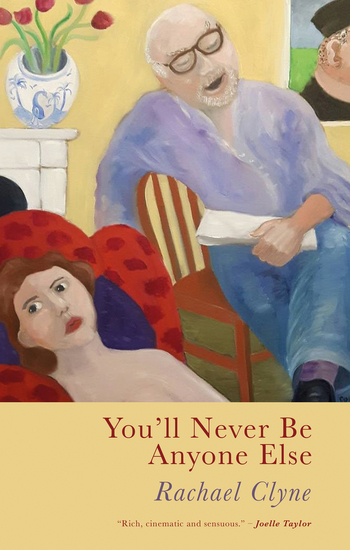
Rachael Clyne's You'll Never Be Anyone Else presents a direct and assured voice, demanding that we think carefully about what it takes to reconcile being different. She advises the reader to 'Stop drinking the poison / labelled "Hate me." / It's that simple. I didn't say easy.' Clyne also has an alter-ego "Girl Golem" reminiscent of a superhero but based on the mythical man made from clay and spells to protect Jewish people from persecution. Through this empowering persona, Clyne opens up an exploration of Jewish and lesbian identity. Surveying attitudes in the present day and in the past, these poems explore migrant heritage, sexual identity, domestic violence and ageing.
The stories of this collection are often poignant, like the retired tailor in 'Mr Shopping Trolley', who takes to shearing newspapers, so that his scissor fingers remain busy. Or in 'Leaving Odesa', the speaker revisits the prison where – under Tsarist law – her grandmother (even as an infant) had to serve out the remainder of her father's sentence after he died.Clyne's imagery is razor sharp in its precision, as she deftly weaves different poetic forms and wildly versatile subject matter, even interspersing Yiddish phrases, as part of her own unique poetic idiolect. Take the hilarious poem, 'Jew-a-lingo (Code-switching for Jews 1970 edition)' which emphasizes Jewish humour as a staple survival strategy. You'll Never Be Anyone Else offers a unique story of survival and empowerment told in spite of experiences of violence and prejudice – this from a poet who has spent a lifetime learning self-acceptance and as a psychotherapist helping others to do similar.  Treating even dark subjects with playful wit and colourful imagery, Clyne is a distinctive new voice with a powerful message about self-acceptance.
"Rich, cinematic and sensuous." – Joelle Taylor
'With its impressive scope, ranging from the Holocaust, nuclear fallout, and immigration to domestic life and childhood, Rachael Clyne's Girl Golem thoughtfully explores our tactics for survival: in resistance, in the imagination, in mutual care. In these evocative, spirited poems, Clyne implicitly argues for faith in our own humanity and for the richness of difference.' - Carrie Etter
'Rachael Clyne's poetry, full of physicality and dramatic openness, accumulates a series of tensions within her Sixties free spirited identity and Jewish heritage. Attentive to narrative angle and migrant experience, she allows characters to emerge over generations showing how they mould into a new cultural identity. In its quiet and carefully crafted ways, Girl Golem shows the sweep of history and the importance of a tolerant county that offers salvation to those persecuted abroad.' - David Caddy
'Clyne's poems inhabit a shadowy and uncomfortable space where all is not as it seems – people become pieces of furniture and rooms have sinister personalities. A complex work of many layers – these thought provoking and deftly crafted poems are a playful and powerful examination of identity, sexuality, heritage and family dynamic. Clyne skilfully conveys a sense of disquiet and alienation, a sense of being other, both within the dysfunctions of the family, but also within the context of the wider world.' - Julia Webb
Rachael Clyne is a psychotherapist from Glastonbury. Her prizewinning collection Singing at the Bone Tree (Indigo Dreams) concerns human beings' relationship with nature, and she is a climate activist. Her pamphlet Girl Golem (4word) concerns her migrant background and sense of otherness. A frequent reader at poetry events and festivals, she has been published in magazines like Shearsman, The Rialto, and The Interpreter's House. 
Disponible depuis: 24/04/2023.
Longueur d'impression: 72 pages.
D'autres livres qui pourraient vous intéresser

  • A Rare Recording of William Morris Meredith Jr Reading His Own Poems - cover

    A Rare Recording of William...

    William Morris Meredith Jr.

    • 0
    • 0
    • 0
    William Morris Meredith Jr. (January 9, 1919 - May 30, 2007), born in New York City, was an American poet and educator. He was Poet Laureate Consultant in Poetry to the Library of Congress from 1978 to 1980, and the recipient of the 1988 Pulitzer Prize for Poetry. In the following recordings Mederdith reads his poems "The Wreck of the Thresher," "Parents From The Cheer," "The Illiterate," and "Crossing Over."
    Voir livre
  • The Snail House (NHB Modern Plays) - cover

    The Snail House (NHB Modern Plays)

    Richard Eyre

    • 0
    • 0
    • 0
    Sir Neil Marriot had a 'good pandemic', becoming familiar to millions from his TV appearances as a government medical advisor. His service even earned him a knighthood, and he is now rewarding himself with a lavish birthday party.
    But, amidst the oak panelling, the champagne and the silver service, his family are at one another's throats again, and he thinks there's something familiar – and somehow unsettling – about one of the catering staff...
    The Snail House is a play about how the past impacts on the present, and how overconfidence can have disastrous consequences. Written and directed by Richard Eyre, it premiered at Hampstead Theatre, London, in September 2022.
    Voir livre
  • Erebus - cover

    Erebus

    Elizabeth Lewis Williams

    • 0
    • 0
    • 0
    In 1958, geophysicist A. G. Lewis travelled to the Antarctic to investigate the landscapes and skies of that vast and icy continent.
    Now Elizabeth Lewis Williams traces her father's journeys, from the Peninsula to Mt Erebus. They are real, imagined, and artistic journeys, exploring communication across time and space, and experiments in scientific and poetic measure.
    Erebus transports us to an Antarctic of paradox. A land where perpetual daylight balances months of austral darkness. A land of encounters with the unknown, and with mortality – but where camaraderie and faith are the only defence against catastrophe.
    At its heart, Erebus is a visit to the frozen underworld, and an exploration of how we find a place for ourselves in this vast and often unforgiving world we call home.
    Voir livre
  • The Slave Trade A Poem - Hugely influential activist and social reform poem - cover

    The Slave Trade A Poem - Hugely...

    Hannah More

    • 0
    • 0
    • 0
    Hannah More was born on February 2nd, 1745 at Fishponds in the parish of Stapleton, near Bristol. She was the fourth of five daughters. 
    The City of Bristol, at that time, was a centre for slave-trading and Hannah would, over time, become one of its staunchest critics.  
    She was keen to learn, possessed a sharp intellect and was assiduous in studying.  Hannah first wrote in 1762 with The Search after Happiness (by the mid-1780s some 10,000 copies had been sold). 
    In 1767 Hannah became engaged to William Turner.  After six years, with no wedding in sight, the engagement was broken off.  Turner then bestowed upon her an annual annuity of £200.  This was enough to meet her needs and set her free to pursue a literary career.   
    Her first play, The Inflexible Captive, was staged at Bath in 1775. The famous David Garrick himself produced her next play, Percy, in 1777 as well as writing both the Prologue and Epilogue for it.  It was a great success when performed at Covent Garden in December of that year.  
    Hannah turned to religious writing with Sacred Dramas in 1782; it rapidly ran through nineteen editions. These and the poems Bas-Bleu and Florio (1786) mark her gradual transition to a more serious and considered view of life. 
    Hannah contributed much to the newly-founded Abolition Society including, in February 1788, her publication of Slavery, a Poem recognised as one of the most important of the abolition period.   
    Her work now became more evangelical.  In the 1790s she wrote several Cheap Repository Tracts which covered moral, religious and political topics and were both for sale or distributed to literate poor people.  The most famous is, perhaps, The Shepherd of Salisbury Plain, describing a family of incredible frugality and contentment. Two million copies of these were circulated, in one year. 
    In 1789, she purchased a small house at Cowslip Green in Somerset. She was instrumental in setting up twelve schools in the area by 1800. 
    She continued to oppose slavery throughout her life, but at the time of the Abolition Bill of 1807, her health did not permit her to take as active a role in the movement as she had done in the late 1780s, although she maintained a correspondence with Wilberforce and others.  
    In July 1833, the Bill to abolish slavery throughout the British Empire passed in the House of Commons, followed by the House of Lords on August 1st. 
    Hannah More died on September 7th, 1833.
    Voir livre
  • Poetry Book Society Summer 2025 Bulletin - cover

    Poetry Book Society Summer 2025...

    Alice Kate Mullen

    • 0
    • 0
    • 0
    The Poetry Book Society Bulletin is your beautifully designed quarterly guide to the most essential new poetry from the UK and Ireland. Curated by expert poet-selectors, each issue features exclusive poems, illuminating commentary from leading poets, and insightful reviews of our prestigious PBS Selections: an accolade marking the very best in contemporary poetry. Founded by T. S. Eliot, the PBS remains a trusted compass for readers, writers, and booksellers navigating today's vibrant poetry landscape. A must-have for anyone passionate about poetry, this issue features Fiona Benson, Isabelle Baafi, Pascale Petit and more.
    Voir livre
  • The Crocodile - cover

    The Crocodile

    Fyodor Dostoyevsky

    • 0
    • 0
    • 0
    Ivan Matveich, the most ordinary person you might hope to meet, is swallowed alive by a crocodile at a sideshow. Finding life inside the belly of the beast quite comfortable, he makes a home for himself there. His disquisitions on the state of the world from inside the crocodile make him quite a name for himself; while all the while the discussion rages outside as to whether the beast is going to be cut open to release him or not, its value as a sideshow attraction having massively increased owing to the presence of the human voice buried inside it. One of Jorge Luis Borges' seven most favourite stories
    Voir livre