Join us on a literary world trip!
Add this book to bookshelf
Grey
Write a new comment Default profile 50px
Grey
Subscribe to read the full book or read the first pages for free!
All characters reduced
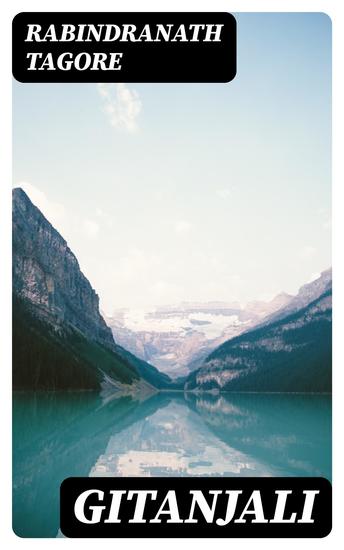
Gitanjali - Including "Fruit-Gathering" - cover

Gitanjali - Including "Fruit-Gathering"

Rabindranath Tagore

Translator Rabindranath Tagore

Publisher: DigiCat

  • 0
  • 0
  • 0

Summary

Rabindranath Tagore's seminal work, "Gitanjali," is a profound collection of poems that explore the deep interconnections between the human soul and the divine. Written in a lyrical style, the verses are infused with a rich tapestry of metaphors and contemplative imagery, reflecting Tagore's philosophical inquiries into spirituality, love, and nature. The literary context of "Gitanjali" positions it within the broader landscape of Bengali literature, marking a significant transition towards modern literary expression, as it oscillates between traditional forms and innovative narratives, inviting readers into a meditative dialogue with the self and the cosmos. Rabindranath Tagore, the first non-European Nobel laureate in literature, draws heavily from his experiences growing up in a culturally vibrant household steeped in artistic tradition. His exposure to the philosophical teachings of the Upanishads and a commitment to the socio-political landscape of India shaped his worldview, leading to the creation of "Gitanjali". This work served not only as a literary masterpiece but also as a call for spiritual awakening amidst the tumult of colonialism. "Gitanjali" is highly recommended for readers seeking to delve into the depths of human experience and the quest for transcendence. Whether an avid poetry enthusiast or a curious newcomer, Tagore's evocative language and profound insights promise to resonate, offering a transformative appreciation of life's beauty and its intricate relationship with divinity.
Available since: 11/13/2022.
Print length: 214 pages.

Other books that might interest you

  • The Raven - cover

    The Raven

    Edgar Allan Poe

    • 0
    • 0
    • 0
    “Leave my loneliness unbroken!—quit the bust above my door! 
    Take thy beak from out my heart, and take thy form from off my door!” 
    Quoth the Raven “Nevermore.” 
      
    Nevermore…Nevermore…Nevermore. Ever since Edgar Allen Poe penned those words to paper in 1845, the infamous response of the raven has continued to echo throughout history. The poem has become so familiar that we know it in our bones. From the memorable opening line—Once upon a midnight dreary—Poe paints a bleak scene that swiftly catapults us to the depths of heartbreak and grief. 
      
    This edition opens with commentary from the great critic Edmund C. Stedman. His insights will satisfy students, scholars, and poetry enthusiasts looking to deepen their understanding of this profound piece of literature. 
      
    Poe’s written masterpiece truly comes alive in this audio performance. Experience the musical quality, heart-pounding rhythm, and haunting notes as never before. Nevermore…Nevermore…Nevermore.
    Show book
  • Rhyme A Dozen A - England - 12 Poets 12 Poems 1 Topic - cover

    Rhyme A Dozen A - England - 12...

    William Blake, Robert Browning,...

    • 0
    • 0
    • 0
    ‘A dime a dozen’ as known in America, is perhaps equal to the English ‘cheap as chips’ but whatever the lingua franca of your choice in this series we hereby submit ‘A Rhyme a Dozen’ as 12 poems on many given subjects that are a well-rounded gathering, maybe even an essential guide, from the knowing pens of classic poets and their beautifully spoken verse to the comfort of your ears. 
     
    1 - A Rhyme A Dozen - 12 Poems, 12 Poets, 1 Topic - England - An Introduction 
    2 - Jerusalem by William Blake 
    3 - Home Thoughts From Abroad by Robert Browning 
    4 - The Lambs of Grassmere by Christina Georgina Rossetti 
    5 - Happy Is England by John Keats 
    6 - This England (from Richard II) by William Shakespeare 
    7 - Daffodils by William Wordsworth 
    8 - Lines Written Beneath An Elm in the Churchyard of Harrow On The Hill Sept 2nd 1807 by George Gordon Byron 
    9 - Beachey Head by Charlotte Smith 
    10 - A Shropshire Lad XXXI - On Wenlock Edge the Wood's in Trouble by A E  Housman 
    11 - London After The Great Fire 1666 by John Dryden 
    12 - The Lament of Swordy Well by John Clare 
    13 - A Song - Men of England by Percy Bysshe Shelley
    Show book
  • Decade of the Brain: Poems - cover

    Decade of the Brain: Poems

    Janine Joseph

    • 0
    • 0
    • 0
    In the deeply personal Decade of the Brain, Janine Joseph writes of a newly-naturalized American citizen who suffers from post-concussive memory loss after a major auto accident.The collection is an odyssey of what it means to recover—physically and mentally—in the aftermath of trauma and traumatic brain injury, charting when “before” crosses into “after.” Through connected poems, buckling and expansive syntax, ekphrasis, and conjoined poetic forms, Decade of the Brain remembers and misremembers hospital visits, violence and bodily injury, intimate memories, immigration status, family members, and the self.  
    After the accident I turned outall of the lights in the room while I watched, 
    concussed, from the mirror. I edged like a feverwith nothing on the tip of my tongue.
    Show book
  • Dracula - cover

    Dracula

    Bram Stoker

    • 0
    • 0
    • 0
    Dracula is a novel by Bram Stoker, published in 1897. It is an epistolary novel with no single protagonist. The narrative is related through letters, diary entries, and newspaper articles. 
    It was mostly written in the 1890s and drew extensively from Transylvanian folklore and history. Some scholars have suggested that the character of Dracula was inspired by historical figures like the Wallachian prince Vlad the Impaler or the countess Elizabeth Báthory, but there is widespread disagreement. Stoker's notes mention neither figure. He found the name Dracula in Whitby's public library while on holiday, thinking it meant devil in Romanian. 
    Dracula is one of the most famous pieces of English literature. Many of the book's characters have entered popular culture as archetypal versions of their characters; for example, Count Dracula as the quintessential vampire, and Abraham Van Helsing as an iconic vampire hunter. The novel, which is in the public domain, has been adapted for film over 30 times, and its characters have made numerous appearances in virtually all media.
    Show book
  • Bessie Dunlop the Witch o Dalry - cover

    Bessie Dunlop the Witch o Dalry

    John Hodgart

    • 0
    • 0
    • 0
    Based on the historical record of Bessie’s ‘confession’ to witchcraft in sixteenth-century Scotland, the episodic structure of the play shows the many characters and events that supposedly made up the catalogue of her crimes, but which in fact testify to her innocence and goodness. Bessie Dunlop, the Witch o Dalry introduces students to different levels and varieties of Scots and English and contains teaching notes, suggestions for classroom activities, and questions for discussion or writing. The original version of Bessie Dunlop, the Witch o Dalry was written by John Hodgart and Martin Clarke in 1977. Hodgart rewrote the play for an EIS Drama competition before revising it again for Hodder and Staunton who published it as a school text in 1995. This 2021 shorter edition is the fourth version of the play.
    Show book
  • The Aeneid - Revised and Expanded Edition - cover

    The Aeneid - Revised and...

    Vergil

    • 0
    • 0
    • 0
    A powerful and poignant translation of Vergil’s epic poem, newly equipped with introduction and notes 
     
    "Ruden set the bar for Aeneid translations in 2008, and has raised it now with this revision. I am confident it will be a long time before a translator exceeds the standard that she has set."—A.M. Juster, Athenaeum Review 
     
    This is a substantial revision of Sarah Ruden’s celebrated 2008 translation of Vergil’s Aeneid, which was acclaimed by Garry Wills as “the first translation since Dryden’s that can be read as a great English poem in itself.” Ruden’s line-for-line translation in iambic pentameter is an astonishing feat, unique among modern translations. Her revisions to the translation render the poetry more spare and muscular than her previous version and capture even more closely the essence of Vergil’s poem, which pits national destiny against the fates of individuals, and which resonates deeply in our own time. 
     
    This distinguished translation, now equipped with introduction, notes, and glossary by leading Vergil scholar Susanna Braund, allows modern readers to experience for themselves the timeless power of Vergil’s masterpiece. 
     
    Praise for the First Edition: 
     
    “Fast, clean, and clear, sometimes terribly clever, and often strikingly beautiful. . . . Many human achievements deserve our praise, and this excellent translation is certainly one of them.”—Richard Garner, The New Criterion 
     
    “Toning down the magniloquence, Sarah Ruden gives us an Aeneid more intimate in tone and soberer in measure than we are used to—a gift for which many will be grateful.”—J. M. Coetzee 
     
    “An intimate rendering of great emotional force and purity. . . . The immediacy, beauty, and timelessness of the original Latin masterpiece lift off these pages with gem-like originality.”—Choice
    Show book