Begleiten Sie uns auf eine literarische Weltreise!
Buch zum Bücherregal hinzufügen
Grey
Einen neuen Kommentar schreiben Default profile 50px
Grey
Jetzt das ganze Buch im Abo oder die ersten Seiten gratis lesen!
All characters reduced
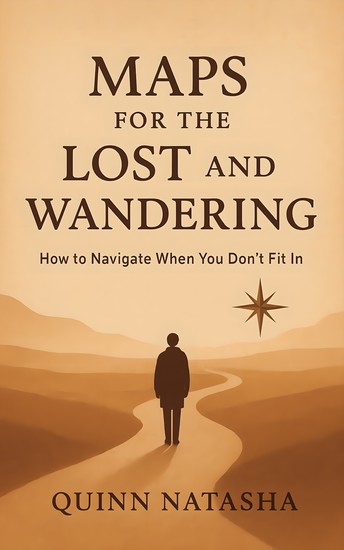
Maps for the Lost and Wandering - How to Navigate When You Don’t Fit In - cover

Maps for the Lost and Wandering - How to Navigate When You Don’t Fit In

Quinn Natasha

Verlag: Publishdrive

  • 0
  • 0
  • 0

Beschreibung

Maps for the Lost and Wandering is a heartfelt and unfiltered exploration of what it means to feel like an outsider in a world that often demands conformity. Through raw personal stories, reflections, and practical exercises, Quinn Natasha offers a compassionate, messy field guide for those who’ve ever felt invisible, out of place, or disconnected. This book rejects the idea of “fixing” yourself to fit in, instead celebrating the unique strengths, creativity, and perspective that come from living on the edges. Ideal for readers navigating social anxiety, loneliness, or the search for belonging, it’s a powerful reminder that you’re not alone—and your story is enough.
Verfügbar seit: 02.09.2025.
Drucklänge: 95 Seiten.

Weitere Bücher, die Sie mögen werden

  • Medieval History of Montenegro The: The History of the Region’s Rulers and Culture Before the Modern Era - cover

    Medieval History of Montenegro...

    Editors Charles River

    • 0
    • 0
    • 0
    Much has been written about Western intervention during the breakup of Yugoslavia, and whether it made matters worse, prevented worse atrocities, or was simply ineffective. In early 1992, however, what was clear was that Europe was hopelessly divided over the best course of action to take towards Yugoslavia, and after several years of fighting, the Bosnian War was one of the most violent conflagrations in Europe since the end of World War II.  
    	That war had been the byproduct of centuries of tensions in the Balkans, and an attempt in the wake of World War I to redraw the political boundaries of Europe and the Middle East. That included forming the Kingdom of Yugoslavia, initially known as the Kingdom of Serbs, Croats and Slovenes, a particularly fragile enterprise, and there was almost constant tension between the majority Serbs and the other Yugoslav nationalities, especially the Croats. As a result, the Kingdom was a land of political assassinations, underground terrorist organizations, and ethnic animosities. In 1929, King Alexander I suspended democracy and ruled as a dictator until he himself was assassinated in 1934.  
    	Depending on the source, many authors have focused on different catalysts for Yugoslavia’s demise, but Vesna Drapac may have succinctly summed the situation up when he wrote that by the end, the state “lacked a reason to exist.” There is certainly something in this sentiment, but the disintegration came at an enormous cost. 
    	Given what happened in Yugoslavia, it should be little surprise the area that eventually became the modern nation of Montenegro has had a turbulent history for millennia, with shifting borders, different degrees of autonomy, and various conflicts occurring within it.  
    	  
      
    Zum Buch
  • Mind Mood and Memory - The Neurobehavioral Consequences of Multiple Sclerosis - cover

    Mind Mood and Memory - The...

    Anthony Feinstein

    • 0
    • 0
    • 0
    Endorsed by The Consortium of Multiple Sclerosis Centers
    Multiple sclerosis (MS), a progressive neurologic disease, is characterized by a host of physical symptoms. But the neurobehavioral consequences of MS can be as devastating and debilitating as physical symptoms, and they are often unreported and undertreated. In this new book, Dr. Anthony Feinstein, a neuropsychiatrist, documents the effects of MS on cognition, information processing speed, learning and memory, executive function, personality, mood, and behavior.
    Feinstein touches on a number of topics, including
    •    the common cognitive challenges that occur with MS, such as slowed information processing speed, impaired memory, and executive function deficits 
    •    psychiatric disorders that accompany MS, such as depression and psychosis
    •    current neuropsychological, brain MRI, and treatment data applicable to the psychiatric and cognitive disorders
    Mind, Mood, and Memory in Multiple Sclerosis is enhanced both by the latest science and by eloquent case histories that illustrate each cognitive and emotional disorder. Feinstein also provides recommendations for evidence-based therapeutic interventions. Written in an immediate, accessible way, this book has a crossover appeal, making it of interest not only to neurologists, psychiatrists, neuropsychiatrists, neuropsychologists, psychologists, occupational therapists, and nurses but also to people with MS and their caregivers, family, and friends.
    Zum Buch
  • Uncle Tom's Cabin Volume 1 - cover

    Uncle Tom's Cabin Volume 1

    Harriet Beecher Stowe

    • 0
    • 0
    • 0
    In Uncle Tom’s Cabin Volume 1, Harriet Beecher Stowe introduces readers to the harsh realities of slavery through the lives of its characters. The story begins with the sale of Uncle Tom and Harry, a young boy, by their owner, Mr. Shelby, to settle debts. As Tom embarks on a journey southward with the cruel slave trader Haley, readers witness the cruelty and compassion that shape his fate. Meanwhile, Eliza, Harry’s mother, makes a daring escape to protect her child. Through vivid portrayals of suffering and resilience, Stowe exposes the moral injustices of slavery, setting the stage for a powerful exploration of humanity, faith, and freedom.
    Zum Buch
  • Orwell's Ghosts - Wisdom and Warnings for the Twenty-First Century - cover

    Orwell's Ghosts - Wisdom and...

    Laura Beers

    • 0
    • 0
    • 0
    For the seventy-fifth anniversary of 1984, Laura Beers explores George Orwell's still-radical ideas and why they are critical today. 


    George Orwell devoted his career to exposing social injustice and political duplicity, urging his readers to face hard truths about Western society and politics. Now, the uncanny parallels between the interwar era and our own—rising inequality, censorship, and challenges to traditional social hierarchies—make his writing even more of the moment. In Orwell's Ghosts, historian Laura Beers considers Orwell's full body of work—his six novels, three nonfiction works, as well as his brilliant essays—to examine what "Orwellian" means and to take it out of the hands of political pundits. She explores how Orwell's writing on free speech addresses the proliferation of "fake news," highlights his vivid critiques of capitalism, and, in contrast, analyzes his failure to understand feminism. Timely, wide-ranging, and thought-provoking, Orwell's Ghosts investigates how the writings of a lionized champion of truth and freedom can help us face the crises of modernity.
    Zum Buch
  • Stories from Kathasaritasagara series -1 - From Various sources - cover

    Stories from Kathasaritasagara...

    Anusha HS

    • 0
    • 0
    • 0
    The book Kathasaritsagara has been created by Soma Deva. It consists of 21,500 shlokas. 
     This book Kathasaritsagara has been divided into 18 lambakaas, and those 18 lambakaas are still more divided into 125 Tharanga's. 
     Some lambakaas are very big, while some are very small. 
     If there are 115 Shlokas in the 11th Lambaka, there are around 4925 Shlokas in 12th Lambaka. 
     During ancient times from the mouth of Lord Shiva, this story got birth. Those who listen to this story will experience all sorts of worldly pleasures. They will be blessed by Lord Shiva and at last reach jnana Loka by the blessings of lord shiva.
    Zum Buch
  • All Along the Watchtower - Murder at Fort Devens - cover

    All Along the Watchtower -...

    William J. Craig

    • 0
    • 0
    • 0
    The controversy around the case of a former Green Beret’s murder of his wife shows the lengths the government will go to to keep its secrets hidden. It was a dreary winter afternoon in Ayer, Massachusetts, a quintessential New England town, the type which is romanticized in Robert Frost’s poems. But on January 30, 1979, a woman’s scream was heard piercing the northeast tempest wind. In an unassuming apartment building on Washington Street, Elaine Tyree, a mother, wife, and US Army soldier, had her life brutally ripped from her. Her husband, William Tyree, a Special Forces soldier, was convicted of this heinous murder, which he has always vehemently denied. Some elements of this case seem to be chilling echoes of the Jeffrey MacDonald case, made famous in the book and film Fatal Vision. A military doctor and US Army Captain, MacDonald was convicted of murdering his pregnant wife and two daughters but always maintained his innocence. As in the MacDonald case, the case against William Tyree raises questions as to whether the government and military suppressed evidence that could prove his innocence. The Tyree case sent a shockwave through the idyllic community of Ayer, the United States Army, and the judicial system of Massachusetts. This case provoked suspicions of judicial misconduct, government cover-up, clandestine Black Ops by the military, and various conspiracy theories ultimately implicating “Deep State” involvement. The events that took place that fateful day, the subsequent courtroom showdown, and the ongoing legal battles raise provocative questions that continue to revolve around this case to this day.
    Zum Buch