Begleiten Sie uns auf eine literarische Weltreise!
Buch zum Bücherregal hinzufügen
Grey
Einen neuen Kommentar schreiben Default profile 50px
Grey
Jetzt das ganze Buch im Abo oder die ersten Seiten gratis lesen!
All characters reduced
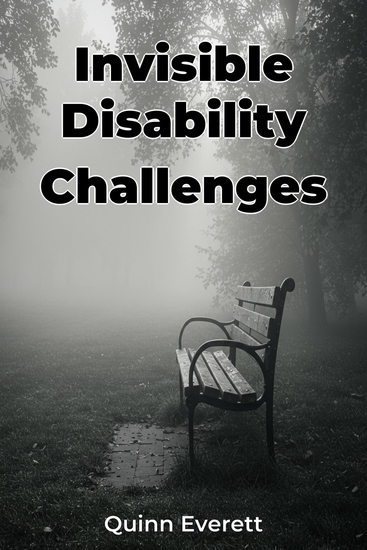
Invisible Disability Challenges - cover

Invisible Disability Challenges

Quinn Everett

Übersetzer A AI

Verlag: Publifye

  • 0
  • 0
  • 0

Beschreibung

Invisible Disability Challenges addresses the widespread lack of understanding surrounding non-apparent disabilities like chronic fatigue and anxiety disorders, and how this impacts individuals in both their personal and professional lives. It sheds light on the unique hurdles faced by those whose conditions aren't immediately obvious, often leading to career setbacks and strained relationships.

 
The book emphasizes that societal and workplace structures are frequently ill-equipped to support these individuals, resulting in significant challenges to their psychological well-being. Readers will find it intriguing to learn that misconceptions and biases often lead to judgment and a failure to provide necessary accommodations, further compounding the difficulties faced by those with invisible disabilities.

 
This book takes a solution-oriented approach, blending empirical research, personal narratives, and case studies to present a comprehensive view. It progresses from introducing the range of invisible disabilities and their impact, to exploring the psychological and social experiences of those living with these conditions, and finally, offering actionable strategies for individuals, employers, and policymakers.

 
A key focus is on practical guidance for advocating for needs and creating inclusive environments, making it a valuable resource for individuals with invisible disabilities, employers, and anyone interested in fostering greater understanding and inclusion.
Verfügbar seit: 05.05.2025.
Drucklänge: 88 Seiten.

Weitere Bücher, die Sie mögen werden

  • The Compulsive Reassurance Seeking Workbook - CBT Skills to Help You Live with Confidence and Break the Cycle of Obsessive-Compulsive Disorder - cover

    The Compulsive Reassurance...

    LCPC Amanda Petrik-Gardner, LCSW...

    • 0
    • 0
    • 0
    Are you constantly seeking reassurance from others? Do you suffer from debilitating anxiety if you aren't absolutely certain about everything? Seeking reassurance to remove doubt or fear is natural, and we all do it from time to time. However, it becomes a compulsion when it develops into something repetitive and ritualistic. This compulsion is linked to obsessive-compulsive disorder (OCD), can perpetuate and worsen this condition, and can also create conflict between you, your friends, coworkers, and loved ones. So, how do you stop? 


    The Compulsive Reassurance Seeking Workbook offers proven-effective tools to reduce compulsions, make peace with uncertainty, and better manage your OCD. Grounded in cognitive behavioral therapy (CBT), an evidence-based treatment for OCD, this workbook reveals how reassurance seeking can interfere with your relationships, and provides healthy coping strategies you can use to reassure yourself—without resorting to compulsive questioning. 


    Compulsive reassurance seeking can be exhausting, and more often than not, exposes you and those closest to you to increased levels of conflict, stress, and anxiety. It's time to reassure yourself the right way—a way that encourages and empowers you to seek genuine well-being, self-worth, and peace of mind from within. This workbook can help you get started today.
    Zum Buch
  • Dragonslayers - Six Presidents and Their War with the Swamp - cover

    Dragonslayers - Six Presidents...

    Larry Schweikart

    • 0
    • 0
    • 0
    The Swamp has been around for over 150 years, and six major presidents have tried to drain it with varying degrees of success. 
     
    Donald Trump promised to “Drain the Swamp,” by which he originally meant lobbyists. When he got in, he found an entirely different Swamp—a Deep State that had grown, layer upon layer, within the government. But he wasn’t the first to encounter entrenched Swamp opposition. Abraham Lincoln had to battle the  
    “Slave Power Conspiracy”; Grover Cleveland was the most successful of three presidents to fight the spoils Swamp. Theodore Roosevelt found a new iteration of the Swamp awaiting him: Trusts. After World War II, John F. Kennedy discovered that he had little control over the Central Intelligence Agency, and even found he  
    needed the CIA for his own purposes. Despite promising to shrink the bureaucracy Swamp, Ronald Reagan found himself helpless to even make a dent in it. And Trump soon learned that the Deep State could ensure no one ever brought any of its own to justice. Dragonslayers explains why these Swamps exist, and why they were—and remain—so hard to defeat.
    Zum Buch
  • The human body and its functions - cover

    The human body and its functions

    KidsChoice

    • 0
    • 0
    • 0
    KidsChoice: World knowledge for Children is an engaging audiobook series that takes young listeners on a fascinating journey to explore and understand the world around them. Aimed at curious children aged 7 to 99, this series dives into a variety of topics in science, society, and culture, making complex ideas accessible and exciting.  Each episode brings a unique theme to life—whether exploring the mysteries of space, uncovering the secrets of the human body, or discovering the diversity of cultures and traditions worldwide. With lively narration, interesting facts, and interactive elements, the series guides young listeners on an adventure full of discovery, encouraging them to ask questions and expand their understanding in a fun way.  In the scientific world of KidsChoice, children learn about the wonders of nature and the universe. Concepts like the solar system, animal behavior, the human body, and Earth's various ecosystems are explained in a way that is easy for kids to grasp and find fascinating. Exciting analogies and vivid examples help spark curiosity, turning learning into an adventure.  Societal topics also have a special place in the series. KidsChoice introduces young listeners to the basics of community, compassion, and making a positive impact. Children learn what it means to be a good citizen and how they can make small, meaningful contributions to their communities.  Additionally, KidsChoice opens a window to the vibrant world of global cultures. Through a virtual journey around the globe, children discover how people in other countries live, the customs and traditions they follow, the languages they speak, and the foods they enjoy. This fosters understanding and respect for diverse ways of life, celebrating the richness of human experience as a beautiful, valuable part of the world.  With its vivid language and captivating soundscapes, "KidsChoice: World knowledge for Children" turns learning into an exciting experience, sparking a lifelong curiosity and a deeper understanding of the world around them.
    Zum Buch
  • On Guerrilla Warfare - cover

    On Guerrilla Warfare

    Mao Tse-Tung

    • 0
    • 0
    • 0
    "On Guerrilla Warfare" by Mao Tse Tung is a foundational text that elaborates on the strategies and philosophies behind guerrilla warfare, authored by the revolutionary leader during the tumultuous period of the Chinese Civil War and the Japanese invasion of China in the 20th century. Mao's work is not just a military manual but a profound treatise on the application of guerrilla tactics as a form of irregular warfare by a smaller, mobile force against a larger, more conventionally equipped enemy. Through this work, Mao emphasizes the importance of political ideology, the support of the local population, and the use of the terrain to the guerrilla fighter's advantage. His insights into the interplay between politics and military strategy have made this work a staple reference in the study of revolutionary warfare and insurgency movements globally, influencing numerous conflicts and shaping the tactics of various liberation movements.
    Zum Buch
  • The Pharaohs of Ancient Egypt - Rulers of the Nile - cover

    The Pharaohs of Ancient Egypt -...

    Omar Khalil

    • 0
    • 0
    • 0
    The emergence of the pharaohs marked the beginning of one of history’s most iconic civilizations. In the early dynastic period around 3100 BCE, Egypt underwent a dramatic transformation as Upper and Lower Egypt were unified under a single ruler, traditionally identified as King Narmer or Menes. This unification not only established centralized rule but also laid the foundations for a dynastic tradition that would endure for millennia. The pharaoh, whose name means “great house,” came to be seen as both a political leader and a divine figure, embodying the will of the gods on earth. 
    As Egypt’s first kings consolidated power, they created administrative systems to manage resources, command armies, and oversee large-scale construction projects. Hierarchical governance emerged, with officials and scribes acting under the pharaoh’s authority to maintain order throughout the land. This new system allowed the pharaohs to centralize authority, control the fertile Nile Valley, and ensure the production and redistribution of grain and other goods, which became critical for sustaining a growing population and for asserting royal dominance. 
    Religious ideology played a key role in solidifying the power of the pharaohs. They were often depicted as the sons of deities, particularly associated with the sun god Ra and the sky god Horus. Temples were erected not just as places of worship, but as instruments of royal propaganda, showcasing the divine legitimacy of the ruler. Rituals, festivals, and monumental inscriptions reinforced the pharaoh’s sacred status and his role in maintaining ma’at, the cosmic order of balance and harmony.
    Zum Buch
  • Stolen Fragments - Black Markets Bad Faith and the Illicit Trade in Ancient Artefacts - cover

    Stolen Fragments - Black Markets...

    Roberta Mazza

    • 0
    • 0
    • 0
    In 2012, Steve Green, billionaire and president of Hobby Lobby, announced a purchase of a Biblical artefact—a fragment of papyrus carrying lines from Paul's letter to the Romans, and dated to the second century CE. Noted scholar Roberta Mazza was stunned. When was this piece discovered, and how could Green acquire such a rare item? The answers, which Mazza spent the next ten years uncovering, came as a shock: the fragment had come from a famous collection held at Oxford University, and its rightful owners had no idea it had been sold. 


    The letter to the Romans was not the only extraordinary piece in the Green collection. They soon announced newly recovered fragments from the Gospels and writings of Sappho. Mazza's quest to confirm the provenance of these priceless fragments revealed shadowy global networks that make big business of ancient manuscripts. 


    Mazza's investigation forces us to ask what happens when the supposed custodians of our ancient heritage act in ways that threaten to destroy it. Stolen Fragments illuminates how these recent dealings are not isolated events, but the inevitable result of longstanding colonial practices and the outcome of generations of scholars who have profited from extracting the cultural heritage of places they claim they wish to preserve. Where is the boundary between protection and exploitation?
    Zum Buch