Begleiten Sie uns auf eine literarische Weltreise!
Buch zum Bücherregal hinzufügen
Grey
Einen neuen Kommentar schreiben Default profile 50px
Grey
Jetzt das ganze Buch im Abo oder die ersten Seiten gratis lesen!
All characters reduced
Cultural Trust Differences - cover

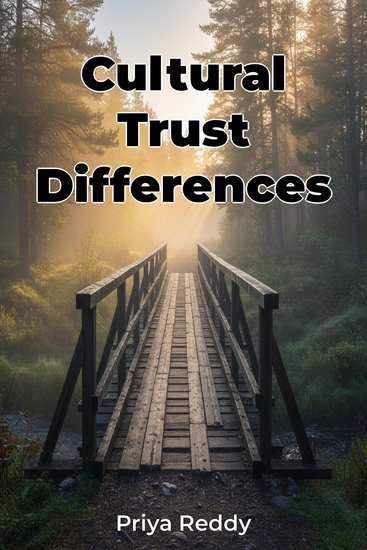
Cultural Trust Differences

Priya Reddy

Übersetzer A AI

Verlag: Publifye

  • 0
  • 0
  • 0

Beschreibung

Cultural Trust Differences explores how trust, a cornerstone of society, varies significantly across cultures. It delves into the psychological and social mechanisms that shape trust perceptions and behaviors, illustrating how these differences impact intercultural interactions. The book emphasizes that trust isn't universal but rather a culturally constructed phenomenon deeply rooted in shared experiences and values. Understanding these nuances is vital in our interconnected world, influencing areas from international business to diplomacy. The book examines cultural dimensions like individualism and collectivism, showing how they correlate with trust behaviors. For instance, societies with strong collectivist values may prioritize trust within their in-group, while individualistic cultures might emphasize broader, more generalized trust. By integrating insights from anthropology, social psychology, and international relations, Cultural Trust Differences provides a comprehensive view. Beginning with core trust concepts, the book progresses to examine specific cultural dimensions using case studies from East Asia, Europe, and the Americas. It culminates by exploring practical implications in international business and diplomacy, offering strategies for building cross-cultural trust. This approach makes it a valuable resource for students, researchers, and professionals navigating diverse cultural landscapes.
Verfügbar seit: 21.02.2025.
Drucklänge: 78 Seiten.


Weitere Bücher, die Sie mögen werden

  • Germany vs Great Britain in the Air: The History of the Enemy Air Forces in World War I and World War II - cover

    Germany vs Great Britain in the...

    Editors Charles River

    • 0
    • 0
    • 0
    One of the most important breakthroughs in military technology associated with World War I, and certainly the one that continues to capture the public imagination, was the use of airplanes, which were a virtual novelty a decade before. While the war quickly ground to a halt in its first few months, the skies above the Western Front became increasingly busy. The great powers had already been acquiring aircraft for potential uses, but given that aerial warfare had never been a major component of any conflict, it’s understandable that few on either side had any idea what the planes were capable of doing. Furthermore, at the start of the war, all sides’ aircraft were ill-equipped for combat mostly because the idea that planes might somehow fight was still a novel one. 
    The Royal Air Force (RAF), Britain's legendary air arm, was born in the skies above the First World War. The British had previously used balloons for spotting and reconnaissance for decades, and in the years leading up to the war, planes started seeing military use. They mostly provided reconnaissance, though experiments were made in using them offensively. During the Boer War of 1899-1902, the British Army used the crews of helium-filled balloons to plot and help target artillery fire. But these were small, tentative steps. The first patent to fit a machine gun to a plane, taken out in 1910, had not yet led to active fighting vehicles, and there was no doctrine, no tactics, and no combat between massed air fleets.  
    The Third Reich's Luftwaffe began World War II with significant advantages over other European air forces, playing a critical role in the German war machine's swift, powerful advance. By war's end, however, the Luftwaffe had been decimated by combat losses and crippled by poor decisions at the highest levels of military decision-making, and it proved unable to challenge Allied air superiority despite a last-minute upsurge in German aircraft production.
    Zum Buch
  • Scottish Gaelic in Twelve Weeks - With Audio Download - cover

    Scottish Gaelic in Twelve Weeks...

    Roibeard O'Maolalaigh

    • 0
    • 0
    • 0
    Scottish Gaelic in Twelve Weeks has been written both as a self-tuition course for beginners and also for use within the classroom. You may want to learn Gaelic because of a general interest in Celtic or Scottish history and culture, or because it was the everyday language of your ancestors. The cynical observer may wonder if the exercise is worthwhile, when only 1.5 per cent of Scotland's population speak the language.
    However, Gaelic is far from dead; in some parts of the Highlands and Western Isles it is the everyday language and it represents an important part of the United Kingdom's cultural mix. There are Gaelic-learning classes in almost every area of Scotland. Each lesson in the book contains some essential points of grammar explained and illustrated, exercises, a list of new vocabulary (with a guide to pronunciation, using the International Phonetics Alphabet), and an item of conversation.
    This new edition includes an audio download link.
    Zum Buch
  • How to Edit Writing: 7 Easy Steps to Master Writing Editing Proofreading Copy Editing Spelling Grammar & Punctuation - cover

    How to Edit Writing: 7 Easy...

    Jaiden Pemton

    • 0
    • 0
    • 0
    Have you just finished writing your masterpiece, but don’t know how to approach the editing stage?  
    Or have you decided to take on a role as an editor for the work of other writers, and don’t know where to start? 
    Do you feel unclear about how to distinguish and use the elements of the editing process? 
      
    How to Edit Writing is the guide you need! We will teach you how to edit writing in 7 easy steps. This guide is designed to provide you with all the tools you need in a concise, easy to understand format that will answer all your burning questions and get you on your way to thorough and successful editing. 
      
    To be a successful editor, you must know how to divide your work into stages, make use of reading aloud, take things one step at a time, deeply engage with the content at hand, and utilize strategies such as isolating text and working in reverse. 
    YOU’LL LEARN:The stages of editing: structural, line editing, and copy editing Necessary conversations to have between writers and editorsThe benefits of reading aloud to yourself and othersHow to separate the smaller elements into manageable chunksHow to maintain consistencyHow to keep readers engagedHow to isolate text in order to determine its purposeHow to engage more deeply with the text in front of youHow to critically evaluate dialogue and general flowHow to monitor pacing and organizationHow to edit in reverseAnd so much more!  
    Whether you're just starting on the journey of editing and need to develop a clearer understanding of the elements, or have been at it for a while and are looking for fresh perspectives and tips for further develop how you perfect your craft, this guide is the companion you need. Let’s get started!
    Zum Buch
  • The Death of a Jaybird - Essays on Mothers and Daughters and the Things They Leave Behind - cover

    The Death of a Jaybird - Essays...

    Jodi M. Savage

    • 0
    • 0
    • 0
    Reminiscent of The Year of Magical Thinking and Somebody’s Daughter, a deeply empathetic and often humorous collection of essays that explore the author’s ever-changing relationships with her grandmother and mother, through sickness and health, as they experience the joys and challenges of Black American womanhood. 
    Jodi M. Savage was raised in Brooklyn, New York, by her maternal grandmother. Her whip-smart, charismatic mother struggled with addiction and was unable to care for her. Granny—a fiery Pentecostal preacher who had a way with words—was Jodi’s rock, until Alzheimer’s disease turned the tables, and a 28-year-old Jodi stepped into the role of caretaker. It was up to Jodi to get them both through the devastations of a deteriorating mind. After Granny passed away, Jodi spent years trying to reckon with her grief. Jodi and her mother were both diagnosed with breast cancer nearly a decade later, and then Jodi lost her too. 
    In this searing, candid collection of essays, Jodi illuminates the roles that identity and memory play in preserving those we love. Jodi explores the lives of modern Black women and communities through the prism of her personal experiences. With grace, creativity, and insight, she looks at femininity, family, race, mental illness, grief, healthcare, and faith. Jodi deftly portrays how trauma is inherited, and how the struggle to break a generational curse can last a lifetime. 
    The Death of a Jaybird is a thoughtful examination of complicated family love, loss, and the liberating power of claiming our stories.
    Zum Buch
  • The Need For Freedom - cover

    The Need For Freedom

    Eben Macdonald

    • 0
    • 0
    • 0
    Despite huge improvements in human living standards having taken place over the decades, extreme poverty still persists - and the Covid-19 pandemic hasn't helped. Research has found that economic growth is far and away the best reducer of poverty; naturally, the question should be asked, what set of policies is best suited to stimulate economic growth, and thus reduce poverty? The answer proposed in this book is simple: economic liberalism: the philosophy of free trade, secure property rights, business freedom, investment freedom, monetary stability, and limited state ownership of industries. Economic liberalism is yet to reach the world's poorest people and entrepreneurs; while citizens of the rich world enjoy the fruits which competitive marketplaces provide, the poor live under the regulatory clutches of intrusive bureaucracies. Case studies consistently demonstrate that liberalising markets is the best way to support economic growth. Public investment into supporting human infrastructure is definitely necessary as well. However, policymakers should focus especially on improving the efficiency of public services, which requires more than just increasing budgets. The link between foreign aid and economic development is empirically inconclusive.
    Zum Buch
  • Mastering Emotional Intelligence - Unraveling the Art of Understanding Navigating and Influencing Emotions in Yourself and Others - cover

    Mastering Emotional Intelligence...

    Vines Graener

    • 0
    • 0
    • 0
    Since the latter part of the twentieth century, breakthroughs in science, like advancements in brain imaging, have sparked a growing fascination with the intersection of emotions and neurobiology. Researchers have come to acknowledge the close connection between the brain and the immune system, the detrimental impact of chronic stress on the human body, and the significant correlation between emotions and health issues such as heart disease. 
    Before this scientific awakening, there was an undue emphasis on academic intelligence by researchers. This bias ignored the reality that intelligence is not a reliable predictor of success and happiness. Instead, emotional intelligence emerges as a more accurate indicator of life trajectory. It encompasses psychological resilience, the ability to persevere in the face of challenges, impulse control, and social skills like empathy. 
    Contrary to earlier beliefs that emotional intelligence was an inherent trait, recent research has revealed it to be a capacity rather than an absolute characteristic. Nevertheless, the formative stage for emotional intelligence is primarily in early childhood. A baby receiving nurturing care is more likely to develop a positive outlook, while a neglected baby may struggle with challenges later in life. Although tendencies toward optimism or pessimism take root early, they can still evolve later on, influenced by one's social network, as emotions tend to be contagious. 
    It's crucial to recognize that complete control over emotions is not feasible. Emotions are a result of the brain processing external feedback and are not consciously regulated. However, individuals can control how they respond to their emotions. The initial step in effective emotional management is being aware of one's emotions, forming the foundation for emotional intelligence.
    Zum Buch