Begleiten Sie uns auf eine literarische Weltreise!
Buch zum Bücherregal hinzufügen
Grey
Einen neuen Kommentar schreiben Default profile 50px
Grey
Jetzt das ganze Buch im Abo oder die ersten Seiten gratis lesen!
All characters reduced
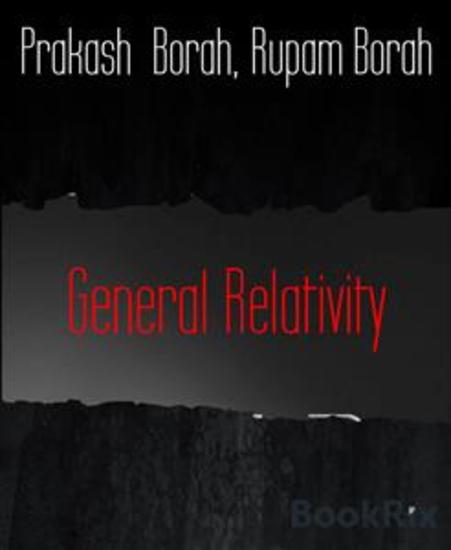
General Relativity - cover

General Relativity

Prakash Borah, Rupam Borah

Verlag: BookRix

  • 0
  • 0
  • 0

Beschreibung

The theory of General Relativity, formulated by Albert Einstein in 1915, revolutionized our understanding of gravity and the nature of spacetime. This theory proposes that gravity is not a force transmitted between masses, but rather a curvature of spacetime caused by mass and energy. In this abstract, we provide a concise overview of the key principles and implications of General Relativity. We discuss the equivalence principle, which states that inertial and gravitational mass are indistinguishable, leading to the geodesic motion of particles in curved spacetime. The Einstein field equations, a set of nonlinear differential equations, describe how matter and energy distribution determine the curvature of spacetime. These equations predict the behavior of gravitational waves, the bending of light in a gravitational field (gravitational lensing), and the existence of black holes. General Relativity has been confirmed through various experiments and observations, including the deflection of starlight during a solar eclipse and the recent detection of gravitational waves. Its profound influence on cosmology and our understanding of the universe's large-scale structure continues to drive scientific inquiry and shape our comprehension of fundamental physics.
Verfügbar seit: 21.12.2023.
Drucklänge: 10 Seiten.

Weitere Bücher, die Sie mögen werden

  • Natural Attachments - The Domestication of American Environmentalism 1920–1970 - cover

    Natural Attachments - The...

    Pollyanna Rhee

    • 0
    • 0
    • 0
    A nuanced analysis takes a California oil spill as its point of departure to show how affluent homeowners pushed for an environmentalism that would protect not only the earth but also property and community norms. A massive oil spill in the Pacific Ocean near Santa Barbara, California, in 1969 quickly became a landmark in the history of American environmentalism, helping to inspire the creation of both the Environmental Protection Agency and Earth Day. But what role did the history of Santa Barbara itself play in this? As Pollyanna Rhee shows, the city’s past and demographics were essential to the portrayal of the oil spill as momentous. Moreover, well-off and influential Santa Barbarans were positioned to “domesticate” the larger environmental movement by embodying the argument that individual homes and families—not society as a whole—needed protection from environmental abuses. This soon would put environmental rhetoric and power to fundamentally conservative—not radical—ends.
    Zum Buch
  • A Road Running Southward - Following John Muir's Journey through an Endangered Land - cover

    A Road Running Southward -...

    Dawn Chapman

    • 0
    • 0
    • 0
    In 1867, John Muir set out on foot to explore the botanical wonders of the South, keeping a detailed journal of his adventures as he traipsed from Kentucky southward to Florida. One hundred and fifty years later, on a similar whim, veteran Atlanta reporter Dan Chapman recreated Muir's journey to see for himself how nature has fared since Muir's time. Channeling Muir, he uses humor, keen observation, and a deep love of place to celebrate the South's natural riches. 


    Each chapter touches upon a local ecological problem—moving between John Muir's vivid descriptions of a lush botanical paradise and the myriad environmental problems facing the South today. Along the way he talks to locals with deep ties to the land—scientists, hunters, politicians, and even a Muir impersonator—who describe the changes they've witnessed and what it will take to accommodate a fast-growing population without destroying the natural beauty and a cherished connection to nature. 


    A Road Running Southward is part travelogue, part environmental cri de coeur, and paints a picture of a South under siege. It is a passionate appeal, a call to action to save one of the loveliest and most biodiverse regions of the world by understanding what we have to lose if we do nothing.
    Zum Buch
  • (L)earn Bitcoin - Become Financially Sovereign - cover

    (L)earn Bitcoin - Become...

    Anita Posch

    • 0
    • 0
    • 0
    Learn Bitcoin is the best Bitcoin book to decide why and how you should begin to use Bitcoin. It presents all its facets from technical, economical, political and social implications. It provides a step-by-step roadmap to navigate this new financial world and sets you up with concrete recommendations on bitcoin investing, earning and storing bitcoin. Ascending the staircase of financial sovereignty will grant you personal freedom and control over your bitcoin money. 
    In this book you will find answers to the questions of what money is, where it comes from, its history, blockchain technology and Bitcoin specifically. It gives answers to the why and how to use Bitcoin while debunking popular myths and misunderstandings surrounding cryptocurrencies. You'll find a deep dive into Bitcoin's development since its inception in 2008 and an outlook on the future of cryptocurrency based on Bitcoin. 
    While mainstream media and economic pundits in the Western world think that it's just a tool for speculation, my goal is to spread the word about Bitcoin as an enabler of financial fairness and social change. What goes unmentioned in most other publications are the positive real world implications that a truly permissionless, uncensorable, neutral digital asset with a fixed supply offers. 
    Later the cryptocurrency book focuses on the more practical applications of Bitcoin (BTC) and how you can safely acquire, use and store it. 
    This is not financial advice, it's for people who want to (l)earn and understand the fundamentals of Bitcoin. 
    Zum Buch
  • Man Cattle and Veld - cover

    Man Cattle and Veld

    Johann Zietsman

    • 0
    • 0
    • 0
    THE book for Profitable Ranching. A Real Ranching Revolution. Cattle Breeding. Grazing Management. 
    Much like nature, this book is both simple and complex. The author has taken great care to create both a simple technical guide as well as a philosophic declaration about complex human and environmental nuances, all in one volume. 
    Those persons who see and shape the future often say that the future is already here, it just isn't evenly distributed. I am confident that, several years from now many will look back upon this book, as well as the rest of Johann Zietsman's works, as foundational to the restoration of—and relationships between—man, cattle, and veld. 
    Zietsman puts forth a much-needed critique of man and his actions over the past century as well as personal stories as contra-example to the narratives we that have dominated the ranching world. 
    Achieving the ranch goal of maximum sustainable profit per hectare depends on breeding and feeding cattle (and all grazing species) as the grazers that they are. Efforts should be directed at raising cattle that are more efficient converters of forage, not on trying to make forage-reliant species into grain-efficient machines. Forces of nature created the animals we have, and their genetic potential will be brought out through non-selective grazing and proper supplementation. 
    Non-selective, time-controlled grazing, in which 80 to 95 percent of the mass of all grasses and forbs are utilized, thus pruning plants back to their crowns, is the process by which grasslands are improved in both plant vigor and species composition. I cannot overemphasize the importance of this last point—plant species diversity is promoted by time-controlled severe grazing events, whereas selective, take half leave half grazing is much more limited in improving species diversity, even leading to species narrowing in some circumstances.
    Zum Buch
  • CHARGE - Why Does Gravity Rule? - cover

    CHARGE - Why Does Gravity Rule?

    Frank Close

    • 0
    • 0
    • 0
    Humans have long been aware of the electric and magnetic forces around us, and scientific investigation showed that the two are intimately connected as electromagnetism. Lightning shows how devastating electricity can be in nature, while humans learned to exploit the flow of negatively charged electrons that make up an electric current. In the early twentieth century, the experiments of Ernest Rutherford showed that at the heart of atoms lies a positively charged nucleus. The positive charge comes from protons. Atoms are neutral because the charges of the electron and proton cancel out. 


    The charges of the proton and electron are opposite and equal, even though the proton is bigger. But why are they equal? This is one of the deepest unresolved puzzles of physics. Frank Close takes us on a journey into the quantum subatomic world of particles. He describes the strong and weak forces that operate alongside electromagnetism, the color and flavor charges, as well as the parallels between them, giving hints of a deeper unity. Seeking an answer to why matter is neutral brings us to fundamental forces and particles, the Standard Model, the Higgs boson, and implications of grand unification for the stability of matter. Close packs in a rich account of our current understanding and the latest ambitious experiments to probe further, and test theoretical possibilities.
    Zum Buch
  • The Digital Paradigm Shift - A Groundbreaking Machine's Impact on Civilization - cover

    The Digital Paradigm Shift - A...

    John Harpoon

    • 0
    • 0
    • 0
    The journey into the digital age began with the spark of human ingenuity and the desire to simplify complex tasks. Early civilizations laid the groundwork for computation by devising systems to manage trade, record history, and calculate astronomical events. These early tools, such as the abacus and mechanical calculators, may seem rudimentary by modern standards, yet they were the building blocks of a monumental transformation. 
    In the late 19th and early 20th centuries, the seeds of the digital age began to take root. Pioneers like Charles Babbage and Ada Lovelace envisioned the potential of programmable machines long before the technology to build them existed. Lovelace's notes on Babbage's Analytical Engine contained the first algorithm intended for implementation on a machine, earning her recognition as the world’s first computer programmer. Their ideas laid a conceptual foundation that would inspire future innovators. 
    The advent of World War II catalyzed the development of modern computing. The need for advanced cryptography, ballistics calculations, and logistical coordination drove governments and researchers to invest in computational technologies. Alan Turing, often referred to as the father of computer science, developed the Turing Machine, a theoretical construct that became a cornerstone of computer science. His work at Bletchley Park, cracking the German Enigma code, not only shortened the war but also showcased the immense potential of automated computation.
    Zum Buch