Join us on a literary world trip!
Add this book to bookshelf
Grey
Write a new comment Default profile 50px
Grey
Subscribe to read the full book or read the first pages for free!
All characters reduced
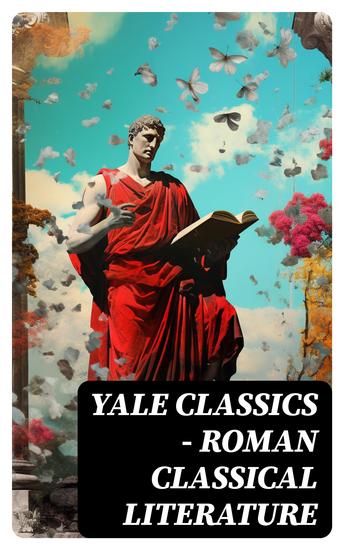
Yale Classics - Roman Classical Literature - Enriched edition - cover

Yale Classics - Roman Classical Literature - Enriched edition

Lucius Annaeus Seneca, Julius Caesar, Boethius, Horace, Plutarch Plutarch, Apuleius, Virgil Virgil, Persius, Terence, Ammianus Marcellinus, Sallust, Juvenal, Lucan, Suetonius, Tibullus Tibullus, Tacitus Tacitus, Petronius, Cornelius Nepos, Lucretius Lucretius, Martial, Catullus, Cicero Cicero, Claudian, Pliny the Younger, Saint Augustine of Hippo, Plautus, Ennius, The Metamorphoses, Augustus, Quintilian

Translator Alfred John Church, Paul Nixon, J. S. J.S.Watson, Christopher Smart, William Rose, James Rhodes, Lewis Evans, John William Mackail, William Jackson Brodribb, W. A. McDevitte, W. S. Bohn, Richard Mott Gummere, Henry Thomas Riley, William Ellery Leonard, Frederick Charles Tindal Bosanquet, E. Jones, Robinson Ellis, Harold Edgeworth Butler, Theodore Chickering Williams, John Selby Watson, Frederick W. Shipley, Edward Ridley, William Charles Firebaugh, Maurice Platnauer

Publisher: DigiCat

  • 0
  • 0
  • 0

Summary

Yale Classics - Roman Classical Literature invites readers on an intellectual journey through the epochs of ancient Rome, featuring works that span a vast array of themes from philosophy and politics to satire and epic poetry. This anthology is a vibrant tapestry of Roman literary tradition, showcasing the dynamism and complexity of the era. From philosophical meditations to incisive political commentaries, the collection reveals the multifaceted nature of Roman thought and its enduring impact on Western literature. The insightful interrogations of human nature and governance are powerfully echoed throughout, with standout pieces that elucidate the Roman world's intricate cultural and moral landscape. The anthology presents an impressive assembly of literary figures, from esteemed philosophers like Seneca and Saint Augustine to epic poets such as Virgil and Lucan. Each author provides a unique lens through which the reader can explore the vast field of Roman literary and cultural influence. The collection aligns with significant historical currents, offering insights into the philosophical, rhetorical, and societal transformations that defined Roman antiquity. As these diverse voices converge, they craft a dialogue enriched by their varied perspectives, underscoring the value of literary and historical diversity in understanding this seminal era. This anthology serves as a vital resource for readers seeking a comprehensive understanding of Roman thought and literature's historical continuity. It offers a remarkable opportunity to delve into a carefully curated selection of classical texts within a single volume, providing a rich educational experience. By engaging with these varied perspectives, styles, and themes, readers are invited to explore the dialogues that transcend time, making it an indispensable addition to the library of any enthusiast of classical literature.

In this enriched edition, we have carefully created added value for your reading experience:
- An Introduction draws the threads together, discussing why these diverse authors and texts belong in one collection.
- Historical Context explores the cultural and intellectual currents that shaped these works, offering insight into the shared (or contrasting) eras that influenced each writer.
- A combined Synopsis (Selection) briefly outlines the key plots or arguments of the included pieces, helping readers grasp the anthology's overall scope without giving away essential twists.
- A collective Analysis highlights common themes, stylistic variations, and significant crossovers in tone and technique, tying together writers from different backgrounds.
- Reflection questions encourage readers to compare the different voices and perspectives within the collection, fostering a richer understanding of the overarching conversation.
Available since: 11/27/2023.
Print length: 7732 pages.

Other books that might interest you

  • The Civil Wars Book 3 - cover

    The Civil Wars Book 3

    Julius Caesar

    • 0
    • 0
    • 0
    The Civil Wars is a firsthand account of the pivotal conflict between Julius Caesar and Pompey the Great, written by Caesar himself. Covering the events leading to the war, his strategic campaigns in Italy, Spain, and Greece, and culminating in Pompey’s defeat at Pharsalus, the narrative showcases Caesar’s military genius, political resolve, and justification for seizing power. Written in a clear, detached tone, the work presents Caesar’s perspective as a commander fighting for legitimacy against a corrupt Senate. Though unfinished—ending before his ultimate victory—it remains a crucial historical document offering insight into Roman politics, loyalty, and the fall of the Republic. A foundational text of military and political history.
    Show book
  • Mughal Empire The: The History of the Modern Dynasty that Ruled Much of India Before the British - cover

    Mughal Empire The: The History...

    Editors Charles River

    • 0
    • 0
    • 0
    In the late 15th century, Western Europe entered the Renaissance, which is often credited with the origins of modern, scientific thought. The Age of Exploration also began around that time, and 1517 is when the Reformation began. Meanwhile, the Islamic world was also quickly evolving around the same time, with the Ottoman Empire expanding into Eastern Europe and wiping the Orthodox Christian Byzantine Empire off the face of the map. And while the Ottomans were establishing themselves as the premier Islamic power with the help of early gunpowder weapons, hundreds of miles away in Central Asia, another “gunpowder empire” was forming.  
    	The Mughals, a group with Turkish and Mongolian roots, also used gunpowder weapons to sweep into northern India, topple the existing Islamic dynasty in Delhi, and eventually subject most of India to their rule. The term “gunpowder empire” was originally coined by Russian scholar V. V. Bartold and popularized by American historians William McNeil and Marshall Hodgson in the mid-20th century to describe the Islamic Ottoman, Safavid, and Mughal empires, which they claimed came to power through gunpowder. Although that core thesis has been challenged by historians in recent years, who argue that gunpowder weapons were a feature or result of the rise of these empires, not the cause for them, the term is still used (Streusand 2011, 3).  
    	To be fair, the Mughals rose through a combination of political acumen and battlefield brutality, and they held onto their empire for hundreds of years in much the same way. In the process, the Mughals developed a state that was unique in many ways, adopting elements of Islamic culture and meshing them with native Indian culture and even Western European culture. When the British conquered India in the mid-19th century, they had the benefit of inheriting the Mughal system, which, despite many problems, proved to be a suitable template for rule over a land as vast and diverse as India.
    Show book
  • The Stranger Who Was Myself - cover

    The Stranger Who Was Myself

    Barbara Jenkins

    • 0
    • 0
    • 0
    Barbara Jenkins writes about the experiences of a personal and family-centred life in Trinidad with great psychological acuteness, expanding on the personal with a deep awareness of the economic, social and cultural contexts of that experience. She writes about a childhood and youth located in the colonial era and an adult life that began at the very point of Trinidad's independent nationhood, a life begun in poverty in a colonial city going through rapid change. It is about a life that expanded in possibility through an access to an education not usually available to girls from such an economic background. This schooling gave the young Barbara Jenkins the intense experience of being an outsider to Trinidad's hierarchies of race and class. She writes about a life that has gender conflict at its heart, a household where her mother was subject to beatings and misogynist control, but also about strong matriarchal women.
    As for so many Caribbean people, opportunity appeared to exist only via migration, in her case to Wales in the 1960s. But there was a catch in the arrangement that the years in Wales had put to the back of her mind: the legally enforceable promise to the Trinidadian government that in return for their scholarship, she had to return. She did, and has lived the rest of her life to date in Trinidad, an experience that gives her writing an insider/outsider sharpness of perception.
    'From her childhood in colonial Port of Spain, to becoming a migrant student and young mother in Wales and then returning to Trinidad post-Independence, Jenkins tells her own life story with the emotional sensitivity of a natural storyteller, the insight of a philosopher, the scope of a historian and the good humour of a Trini. This beautifully written and moving memoir will feel achingly familiar to anyone who knows what it is like to navigate race, class and girlhood while growing up in the West Indies, anyone who has ever felt like an outsider.' Ayanna Lloyd Banwo, author of When We Were Birds.
    Show book
  • On Our Way Home from the Revolution - Reflections on Ukraine - cover

    On Our Way Home from the...

    Sonya Bilocerkowycz

    • 0
    • 0
    • 0
    In 2014 Sonya Bilocerkowycz is a tourist at a deadly revolution. At first she is enamored with the Ukrainians' idealism, which reminds her of her own patriotic family. But when the romantic revolution melts into a war with Russia, she becomes disillusioned, prompting a return home to the US and the diaspora community that raised her. As the daughter of a man who studies Ukrainian dissidents for a living, the granddaughter of war refugees, and the great-granddaughter of a gulag victim, Bilocerkowycz has inherited a legacy of political oppression. But what does it mean when she discovers a missing page from her family's survival story—one that raises questions about her own guilt? 


    In these linked essays, Bilocerkowycz invites listeners to meet a swirling cast of post-Soviet characters, including a Russian intelligence officer who finds Osama bin Laden a few weeks after 9/11; a Ukrainian poet whose nose gets broken by Russian separatists; and a long-lost relative who drives a bus into the heart of Chernobyl. On Our Way Home from the Revolution muddles our easy distinctions between innocence and culpability, agency and fate.
    Show book
  • African American Women's Literature in Spain - Translation and Reception - cover

    African American Women's...

    Sandra Llopart Babot

    • 0
    • 0
    • 0
    This volume brings forward a descriptive approach to the translation and reception of African American women's literature in Spain. Drawing from a multidisciplinary theoretical and methodological framework, it traces the translation history of literature produced by African American women, seeking to uncover changing strategies in translation policies as well as shifts in interests in the target context, and it examines the topicality of this cohort of authors as frames of reference for Spanish critics and reviewers. Likewise, the reception of the source literature in the Spanish context is described by reconstructing the values that underlie judgements in different reception sources. Finally, this book addresses the specific problem of the translation of Black English into Spanish. More precisely, it pays attention to the ideological and the ethical implications of translation choices and the effect of the latter on the reception of literary texts.
    Show book
  • The Writer's Campaign - Play Your Way to a Finished First Draft - cover

    The Writer's Campaign - Play...

    Richard Parry

    • 0
    • 0
    • 0
    Your story is a dungeon. Let’s go raid it. 
    Is there a story trapped inside you, waiting to be rescued by your inner adventurer? 
    Most writing advice sucks. It’s either too vague to be useful or so rigid it strangles your creativity. It treats writing like a chore, when it should feel like the most addictive game you’ve ever played. 
    It’s time to flip the board over. 
    The Writer’s Campaign is a gamified, RPG-inspired system designed to get you from a blank page to a finished first draft. Using dice, a notebook, and the spirit of adventure, you will:Generate a unique world, a compelling hero, and a high-stakes plot.Navigate every key story beat, from the Inciting Incident to the final, epic Climax.Slay writer's block by transforming it into a series of fun, achievable quests.Finish your damn book. 
    Whether you're a complete beginner stuck on page one or a veteran writer looking to debug a broken manuscript, this is your system for turning ideas into words… and worlds. 
    Stop waiting for the muse. Pick up your dice and start your quest. 
    The adventure is ready. Are you?
    Show book