Rejoignez-nous pour un voyage dans le monde des livres!
Ajouter ce livre à l'électronique
Grey
Ecrivez un nouveau commentaire Default profile 50px
Grey
Abonnez-vous pour lire le livre complet ou lisez les premières pages gratuitement!
All characters reduced
Symposium - cover

Symposium

Plato Plato

Maison d'édition: Memorable Classics eBooks

  • 0
  • 0
  • 0

Synopsis

Symposium by Plato - In ancient Greece, the symposium (Greek: συμπόσιον symposion or symposio, from συμπίνειν sympinein, "to drink together") was a part of a banquet that took place after the meal, when drinking for pleasure was accompanied by music, dancing, recitals, or conversation.

Literary works that describe or take place at a symposium include two Socratic dialogues, Plato's Symposium and Xenophon's Symposium, as well as a number of Greek poems such as the elegies of Theognis of Megara. Symposia are depicted in Greek and Etruscan art that shows similar scenes.

In modern usage, it has come to mean an academic conference or meeting such as a scientific conference. The equivalent of a Greek symposium in Roman society is the Latin convivium.
Disponible depuis: 02/06/2022.
D'autres livres qui pourraient vous intéresser

  • The Devotees of Buddhism - Diary of An Investigation - cover

    The Devotees of Buddhism - Diary...

    Marion Dapsance

    • 0
    • 0
    • 0
    The temple is packed. "It stinks in here," says the master in English. "You mustn't do any more prostrations, or else you'll have to open the windows." A tall, skinny steward discreetly points out that it's pouring rain, and that perhaps this isn't entirely appropriate. The master then grabs him by the hair and shakes him back and forth. "Who are you to judge? I'm your master, you're my slave. Ah, it may not be politically correct with you Westerners, but in Tibet it's like that. You have to submit totally. You must never challenge a great master.
    Anthropologist Marion Dapsance conducts the first field survey of Buddhism in the West, delving into the heart of a hijacked religion that leaves you speechless: sectarian organization, sexual aberrations, financial pyramids, hierarchical humiliations.
    Voir livre
  • The Posthumous Essays of John Churton Collins - cover

    The Posthumous Essays of John...

    John Churton Collins

    • 0
    • 0
    • 0
    John Churton Collins was a literary critic who lived from 1848-1908. In 1904 John Collins became professor of English literature at Birmingham University (United Kingdom). He writes about the lives of English and German authors beginning with William Shakespeare (1564-1616) and ending with Alfred, Lord Tennyson(1809-1892). He wrote the book in response to On Heroes, Hero-Worship, and the Heroic in History, by Thomas Carlyle (1840). His son, L.C. Collins, collected these essays from various sources after his father's death. (Summary by Craig Campbell)  
     
    Additional proof-listening by Larry Wilson.
    Voir livre
  • Secrets to Learning Languages - Season 2 - Time Management Learning Behaviour Fast Fluency and Neurodiversity - cover

    Secrets to Learning Languages -...

    Anya Lewis

    • 0
    • 0
    • 0
    Season 2 of the Language Learning Series goes beyond textbooks to show how your mind, methods, and minutes shape fluency. Host Anya Lewis explores how language rewires perception, why formality and flow matter, and what actually works to speak faster—mixing high-frequency vocabulary, early conversation, and practical "toolbox" phrases. You'll learn ADHD- and autism-friendly study strategies, dyslexia-aware pathways that prioritize speaking, and time systems (Trident calendar, time-blocking, Pomodoro, Pareto) that turn good intentions into daily progress. From Japanese politeness levels to meetup tactics that kill translation lag, each episode gives you clear actions and motivating stories so you can think less about "perfect grammar" and more about communicating now. Press play to build momentum, design a routine you'll keep, and level up your fluency—one focused session at a time.
    Voir livre
  • Cognitive & Dialectical Behavior Therapy Mastery - (4 Books in 1) How to Regulate Your Emotions Control Your Mood Overcome Phobias Addictions Depression & Anxiety Through Mindfulness Awareness - cover

    Cognitive & Dialectical Behavior...

    James Ashley, Lance Pettiford,...

    • 0
    • 0
    • 0
    Dive into the ultimate anthology of psychological mastery with "Cognitive & Dialectical Behavior Therapy Mastery." This formidable volume unifies four essential books into one comprehensive guide, providing a multi-faceted approach to conquering a myriad of mental health challenges. 
    Each section, derived from a distinct original work, converges to form a robust framework for understanding and applying the principles of both Cognitive Behavior Therapy (CBT) and Dialectical Behavior Therapy (DBT). Whether you're grappling with anxiety, phobias, depression, addiction, or seeking to improve overall emotional regulation, this singular collection offers a wealth of knowledge and therapeutic strategies. 
    From James Ashley's in-depth exploration of internal conflict resolution in "Cognitive And Dialectical Behavior Therapy Unleashed," to Lance Pettiford's practical guide on overcoming problematic disorders with CBT, each book complements the others to create a dynamic toolkit for personal transformation. 
    Delve deeper with D.C. Johnson's "Cognitive Behavioral Therapy: Learn How To Use CBT And The Power Of The Mind To Overcome Negative Thinking, Addiction, Depression, Phobias, Anxiety And Panic Disorders," which empowers you to shift the tides of your thought patterns and emotional responses. 
    Completing this collection, Crystal Johnson's "Conquer The World!" shares an inspiring journey of overcoming personal adversity, offering tangible steps to utilize CBT techniques for conquering fears and achieving success.
    Voir livre
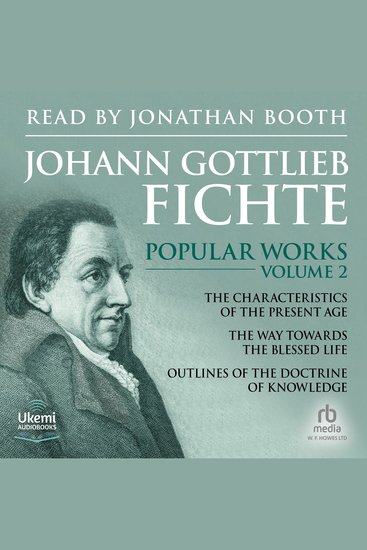
  • Popular Works Volume 2 - The Characteristics of the Present Age The Doctrine of Religion and Other Works - cover

    Popular Works Volume 2 - The...

    Johann Gottleib Fitche

    • 0
    • 0
    • 0
    Though born to a poor but pious family of ribbon weavers in in Saxony in 1762, Johann Gottlieb’s exceptional intelligence was apparent from an early age. Remarkably, from this humble background, he earned himself a respected place in the pantheon of late 18th and early 19th century German philosophers. That fact that he is placed between Kant and Hegel, yet still retains a significant and individual presence, says much about his work and personality. He became known, especially, for initiating the concept of ‘German idealism’ (linked with Romanticism and the revolutionary politics which emerged after the Enlightenment). In the 20th and 21st century, his importance and contribution to Western philosophy has been increasingly acknowledged.  
     
    There are two substantial lecture series and one essay stemming from his time in Berlin in Popular Works Volume 2: much of Fichte’s important work appeared initially in lectures. 
     
     The Characteristics of the Present Age, (1806) consists of 17 lectures in which Fichte presents his ‘speculative philosophy of history’. The series opens with ‘The Idea of Universal History’ in which he ‘divides earthly life into 5 Principal Epochs.’ Against this overview of history and culture, (including the state, civil and political freedom, science and religion) he develops his thesis with particular reference to his ‘present age’ – the time of Voltaire, Rousseau on the one hand and Lessing, Kant and Goethe on the other.  
     
    In The Way Towards The Blessed Life or The Doctrine Of Religion (1806) (11 lectures) Fichte considers the relationship between established religion and his particular view on ‘transcendental’ philosophy. His opening statement is ‘Life is Love; and hence Life and Blessedness are in themselves one and the same.’  He continues by examine metaphysics, ontology, mysticism, actual and apparent life, Christianity, and his Doctrine of Being.  
     
    The final work in this anthology is Outlines of the Doctrine of Knowledge (1810). It is a concise exposition of Fichte’s Wissenschaftslehre’ but in its strictly scientific form. It had an unusual provenance in that it was printed by Fichte at the conclusion of lectures as a form of a memorandum with 14 short sections. It opens with the question: ‘How this Knowledge can come into being, and what it is in its inward and essential Nature?’
    Voir livre
  • The Renaissance - Studies in Art and Poetry - cover

    The Renaissance - Studies in Art...

    Walter Pater

    • 0
    • 0
    • 0
    Published to great acclaim in 1873, Walter Pater's compendium of idiosyncratic, impressionistic essays on the Renaissance gained him a reputation as a daring modern philosopher. Oscar Wilde called it the "holy writ of beauty." It was Pater's cry of "art for art's sake" that became the manifesto for the aesthetic movement. He believed that art should be sensual and that beauty should rank as the highest ideal. Marked by elegant fluency, Pater's essays discuss Botticelli, Michelangelo, Leonardo da Vinci, and other artists who, for him, embodied the spirit of the Renaissance. Pater's work survives to this day as one of the best pieces of cultural criticism to emerge from the nineteenth century. 
    This collection is criticism as beautiful as the art it considers.
    Voir livre