



Laches
Plato Plato
Verlag: Project Gutenberg
Beschreibung
Entschuldigung, wir haben noch keine Inhaltsangabe für dieses Buch. Melden Sie sich auf 24symbols.com an, um es zu lesen.
Verfügbar seit: 01.12.1998.

Verlag: Project Gutenberg
Entschuldigung, wir haben noch keine Inhaltsangabe für dieses Buch. Melden Sie sich auf 24symbols.com an, um es zu lesen.

"Arise, Awake, and Stop Not Till the Goal is Reached."

Swami Vivekananda was the spiritual bridge between East and West, a visionary who transformed ancient Vedic wisdom into a practical blueprint for modern living. This comprehensive collection brings together his legendary speeches, letters, poetry, and deep philosophical treatises. It serves as a clarion call to recognize the innate divinity within every human being and to manifest that strength through service and self-mastery.

A Legacy of Strength and Universal Harmony: Vivekananda's teachings move beyond the temple and into the heart of daily life, emphasizing that true religion is the realization of the soul. From his groundbreaking addresses at the Parliament of the World's Religions to his "Man-Making" education, his work is designed to build character, willpower, and an "iron" resolve. Whether through the science of meditation or the path of selfless action, these works offer a timeless map for anyone seeking to understand the nature of the self and the unity of all existence.

Vivekananda's words continue to inspire leaders, scientists, and seekers alike. His message is one of courage, rationality, and boundless hope. This volume is an essential cornerstone for any library of Eastern philosophy, comparative religion, and personal transformation.

Unlock the power of your own soul. Buy "The Complete Works of Swami Vivekananda" today and embark on the ultimate journey of self-discovery.
Zum Buch

Because of extreme cold weather, Chief Justice Warren Burger administered the official oath of office in the White House on January 20, 1985. A public administration of the oath of office and the inaugural address were delayed until January 21, 1985, in the Capitol Rotunda.
On the 50th inauguration since George Washington’s, Reagan marvels at America’s growth and inventions, including journeying to the moon and back. “There are no limits to growth and human progress when men and women are free to follow their dreams.” Our values of faith, family, work, and neighborhood were restored “when our economy was finally freed from government’s grip”.
America supports "individual liberty, self-government, and free enterprise throughout the world…” We deal best with great challenges when we come “together not as Democrats or Republicans, but as Americans united in a common cause.”
“We must never again abuse the trust of working men and women by sending their earnings on a futile chase after the spiraling demands of a bloated Federal Establishment.” “Freedom and incentives unleash the drive and entrepreneurial genius that are the core of human progress.”
“We must act now to protect future generations from government's desire to spend its citizens' money and tax them into servitude when the bills come due.” Though “our heritage is one of blood lines from every corner of the Earth, we are all Americans, pledged to carry on this last, best hope of man on Earth.”
Rather than relying on mutual assured destruction, we need “a security shield that will destroy nuclear missiles before they reach their target” and “render nuclear weapons obsolete.”
We are “one people under God, dedicated to the dream of freedom that He has placed in the human heart, called upon now to pass that dream on to a waiting and hopeful world.”
Audio recording courtesy of the Ronald Reagan Presidential Library.
AspenLeafMedia.com
Zum Buch

Only two species of mammal have a post-reproductive life that lasts longer than their reproductive life: the killer whale, whose elders are able to sniff out food supplies over vast oceanic distances to keep their pods fed, and Homo sapiens. While the evolutionary purpose of the killer whale's extensive life seems clear, what is the point of ours?

This was a question that intrigued psychoanalyst Carl Jung, who observed that if a culture is to maintain its deepest, profoundest roots while moving forward to embrace the challenges of historical and technological change, it needs to find an equilibrium between the energy, vigour and creativity of those in the ego-driven first half of life and the experience, dignity and wisdom of those in the second. But to make it to that second half of life, we need to traverse the dreaded 'middle years', when so many of us find ourselves discontent with our jobs, unhappy in our relationships and lamenting our fetishized youths.

Drawing on history, psychology, science and literature, Jamieson shows just how ubiquitous, and crucial, the 'midlife crisis' is, and the devastating consequences for society at large if we continue to regard it as something we can, and should, avoid.
Zum Buch
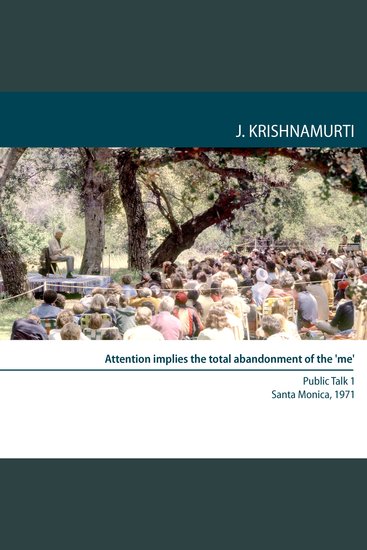
"Attention implies the total abandonment of the ‘me’ " - 6 March 1971Can the mind undergo a radical revolution?How do you observe the world?What solves our human problem is observing the whole process of ourselves without judging, condemning, translating or rejecting – just to observe.Question topics following the talk include: being disturbed in order to know, being confused, transcendental meditation.Zum Buch

Leadership is the one thing that’s most critical in every industry, market and government in the world. There are people in positions of power who called themselves leaders, but they’re not. Yes, they may be the boss and in-charge but they don’t operate in the true spirit of leadership and righteousness.
When you are in charge, do you force and manipulate people to do what you want them to do? Do you inspire them to willingly listen to you out of love and respect? Do you gaslight someone into getting what you want? Do you reason with them with their best interest in mind? Or have you ever been on the receiving end of all of these things?
The Purpose of this course is to explore the dynamic sides of leadership and authority to understand how to increase your value and influence as a true leader. You will learn to use a formula that will help you understand what true leadership looks like and how to apply it to your personal and professional life.
In this course, you will learn to master Seven Key Fundamental Leadership Pillars that drive success for every authentic leader. Without embracing these, your leadership outcomes will fall short.
You will also learn:An effective strategy to reprogram your mindset and help you achieve success in leadership by taking action.How to create a non-toxic working environment for yourself and your organization.Establish better working relationships with colleagues, direct reports, and diverse groups of people.How to develop the confidence you need to become a transformational leader throughout your career and personal life.
Zum Buch
Are you looking for a way to improve your presentation and public speaking skills?
Look no further!
DST Hypno with Stu Newman offers hypnosis sessions designed to help you become the confident, articulate speaker that you have always wanted to be.
With his guidance, you can learn how to effectively communicate your ideas in any setting.
Whether it’s an important meeting at work or a speech in front of hundreds of people, DST Hypno will give you the tools necessary for success.
You’ll gain confidence and develop invaluable communication skills that will last well beyond your time with him.
Don’t hesitate - take this opportunity now and start improving yourself today!
Zum Buch





