Begleiten Sie uns auf eine literarische Weltreise!
Buch zum Bücherregal hinzufügen
Grey
Einen neuen Kommentar schreiben Default profile 50px
Grey
Jetzt das ganze Buch im Abo oder die ersten Seiten gratis lesen!
All characters reduced
The Greatest Korean War Stories EVER - Volume I - cover

The Greatest Korean War Stories EVER - Volume I

Phillip W. Meyer

Verlag: PM Media LLC

  • 0
  • 0
  • 0

Beschreibung

Follow Private Meyer's wartime memoirs as he travels you back in time to 1950 to 1952, as an infantry soldier on the frontlines of the Korean War, only just turning 17 years old. Be inspired by these true life stories with fully illustrated comics for each one. See him survive harsh winters in foxholes and deal with the life at war. Motivating, captivating, and sometimes even funny. So grab a cup of coffee, sit back, and enjoy these greatest ever stories by a U.S. Army veteran.
 
At 90 years old Phillip W. Meyer still enjoys writing stories and poems.
 
Each story in this book includes a fully illustrated comic.
Verfügbar seit: 14.06.2023.
Drucklänge: 134 Seiten.

Weitere Bücher, die Sie mögen werden

  • My Family Is Special - cover

    My Family Is Special

    Kim Mitzo Thompson, Karen Mitzo...

    • 0
    • 0
    • 0
    Kids will love this playful story about what makes a family special and unique. Simple sentence structures and repetitive words will encourage young children to fall in love with learning to read.  Kids will enjoy following along word-for-word with the recorded story that features sound effects and professional voices to help children develop vocabulary and improve listening skills.  This reader features adorable art showing diversity to help children form a sense of acceptance and understanding of different races and individual differences.
    Zum Buch
  • DIY - The Wonderfully Weird History and Science of Masturbation - cover

    DIY - The Wonderfully Weird...

    Dr. Eric Sprankle

    • 0
    • 0
    • 0
    The first-ever social and scientific history of masturbation, which unapologetically critiques a system that has sought to control the very human desire for self-pleasure. 


    Despite decades of medical and psychological research confirming that masturbation is healthy, the act remains shrouded in taboo and pseudoscience. In DIY, Dr. Eric Sprankle reveals the untold story of crusaders on a long campaign to suppress masturbation and the sex educators fighting back with science. He introduces listeners to a colorful cast of characters: doctors advocating for the use of chastity devices, wellness influencers who believe ejaculation depletes the body of vital nutrients, pastors who preach that masturbation creates mermaids, and vibrator aficionados who teach the curious how to come. DIY will challenge what you think you know about the very human need for self-pleasure. 


    Part sex-positive exposé, part fascinating science, DIY spotlights generations of sex education countering anti-masturbation pseudoscience with empowering truths about pleasure. This sex book is perfect for fans of Mary Roach books like Bonk or anyone curious about the history of sex and masturbation.
    Zum Buch
  • Romaine Wasn't Built in a Day - The Delightful History of Food Language - cover

    Romaine Wasn't Built in a Day -...

    Judith Tschann

    • 0
    • 0
    • 0
    Discover how the food we love shapes the language we use in this sharp, laugh-out-loud story of the etymology of food words. All food has a story, reaching as far back into history as language itself. Throughout time, as languages followed and reflected the tides of civilizations, food language came to represent some of the highs and lows of how humans communicate: from the highbrow "Chateauneuf du Pape," which must be pronounced with a healthy dose of snootiness; to the giggle-inducing yet delicious "nun's farts" of Jamaica (also known as "beignets"); to the fascinating travels of the word "coffee" across centuries and continents, attesting to the undying and unifying allure this drink holds for us. From Spam to amuse-bouches, ciabatta to kombucha, Romaine Wasn’t Built in a Day reveals the delightful history and stories behind the words we use for the foods we love.   In Romaine Wasn’t Built in a Day, linguist Tschann takes us on a journey from the vineyards of Avignon to the shores of Tahiti to the port of Mocha on the Red Sea coast to explore the history of the history of the words we use for the food we eat. Chock full of linguistic did-you-knows and delectable trivia, this is your go-to gift for history buffs, crossword fiends, and Scrabble diehards. This is the surprising and sometimes hilarious history of food, told through the lens of the fascinating evolution of language. All food has a story, reaching as far back into history as language itself. Throughout time, as languages followed and reflected the tides of civilizations, food language came to represent some of the highs and lows of how humans communicate: from the highbrow "Chateauneuf du Pape," which must be pronounced with a healthy dose of snootiness; to the giggle-inducing yet delicious "nun's farts" of Jamaica (also known as "beignets"); to the fascinating travels of the word "coffee" across centuries and continents, attesting to the undying and unifying allure this drink holds for us. From Spam to amuse-bouches, ciabatta to kombucha, Romaine Wasn’t Built in a Day reveals the delightful history and stories behind the words we use for the foods we love.   In Romaine Wasn’t Built in a Day, linguist Tschann takes us on a journey from the vineyards of Avignon to the shores of Tahiti to the port of Mocha on the Red Sea coast to explore the history of the history of the words we use for the food we eat. Chock full of linguistic did-you-knows and delectable trivia, this is your go-to gift for history buffs, crossword fiends, and Scrabble diehards. This is the surprising and sometimes hilarious history of food, told through the lens of the fascinating evolution of language.
    Zum Buch
  • Learn Spanish for Kids Fun Stories Songs & Vocabulary Words For Beginners - Simple Language Lessons with Easy Phrases Flash Cards and Short Stories to Learn While Sleeping or in Your Car (Complete Audio Course for Children and Dummies) - cover

    Learn Spanish for Kids Fun...

    Damián Carabello

    • 0
    • 0
    • 0
    ¡Hola, future Spanish speaker! Ready to turn learning into an exciting, laughter-filled adventure? "Learn Spanish for Kids. Fun Stories, Songs & Vocabulary Words For Beginners" is not just an audiobook—it’s your passport to a magical world of colors, animals, songs, and playful characters that make learning Spanish absolutely irresistible! Join Sol, your cheerful guide, as you explore vibrant tales like La Familia de los Colores, sing catchy songs, and build real-world vocabulary you'll remember forever. Whether you're coloring at home or riding in the car, you'll be absorbing Spanish naturally—without even realizing you're learning! By the end, you’ll be able to introduce yourself, chat about your favorite things, and sing in Spanish with confidence and joy. This isn't boring classroom stuff—it’s fun, dynamic, and made just for kids like you! So put on your listening ears, take a deep breath, and jump into this unforgettable journey. ¡Vamos! Let’s make Spanish your new superpower!
    Zum Buch
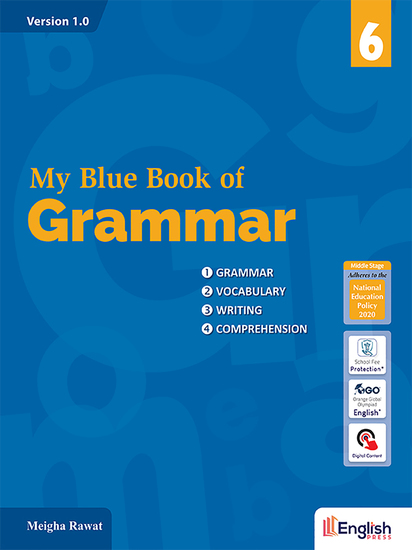
  • My Blue Book of Grammar for Class 6 - cover

    My Blue Book of Grammar for Class 6

    Meigha Rawat

    • 0
    • 0
    • 0
    A Grammar Series That Uses the Functional Approach 
    
    KEY FEATURES 
    - Functional approach to grammar teaching, using exemplars to illustrate the usage before defining the structure and rules 
    - Vocabulary taught through language-in-use to build the learners’ vocabulary through use rather than memorisation of rules 
    - Contemporary topics to inculcate 21-century skills amongst learners 
    - Use of literature to help learners understand how grammar is used in text 
    - A comprehension section comprising texts from different genres so that learners may relate grammar to different types of works produced in English 
    - Phonics in Grades 1 and 2 to teach the very basis of language 
    - Uniquely stylised illustrations 
    - Activities such as puzzles, crosswords, word grids and games to aid the facilitator in using the concept of ‘flipped classroom’ 
    - Periodic tests to help the learners self-assess the acquisition of concepts 
    - Digital component to cater to a technology-driven classroom 
    
    DESCRIPTION: 
    My Blue Book of Grammar is a course that has been conceptualized and designed keeping in mind the increasingly dynamic role of the English language in today’s world. Especially in our country, where English serves as the lingua franca, a grammar course has to offer not only an exposition of the pedagogy but also the exhibition of the utility of that pedagogy. The aim of a grammar series should be to encourage the development of competency amongst learners, even though their proficiency levels may vary. While the level of exposure to English of all learners may be different, a grammar series should aid in the development of a certain level of confidence amongst the learners, with the end result being that they are able to converse without hesitation in English. 
    
    WHAT WILL YOU LEARN 
    - Understand grammar concepts 
    - Learn how to use different vocabulary concepts taught through language-in-use 
    - Learn 21-century skills 
    - Develop deeper understanding of and appreciation for literature 
    - Have clearer pronunciation through a better understanding of phonics 
    
    WHO THIS BOOK IS FOR: 
    School students of Grades 6 
    
    TABLE OF CONTENTS 
    GRAMMAR 
    1. Types of Clauses – Let’s Recall 
    2. Simple, Compound and Complex Sentences 
    3. Pronoun–Antecedent Agreement 
    4. Reflexive and Intensive Pronouns 
    5. Auxiliaries and Modals – Revision 
    6. Transitive and Intransitive Verbs 
    8. Future Continuous Form 
    9. Future Perfect Form 
    10. Future Perfect Continuous Form 
    11. Types of Adjectives 
    12. Hyphens in Compound Adjectives 
    13. Adjectives vs Adverbs 
    14. Colon 
    15. Punctuating Addresses 
    Test Paper 1 
    VOCABULARY 
    16. Noun–Noun Collocations 
    17. Prefix: sub–, non– 
    18. Latin and Greek Roots of Words 
    19. Analogies 
    20. Idioms and Adages 
    21. Formal and Informal Language 
    22. Words with Multiple Meanings 
    23. Clichés 
    24. Shades of Meaning 
    25. Figures of Speech 
    Test Paper 2 
    WRITING 
    26. Formal Letter Writing 
    27. Informal Letter Writing 
    28. Writing a Formal Email 
    29. Writing an Informal Email 
    30. Interview Transcription 
    31. Writing a Story 
    32. Writing an Itinerary 
    33. Writing a Poem 
    34. Using Imagery in Poems 
    35. Avoiding Clichés When Writing a Poem 
    Test Paper 3 
    COMPREHENSION 
    36. Message to the Grassroots 
    37. Mallakhamb 
    38. Luka 
    39. The Solitude of Latin America 
    Orange Global Olympiad – English Sample Paper
    Zum Buch
  • Glory and Decay - The Roman Empire through the Ages - cover

    Glory and Decay - The Roman...

    Rogan Fish

    • 0
    • 0
    • 0
    The story of Rome’s rise is one of ambition, resilience, and conquest. What began as a small settlement along the Tiber River grew into one of the most powerful empires in history. Rome’s transformation from a monarchy to a republic and eventually into a sprawling empire was shaped by its military prowess, political strategies, and influential leaders. 
    Rome’s early history is rooted in legend. According to myth, the city was founded in 753 BCE by Romulus, who, after a dispute, killed his twin brother Remus. While this tale is shrouded in mystery, archaeological evidence suggests that settlements on the Palatine Hill date back much earlier. Initially ruled by kings, Rome transitioned to a republic in 509 BCE after the overthrow of the last Etruscan monarch, Tarquin the Proud. This shift established a new political system that placed power in the hands of elected officials, most notably the Senate and the consuls. 
    The Republic’s success was largely due to its military strength. The Roman legions were highly disciplined and adaptable, allowing Rome to expand its influence across the Italian Peninsula. Through a combination of warfare and strategic alliances, Rome defeated neighboring city-states and incorporated them into its growing domain. One of its defining moments came during the Punic Wars against Carthage (264–146 BCE), where figures like Scipio Africanus led Rome to decisive victories, securing its dominance over the Mediterranean.
    Zum Buch