Rejoignez-nous pour un voyage dans le monde des livres!
Ajouter ce livre à l'électronique
Grey
Ecrivez un nouveau commentaire Default profile 50px
Grey
Abonnez-vous pour lire le livre complet ou lisez les premières pages gratuitement!
All characters reduced
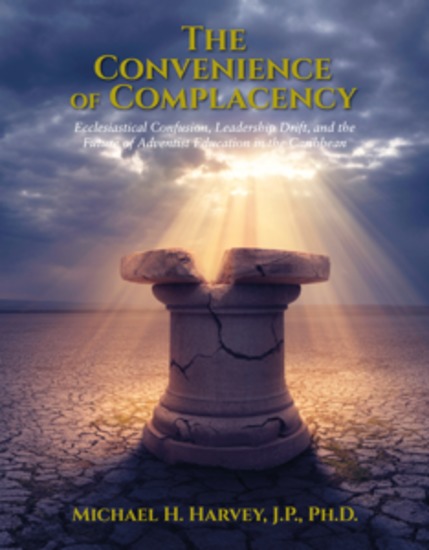
The Convenience of Complacency - Ecclesiastical Confusion Leadership Drift and the Future of Adventist Christian Education in the Caribbean - cover

The Convenience of Complacency - Ecclesiastical Confusion Leadership Drift and the Future of Adventist Christian Education in the Caribbean

PHD Michael H. Harvey JP

Maison d'édition: Spines

  • 0
  • 0
  • 0

Synopsis

In the Caribbean, Adventist academic institutions grapple with complacency amidst a legacy of faith-based education. The call for visionary leadership and innovation rings out, to revive the spirit of learning and service that once defined them. This narrative urges a blending of tradition with fresh fervor, challenging educators to cultivate minds for a higher purpose and to renew their commitment to transformative education, balancing scholarship with unwavering faith, and shaping destinies.
Disponible depuis: 08/01/2026.
Longueur d'impression: 312 pages.
D'autres livres qui pourraient vous intéresser

  • Trauma Proof - Healing Attachment and the Science of Prevention - cover

    Trauma Proof - Healing...

    Benjamin Perks

    • 0
    • 0
    • 0
    From the moment they're born, babies seek a loving parental attachment. When that connection is absent, it derails childhood development in ways that can last a lifetime. The annual health costs of illness related to child trauma for North America and Europe alone are 1.3 trillion dollars. Child trauma is much more widespread than previously thought and passes from one generation to the next. But that's not the end of the story—there is overwhelming evidence that this intergenerational transmission can be disrupted. So why isn't the eradication of childhood trauma a tier-one public priority, like defense or growth? 


    In Trauma Proof, Benjamin Perks argues that it must be, and that we can tackle it as a public health problem like COVID-19, by 1) making sure everyone is aware of the risk; 2) preventing transmission; and 3) opening pathways to healing. Perks shows we have the tools to make these three things happen, and the evidence to show they work. Psychology, neuroscience, and medicine have made huge leaps in the past twenty-five years. We now know what causes Adverse Childhood Experiences (ACEs), how to reduce them, and how to address them. For the first time in history, we know child mistreatment is not inevitable. Trauma Proof is a rallying call to address child trauma as the public health crisis it is—because we can do better for kids, and we should.
    Voir livre
  • History of Mongolia - A Comprehensive Overview of Mongolian History Genghis Khan & Kublai Khan and the Yuan Dynasty - cover

    History of Mongolia - A...

    Days of History

    • 0
    • 0
    • 0
    Are you ready to embark on a journey through the centuries?  
    This book about the History of Mongolia takes you on an epic adventure, tracing the country's fascinating past and exploring its enduring legacy. 
    From the rise of the legendary Genghis Khan to the fall of the Mongol Empire, this book is a comprehensive and engaging account of Mongolia's rich history. 
    You'll follow the footsteps of nomadic tribes, explore vast steppes, and witness the triumphs and tragedies of a people shaped by their environment and their fierce spirit. 
    Embark on a journey through time and explore Mongolia's epic and captivating history.Discover the fascinating history of Mongolia and its two most iconic leaders, Genghis Khan and Kublai Khan, and their impact on the formation of the legendary Yuan Dynasty.Dive deep into the ancient culture of Mongolia and learn about the nomadic lifestyle, military tactics, and political intrigue that shaped the course of history in Central Asia.Uncover the secrets of Genghis Khan's legendary conquests and Kublai Khan's successful reign, and gain insights into how their leadership styles and ideologies influenced the development of modern-day Mongolia and China. 
    With captivating storytelling, this book is a must-read for anyone interested in the history of Asia, the nomadic way of life, or the resilience of the human spirit. 
    Order your copy today and embark on a journey into the History of Mongolia.
    Voir livre
  • Rome's Imperial Legacy - The Empire's Enduring Impact - cover

    Rome's Imperial Legacy - The...

    Rogan Fish

    • 0
    • 0
    • 0
    The rise of the Roman Empire marks one of the most transformative periods in world history. Emerging from humble beginnings as a small settlement on the banks of the Tiber River, Rome grew to dominate the ancient world through a combination of military prowess, political innovation, and cultural assimilation. This chapter explores the foundations of Roman power, the empire’s expansive reach across continents, and the key figures who shaped its rise. 
    Rome's origins date back to the 8th century BCE, with its legendary founding attributed to Romulus and Remus. Initially a monarchy, Rome evolved into a republic around 509 BCE after the overthrow of the last Etruscan king. This transition marked the beginning of a new political era, where power rested with the Senate and elected magistrates. The republican framework, characterized by a system of checks and balances, laid the foundation for Rome's expansive ambitions. As the republic matured, it developed a complex legal system and a robust military structure that would be instrumental in its growth. 
    One of Rome’s most significant advantages was its strategic location. Positioned at the crossroads of the Mediterranean, Rome became a hub for trade and communication. The city's ability to integrate conquered territories through road networks and infrastructure projects further solidified its control. Additionally, the Roman practice of granting varying levels of citizenship to conquered peoples helped maintain loyalty and stability within the expanding state.
    Voir livre
  • The Involuntary American - A Scottish Prisoner's Journey to the New World - cover

    The Involuntary American - A...

    Carol Gardner

    • 0
    • 0
    • 0
    In the winter of 1650–51, 150 ragged Scottish prisoners of war arrived at Massachusetts Bay Colony, where they were sold as indentured laborers for twenty to thirty pounds each. Among them was Thomas Doughty, a common foot soldier who had survived the Battle of Dunbar. Doughty was among some 420 Scottish soldiers who were captured during the War of the Three Kingdoms, transported to America, and sold between 1650 and 1651. Their experiences offer a fresh perspective on seventeenth-­century life. 


    The Involuntary American: A Scottish Prisoner's Journey to the New World describes Doughty's life as a soldier, prisoner of war, exile, servant, lumberman, miller, and ultimately free landowner. It follows him and his peers through critical events: the apex of the Little Ice Age, the War of the Three Kingdoms, the colonization of New England, the burgeoning transatlantic trade in servants and slaves, King Philip's and King William's wars, and the Salem witch crisis. 


    The Involuntary American demonstrates how even indi­viduals of humble circumstances were swept into the mael­strom of the First Global Age. It expands our understanding of immigration to the colonies, colonial servitude, the link­ages and tensions between Europe, Massachusetts Bay, and America's northeastern frontier, and of New England socie­ty in the early colonial period.
    Voir livre
  • World Prehistory - The Basics - cover

    World Prehistory - The Basics

    Brian M. Fagan, Nadia Durrani

    • 0
    • 0
    • 0
    Written in a non-technical style by two archaeologists and experienced writers about the past, the story begins with human origins in Africa some six million years ago and the spread of our remote ancestors across the Old World. Then we return to Africa and describe the emergence of Homo sapiens (modern humans) over 300,000 years ago, then, much later, their permanent settlement of Europe, Eurasia, Asia, and the Americas. From hunters and foragers, we turn to the origins of farming and animal domestication in different parts of the world after about 11,000 years ago and show how these new economies changed human existence dramatically. The narratives chronicle the rise and fall of civilizations, and the devastating effects of long droughts on many of them. The closing chapter poses a question: Why is world prehistory important in the modern world? What does it tell us about ourselves? 


    Providing a simple, but entertaining and stimulating, account of the prehistoric past from human origins to today from a global perspective, World Prehistory: The Basics is the ideal guide to the story of our early human past and its relevance to the modern world.
    Voir livre
  • Inca Mythology - Sacred Legends of the Inca Empire - cover

    Inca Mythology - Sacred Legends...

    Matthew Fillard

    • 0
    • 0
    • 0
    The Inca Empire, at its zenith, spanned much of South America, including present-day Peru, Ecuador, Bolivia, and parts of Chile and Argentina. Known for its advanced architecture, agricultural systems, and administrative organization, the Inca civilization also possessed a deeply spiritual culture. Central to their worldview was a rich tapestry of mythology that explained the creation of the world, the origins of humankind, and the roles of the gods in the natural and spiritual realms. These sacred legends were not just stories; they were the very foundation upon which the Inca society was built, shaping everything from daily rituals to the governance of the empire.  
    Inca mythology was intricately connected to the natural world, with gods and deities representing various elements of the environment, such as the sun, the moon, the earth, and water. The Inca people believed that these deities were not distant, abstract beings but rather active forces that influenced their lives. The most important gods were thought to have a direct relationship with the ruler, often considered to be divine or descended from these gods. As such, the Inca king, or Sapa Inca, was revered as the son of the sun god, Inti, and his authority was considered sacred.  
    The role of mythology extended beyond the divine and into the social and political spheres. It was through myth that the Inca legitimized their rule, connected their empire to the divine order, and reinforced the unity of their vast territories. Legends of the first rulers, such as Manco Capac and Mama Ocllo, were tied to creation myths that depicted them as divine figures sent to bring civilization to the world. These stories were used to justify Inca conquests and to explain the hierarchical structure of society. 
    Voir livre