Begleiten Sie uns auf eine literarische Weltreise!
Buch zum Bücherregal hinzufügen
Grey
Einen neuen Kommentar schreiben Default profile 50px
Grey
Jetzt das ganze Buch im Abo oder die ersten Seiten gratis lesen!
All characters reduced
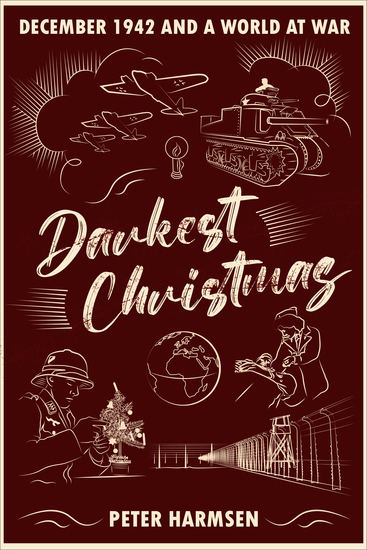
Darkest Christmas - December 1942 and a World at War - cover

Darkest Christmas - December 1942 and a World at War

Peter Harmsen

Verlag: Casemate

  • 0
  • 0
  • 0

Beschreibung

"This book is of interest to any scholar of World War II, particularly those focused on bridging culture and war. Highly readable, this text is suitable for undergraduate and popular audiences as well. Many should find its analysis to be a refreshing take on the well-trodden field of World War II histories." — Journal of Military HistoryDecember 1942 saw the bloodiest Christmas in the history of mankind. From the islands in the Pacific to the China front, from the trenches in Russia to the battle lines in North Africa, in the skies over Europe and in the depths of the Atlantic, men were killing each other in greater numbers than ever before. The Holocaust continued, and innocent civilians were murdered by the thousands throughout the evil Nazi empire, even as the perpetrators celebrated the birth of Christ.  Millions stationed in far-off lands amid the greatest conflict in human history feared this was their last Christmas in freedom, or their last Christmas alive. At the same time as the slaughter continued unabated, throughout the world there were random acts of kindness, born out of an instinctive feeling of the essential brotherhood of man. These gestures also straddled religious barriers and sometimes included those of non-Christian faiths. Even some Japanese, otherwise embarked on a self-declared crusade against the West, relented for a few precious hours in acknowledgment of the holiday.  At the same time, Christmas 1942 saw the injunction of ‘good will to man’ distorted in ugly and callous ways. At Auschwitz, SS guards played cruel games with their prisoners. In Berlin, the German heart of darkness, Propaganda Minister Joseph Goebbels spent time with his family while still buried in feverish fantasies about the Jewish world conspiracy.  Christmas 1942 saw the entire range of man’s conduct towards his fellow man, reflecting the extremes of behavior, good and bad, that World War II gave rise to. The way the holiday was marked around the world tells a deeper and more universal story of the human condition in extraordinary times.
Verfügbar seit: 21.10.2022.
Drucklänge: 240 Seiten.

Weitere Bücher, die Sie mögen werden

  • How to be Heard Without Screaming! - Find Your Voice and Use It Skillfully in 30 Days - cover

    How to be Heard Without...

    Brenda J. Viola

    • 0
    • 0
    • 0
    It's time to find your voice. 
    Have you ever felt invisible? Your lips are moving, but no one's hearing you. 
    It's frustrating when your great ideas or insights are overlooked. It can make you want to scream! 
    Instead, take the next thirty days to learn and implement powerful tactics to improve your quality of communication. 
    Whether making a case for budget dollars, being interviewed by a reporter, speaking up in a staff meeting, or having a heart-to-heart with your partner, your voice is important. 
    Not only will this book help you find your voice, but it will also empower you to use it skillfully.
    Zum Buch
  • In the Mind of Stalin - cover

    In the Mind of Stalin

    James Greensmith

    • 0
    • 0
    • 0
    On 1 October 1939, Winston Churchill, First Lord of the Admiralty and soon to be the UK’s wartime leader, described Russia as ‘a riddle wrapped in a mystery inside an enigma’. The same can certainly be said of Stalin. How can this paradox of a man, who on the one hand had once exhibited great tenderness and kindness to his daughter Svetlana, and on the other sent millions – including members of his own family - to their deaths, be explained? 
     
    It is impossible to quantify the total number of deaths attributable to the policies of Stalin, but the ‘Excess Mortality’ (i.e., deaths over and above what would normally have been expected during the period in question) gives an approximate figure in excess of 40 million. 
     
    However, this is only part of the story of the amount of misery inflicted by the Stalin regime through torture, deliberate starvation, neglect, separation from loved ones, cold and hypothermia (e.g. in the prisons of Siberia), which is unquantifiable and unimaginable. 
     
    Svetlana confessed that she ‘would never undertake to “explain” what motivated all my father’s actions, simply because I do not possess the psychological genius of [Russian novelist] Dostoevsky, who knew how to “penetrate” into another man’s soul and “examine it from within”’.
    Zum Buch
  • Essay on the Principle of Population An - cover

    Essay on the Principle of...

    Thomas Malthus

    • 0
    • 0
    • 0
    Thomas Malthus, an English economist and cleric, published his influential work "An Essay on the Principle of Population" in 1798. The book introduced the idea that population growth would outstrip resources in the long run, leading to catastrophic consequences such as famine, disease, and war. 
    Malthus argued that population growth was exponential, while resources grew at a much slower arithmetic rate. This meant that over time, the population would inevitably outstrip the ability of the land to produce food, leading to a "positive check" on population growth in the form of famine, disease, or war. 
    Malthus also identified a "preventative check" on population growth, which he saw as the moral restraint of individuals to delay marriage and childbirth until they could support a family. However, he believed that this restraint would only be effective for the wealthy and educated classes, while the poor would continue to have large families out of necessity. 
    Malthus's ideas were controversial at the time, as they challenged the prevailing belief in progress and the idea that human ingenuity and technological advances could overcome any resource constraints. However, his ideas gained traction in the 19th century as Europe experienced a series of famines and population pressures, and his work influenced later economists such as David Ricardo and John Stuart Mill. 
    Critics of Malthus have argued that his predictions did not come to pass, as the world has experienced significant improvements in food production and living standards over the last two centuries. However, Malthus's ideas continue to influence debates on population growth, resource constraints, and environmental sustainability.
    Zum Buch
  • Capitalist Manifesto The: Book Summary & Analysis - cover

    Capitalist Manifesto The: Book...

    Briefly Summaries

    • 0
    • 0
    • 0
    This is a concise summary and analysis of 
    The Capitalist Manifesto, by Andrew Bernstein.
     
    It is not the original book and is not affiliated with or endorsed by Andrew Bernstein.
    Ideal those seeking a quick and insightful overview.
     
    The Capitalist Manifesto argues that capitalism is the most moral and practical system for advancing human progress. Through a combination of historical analysis, philosophical reasoning, and real-world examples, the book illustrates how individual rights, free markets, and personal responsibility foster innovation, prosperity, and a higher standard of living for all. It challenges prevailing misconceptions about capitalism and makes a compelling case for its ethical foundations and necessity in building a thriving society.
    Zum Buch
  • A Man of Letters - cover

    A Man of Letters

    Thomas Sowell

    • 0
    • 0
    • 0
    A Man of Letters traces the life, career, and commentaries on controversial issues of Thomas Sowell over a period of more than four decades through his letters to and from family, friends, and public figures ranging from Milton Friedman to Clarence Thomas, David Riesman, Arthur Ashe, William Proxmire, Vernon Jordan, Charles Murray, Shelby Steele, and Condoleezza Rice. These letters begin with Sowell as a graduate student at the University of Chicago in 1960 and conclude with a reflective letter to his fellow economist and longtime friend Walter Williams in 2005.
    Zum Buch
  • Idea of Progress The - JB Bury - cover

    Idea of Progress The - JB Bury

    J.B. Bury

    • 0
    • 0
    • 0
    "The Idea of Progress" by J.B. Bury is a seminal work in the history of ideas, first published in 1920. In this book, Bury explores the concept of progress, tracing its development from ancient times to the modern era. He examines the ways in which people have understood and pursued progress throughout history, and the impact that this has had on the world. 
    Bury argues that the idea of progress is a central feature of Western civilization, and that it has shaped the course of history. He shows how the idea of progress emerged in ancient Greece and Rome, and how it was further developed during the Renaissance and Enlightenment. Bury also examines the ways in which progress has been measured and evaluated over time, and how it has been used to justify social and political change. 
    Throughout the book, Bury offers a nuanced and critical perspective on the idea of progress. He acknowledges the many benefits that progress has brought, but also highlights the negative consequences of pursuing progress without sufficient consideration for its wider impact. He argues that progress should be guided by ethical considerations, and that we must be mindful of the unintended consequences of our actions. 
    "The Idea of Progress" is a thought-provoking and insightful book that continues to influence contemporary debates about the meaning and value of progress. It remains a valuable resource for anyone interested in the history of ideas, and the ways in which they shape our understanding of the world.
    Zum Buch