Begleiten Sie uns auf eine literarische Weltreise!
Buch zum Bücherregal hinzufügen
Grey
Einen neuen Kommentar schreiben Default profile 50px
Grey
Jetzt das ganze Buch im Abo oder die ersten Seiten gratis lesen!
All characters reduced
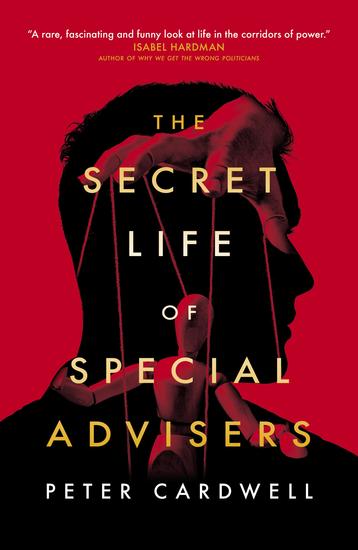
The Secret Life of Special Advisers - cover

The Secret Life of Special Advisers

Peter Cardwell

Verlag: Biteback Publishing

  • 0
  • 0
  • 0

Beschreibung

"A cracking read by a great writer." – Chris Mason, BBC political editor
"A rare, fascinating and funny look at life in the corridors of power." – Isabel Hardman, author of Why We Get the Wrong Politicians and Spectator assistant editor
"It's the book we have long needed." – Michael Crick
"A timely look at how some of the key relationships in Westminster work, and how they sometimes misfire." – Laura Kuenssberg, BBC presenter and former political editor
***
Shadowy geniuses whispering, Rasputin-like, into the ears of our elected politicians under a cloak of secrecy, or a crucial but undervalued cog in the machinery of government? … Or just a rag-tag band of weirdos and misfits?
Despite the acres of speculation devoted to special advisers from Alastair Campbell to Dominic Cummings, their role is much misunderstood. Who are the people Piers Morgan once called 'these miserable little creatures' and just how much influence do they have?
Peter Cardwell served as SpAd to four Cabinet ministers, acting as media adviser, political fixer, troubleshooter and occasional wardrobe consultant. In this candid, compelling and frequently hilarious insider account, he reveals what the job really involves, from dealing with counter-terror emergencies in Cobra to explaining to the Justice Secretary what a dental dam is, to having your inside leg measured in a government office.
Packed with advice on navigating the perks and pitfalls of the job, The Secret Life of Special Advisers will inform and entertain anyone who has ever wondered what these mysterious figures really do all day.
Verfügbar seit: 14.06.2022.
Drucklänge: 304 Seiten.

Weitere Bücher, die Sie mögen werden

  • Undermining the US Constitution - How the communist manifesto of 1848 blueprints the actions of the democratic party - cover

    Undermining the US Constitution...

    Diane S. Vann

    • 0
    • 0
    • 0
    As a nurse I have been in situations where patients learned very bad news about the state of their health, news that was not received well by them, their families, or even their medical team. When preparing this book, my feelings were much the same as when I was in those situations.The bad news about the health of our nation is, like cancer in a patient's body, communism (also known as "Marxism") has grown in the United States. Like cancer, it started with an unnoticed seed and grew insidiously with little sign or symptom. Now like cancer, communism is on the brink of overwhelming us.Because I know that knowledge of their cancer is essential to my patient's first step towards survival, I believe that knowledge of our communism is essential to the United States of America's first step towards survival. So within this book, I describe: how I learned about the symptoms (The Real Communist Threat Witnessed); the disease (the Introduction and Sections 1, 2, 3 and 4 of the Communist Manifesto); the signs and symptoms and the treatment and cure (Constitution versus Communist Manifesto: The War within America).Extremist Socialists, also known as Communists, like Extremist/Radical Islamists believe their ends justify their means (that is: lying, cheating, stealing, and killing). Beware of their joint product, Interfaith Dialogue.
    Zum Buch
  • Who Cleans the Park? - Public Work and Urban Governance in New York City - cover

    Who Cleans the Park? - Public...

    John Krinsky, Maud Simonet

    • 0
    • 0
    • 0
    America’s public parks are in a golden age. Hundreds of millions of dollars—both public and private—fund urban jewels like Manhattan’s Central Park. Keeping the polish on landmark parks and in neighborhood playgrounds alike means that the trash must be picked up, benches painted, equipment tested, and leaves raked. Bringing this often-invisible work into view, however, raises profound questions for citizens of cities. In Who Cleans the Park? John Krinsky and Maud Simonet explain that the work of maintaining parks has intersected with broader trends in welfare reform, civic engagement, criminal justice, and the rise of public-private partnerships. Welfare-to-work trainees, volunteers, unionized city workers (sometimes working outside their official job descriptions), staff of nonprofit park “conservancies,” and people sentenced to community service are just a few of the groups who routinely maintain parks. With public services no longer being provided primarily by public workers, Krinsky and Simonet argue, the nature of public work must be reevaluated. Based on four years of fieldwork in New York City, Who Cleans the Park? looks at the transformation of public parks from the ground up. Beginning with studying changes in the workplace, progressing through the public-private partnerships that help maintain the parks, and culminating in an investigation of a park’s contribution to urban real-estate values, the book unearths a new urban order based on nonprofit partnerships and a rhetoric of responsible citizenship, which at the same time promotes unpaid work, reinforces workers’ domination at the workplace, and increases the value of park-side property. Who Cleans the Park? asks difficult questions about who benefits from public work, ultimately forcing us to think anew about the way we govern ourselves, with implications well beyond the five boroughs.
    Zum Buch
  • Glinda of Oz - cover

    Glinda of Oz

    L. Frank Baum

    • 0
    • 0
    • 0
    Glinda the Good, the great sorceress of Oz takes the spotlight in this, the very last OZ book written by L. Frank Baum himself. Ozma hears of previously unknown parts of her kingdom having difficulties and at war with each other and knows it is her duty to go there and stop the hostilities. She and Dorothy find truly bad conditions in these areas of Flathead Mountain and the Skeezers Magic Island where the inhabitants are being mistreated. But through events that could only happen in Oz, they become trapped in a submerged island along with all the Skeezers. Glinda and all the well known characters of Oz set off to attempt a rescue. Do they make it in time? Listen to this book full of magic and exciting adventures and see.
    Zum Buch
  • The South African Famine of 1820 - Colonial Mismanagement and Drought - cover

    The South African Famine of 1820...

    Sarah Willards

    • 0
    • 0
    • 0
    In the early 19th century, South Africa was a land marked by contrasts—fertile valleys and arid plains, indigenous traditions and growing colonial ambition. The region most affected by the famine of 1820 was the Cape Colony, which had come under British control in 1806. This colony served as a strategic resupply point for British ships sailing to and from the East Indies, and it was gradually becoming a hub for European settlement, particularly by the Dutch-descended Boers and British immigrants arriving as part of state-sponsored schemes. These settlers introduced European agricultural practices, often ill-suited to the diverse and unpredictable South African climate. 
    The colony’s geography played a significant role in shaping life and livelihoods. Coastal areas received more rainfall and were relatively fertile, while the interior—known as the Karoo and other semi-arid zones—was prone to drought and soil erosion. Farming communities depended heavily on seasonal rainfall to sustain crops such as wheat, maize, and barley, as well as livestock including sheep and cattle. When these rains failed, communities faced immediate and severe consequences, especially in regions where irrigation infrastructure was minimal or nonexistent. 
    The social landscape of the Cape was equally complex. Indigenous groups such as the Xhosa, Khoikhoi, and San had long adapted to the challenges of the land through mixed economies of herding, gathering, and small-scale farming. Their interaction with European settlers was often strained, marked by competition over land and water sources, cultural misunderstandings, and colonial policies that marginalized local traditions and governance structures.
    Zum Buch
  • Your Right to Self-Identify My Right to Disagree - Who is oppressing whom? - cover

    Your Right to Self-Identify My...

    Kenny Bomer

    • 0
    • 0
    • 0
    In today’s world, a new social contagion is being spread by provocateurs and social media influencers who are determined to pressure people into accepting falsehood over truth. Battle lines have been drawn on both sides of the debate regarding “Transgenderism” and the mental health effects of Gender Dysphoria. As the battle rages, First Amendments Rights of Freedom of Speech that protect people’s rights to say unpopular things without government interference, and the right to refuse to say things the government wants said, are being called into question. 
    The minority group argues that it is their right to “Self-Identify” as whatever they wish in order to accommodate their thoughts and feelings instead of accepting their bodily realities, thereby defying biological design in the process. In response, the majority fight to maintain their right to disagree with people who psychologists say suffer from mental health issues. Common sense and basic language are being challenged and unfamiliar and innovative words have been invented to define one hundred and twelve genders, as claimed by Transgender Activists. This recent phenomenon leaves society to face many provocative questions. 
    Should the thoughts and feelings of one group override another groups desire to rely on truth and biological facts? Who is oppressing whom? For the God-Conscious, what roll does our Creator play in it all?
    Zum Buch
  • Navalny - Putin's Nemesis Russia's Future? - cover

    Navalny - Putin's Nemesis...

    Jan Matti Dollbaum, Ben Noble,...

    • 0
    • 0
    • 0
    A fascinating account of Russia's famous dissident and the politics he embodies. 


    Who is Alexei Navalny? Poisoned in August 2020 and transported to Germany for treatment, the politician returned to Russia in January 2021 in the full glare of the world media. His immediate detention at passport control set the stage for an explosive showdown with Vladimir Putin. 


    But Navalny means very different things to different people. To some, he is a democratic hero. To others, he is betraying the Motherland. To others still, he is a dangerous nationalist. Navalny explores the many dimensions of his political life, from his pioneering anti-corruption investigations to his ideas and leadership of a political movement. It also looks at how his activities and the Kremlin's strategies have shaped one another. 


    Navalny makes sense of this divisive character, revealing the contradictions of a man who is the second most important political figure in Russia—even when behind bars. In order to understand modern Russia, you need to understand Alexei Navalny.
    Zum Buch