Join us on a literary world trip!
Add this book to bookshelf
Grey
Write a new comment Default profile 50px
Grey
Subscribe to read the full book or read the first pages for free!
All characters reduced
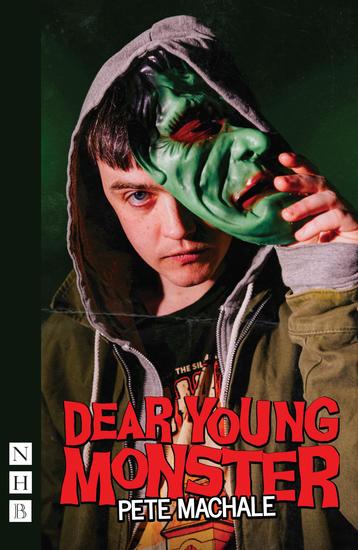
Dear Young Monster - cover

Dear Young Monster

Pete MacHale

Publisher: Nick Hern Books

  • 0
  • 0
  • 0

Summary

'A jolt, a shock, a humming just beneath my skin, something surging through my veins, my body awakening, buzzing to life finally, FINALLY.'
A young trans man, struggling as he begins his medical transition, drops out of university and retreats to his quiet hometown. His friends are gone. The neighbours are watching. His body is changing faster than he can make sense of it... until a midnight screening of Frankenstein offers him a strange kind of salvation.
Staring into the monster's big, dead, sad eyes, something finally clicks: for the first time, he feels seen.
Vivid, witty and humane, Dear Young Monster is Pete MacHale's debut solo show, delving into fear, otherness, and what it means to embrace being the monster the world keeps telling you that you are.
It premiered at Bristol Old Vic in 2024, directed by Sammy Glover, and was nominated for the WhatsOnStage Award for Best Studio Production. It transferred to Soho Theatre, London, in 2025.
Available since: 08/14/2025.
Print length: 56 pages.

Other books that might interest you

  • Tamburlaine the Great Part 1 - cover

    Tamburlaine the Great Part 1

    Christopher Marlowe

    • 0
    • 0
    • 0
    Tamburlaine the Great is the name of a play in two parts by Christopher Marlowe. It is loosely based on the life of the Central Asian emperor, Timur 'the lame'. Written in 1587 or 1588, the play is a milestone in Elizabethan public drama; it marks a turning away from the clumsy language and loose plotting of the earlier Tudor dramatists, and a new interest in fresh and vivid language, memorable action, and intellectual complexity. Along with Thomas Kyd's The Spanish Tragedy, it may be considered the first popular success of London's public stage.Marlowe, generally considered the greatest of the University Wits, influenced playwrights well into the Jacobean period, and echoes of Tamburlaine's bombast and ambition can be found in English plays all the way to the Puritan closing of the theaters in 1642. While Tamburlaine is considered inferior to the great tragedies of the late-Elizabethan and early-Jacobean period, its significance in creating a stock of themes and, especially, in demonstrating the potential of blank verse in drama, are still acknowledged.  (Summary by Wikipedia) 
     
    CAST 
     
    Prologue, Dramatis Personae, GOVERNOR OF DAMASCUS: Martin GeesonMYCETES, king of Persia; MAGNETES, Median lord; CAPOLIN, an Egyptian; A BASSO; ATTENDANT: Algy PugCOSROE, his brother: Bruce PirieMEANDER, Persian lord: David RichardsonTHERIDAMAS, Persian lord: Timothy FergusonORTYGIUS, Persian lord: sparks0314CENEUS, Persian lord: DerekPMENAPHON, Persian lord: AlanTAMBURLAINE, a Scythian shepherd: David GoldfarbTECHELLES, follower of Tamburlaine: ReadalotUSUMCASANE, follower of Tamburlaine: Nigel BoydellBAJAZETH, emperor of the Turks: bishKING OF FEZ; KING OF MOROCCO; SOLDAN OF EGYPT; AGYDAS, Median lord: Marty KrisKING OF ARGIER: JafbadoKING OF ARABIA: Robert ScheidPHILEMUS, a spy: Sarah CramptonZENOCRATE, daughter to the Soldan of Egypt: Sandra GANIPPE, her maid: AvailleZABINA, wife to BAJAZETH: Amy GramourEBEA, her maid: ChyAnne DonnellFIRST VIRGIN, VIRGINS: Elizabeth KlettSECOND VIRGIN, VIRGINS: Arielle LipshawNarrator: Tina Nuzzi
    Show book
  • Charm - cover

    Charm

    Rupert Brooke

    • 0
    • 0
    • 0
    To all who knew him, the man himself was at least as important as his work. "As to his talk" — I quote again from Mr. Somerset — "he was a spendthrift. I mean that he never saved anything up as those writer fellows so often do. He was quite inconsequent and just rippled on, but was always ready to attack a careless thinker. On the other hand, he was extremely tolerant of fools, even bad poets who are the worst kind of fools — or rather the hardest to bear — but that was kindness of heart."Of his personal appearance a good deal has been said. "One who knew him," writing in one of the daily papers, said that "to look at, he was part of the youth of the world. He was one of the handsomest Englishmen of his time. His moods seemed to be merely a disguise for the radiance of an early summer's day." (From Rupert Brooke: A Biographical Note by Margaret Lavington in THE COLLECTED POEMS OF RUPERT BROOKE, (from which this poem is taken.)
    Show book
  • The Arctic Diaries - cover

    The Arctic Diaries

    Melissa Davies

    • 0
    • 0
    • 0
    A poetic project of preservation and sense of place. Rich imagery and language dives deep into the lives of coastal communities in the far north of Norway, from debut poet, Melissa Davies
    When the fisherman dies Fleinvær stories spill out silver strings, like guts from a spring catch. But between these pages they survive.
    The Arctic Diaries chart generations of the characters, myths and misremembered details that make up the oral traditions of a windswept archipelago in Norway's far north. Created over a single arctic winter, using stories gathered from the last surviving fisherman of Langholmen, this collection of poems are part history, part field notes, exploring what role the outsider plays in preserving the experience of another.
    Show book
  • Hernani - cover

    Hernani

    Victor Hugo

    • 0
    • 0
    • 0
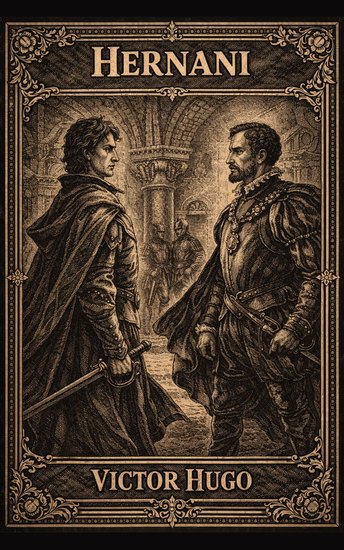
    Hernani is Victor Hugo's electrifying romantic drama—a bold and revolutionary play that transformed the French theatrical world and ignited one of the most famous literary battles in history. First performed in 1830, this passionate tale of love, honor, and defiance challenged the rigid conventions of classical drama and announced the triumphant arrival of Romanticism on the French stage.
    
    Set in 16th-century Spain, Hernani tells the story of a noble outlaw driven by love and vengeance. Hernani, a mysterious and charismatic rebel, is consumed by his devotion to the beautiful Doña Sol. Yet he is not alone in his desire for her hand. Don Carlos, the ambitious King of Spain (and future Holy Roman Emperor), and Don Ruy Gomez de Silva, her aging but powerful guardian, are equally determined to possess her. What unfolds is a fierce struggle shaped by political ambition, personal pride, and the unbreakable codes of honor that govern their world.
    
    At its heart, Hernani is a story of romantic idealism colliding with the harsh realities of power and duty. Hugo crafts characters who are larger than life—men ruled by passion, pride, and destiny. The play pulses with emotional intensity, secret meetings, daring escapes, and dramatic confrontations. Love is portrayed not as gentle or safe, but as a force capable of inspiring heroism and tragedy alike.
    
    Beyond its gripping narrative, Hernani stands as a milestone in literary history. Its premiere sparked the legendary "Battle of Hernani," as supporters of Romanticism clashed with defenders of classical tradition. Hugo broke away from strict theatrical rules, blending poetic language with historical drama and giving voice to raw emotion and individual freedom. The result was a work that reshaped modern theater and influenced generations of writers.
    
    Themes of loyalty, sacrifice, destiny, and rebellion run throughout the play. The tension between personal desire and social obligation creates a powerful emotional undercurrent, leading to a conclusion both dramatic and unforgettable. Hugo's language soars with lyrical beauty, while his characters grapple with the timeless conflicts between love and honor, freedom and authority.
    
    Hernani is more than a romantic tragedy—it is a declaration of artistic independence and a celebration of passion unrestrained by convention. For readers and theater lovers alike, this masterpiece offers a vivid journey into a world where hearts rule over reason and where destiny is sealed by courage and sacrifice.
    Show book
  • Floodmeadow - cover

    Floodmeadow

    Toby Martinez de las Rivas

    • 0
    • 0
    • 0
    The Floodmeadow draws us into a seething pastoral where lightning threatens and thunder gathers, pylons and powerlines hum, and steel-framed gates sing out into the wind. In these incantatory pieces, everything is present at once. The landscape, teetering on apocalypse, is characterised by collision and disintegration. Among fragments of memory and history are meticulously journaled observations of the natural world: the moorhen who 'with exaggerated delicacy steps / free of the reedbeds'; the dragonfly that 'pushes itself through the armour / of its body' to be born.  The world is populated by archangels and wild gods, the roar of military aircraft, hunting dogs caught permanently suspended in the chase and a car that veers from the road into the floodwater in which the whole collection is saturated. Human relations are fleeting and vulnerable, appearing in the impression of a wedding or the recurring moments captured between a father and son, who make between them delicate balsawood constructions, which - as the poems do themselves - take flight in the turmoil, ecstatic one moment, plunged into darkness the next. This is a visionary collection that invokes other times, dimensions and soundscapes to tell out some word of beauty and abundance in the here and now.
    Show book
  • Circumstances Affecting the Heat of the Sun's Rays - cover

    Circumstances Affecting the Heat...

    Amanda Quaid

    • 0
    • 0
    • 0
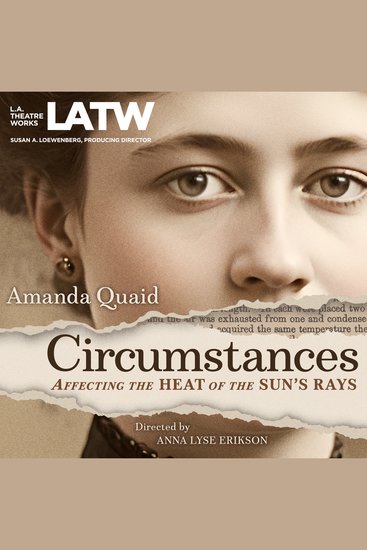
    You may not know her name, but Eunice Newton Foote made groundbreaking discoveries about the greenhouse effect in the 1850s. Her experiments showed that different gases, including carbon dioxide, absorb and trap heat, an early milestone in the history of climate science. And even though her findings were published in a leading scientific journal – a rarity in the days of a male-dominated field – her work remained virtually unknown until recently. Now, thanks to playwright Amanda Quaid, we have a dramatized portrait of the scientist’s life at the time she published her pioneering study, which lends its name to the title of the play.


    This play is part of L.A. Theatre Works’ Relativity Series of science-themed plays. Lead funding for the Relativity Series is provided by the Alfred P. Sloan Foundation, bridging science and the arts in the modern world.


    Recorded at The Invisible Studios, West Hollywood, in November 2024.


    Directed by Anna Lyse Erikson
     
    Producing Director: Susan Albert Loewenberg


    An L.A. Theatre Works full-cast recording, starring:


    Geoffrey Arend as Elisha Foote
     
    Tara Lynne Barr as Augusta Foote
     
    Scott Brick as the Narrator and Joseph Henry
     
    Jake Green as the Glazier
     
    Monica McSwain as Mary Foote
     
    Emily Swallow as Eunice Newton Foote


    Senior Producer: Anna Lyse Erikson
     
    Prepared for audio by Mark Holden
     
    Recording Engineer and Editor: Neil Wogenson
     
    Mixing Engineer: Charles Carroll
     
    Designed by Mark Holden and Charles Carroll for The Invisible Studios, West Hollywood
     
    Senior Radio Producer: Ronn Lipkin
     
    Foley Artist: Stacey Martinez
    Show book