Unisciti a noi in un viaggio nel mondo dei libri!
Aggiungi questo libro allo scaffale
Grey
Scrivi un nuovo commento Default profile 50px
Grey
Iscriviti per leggere l'intero libro o leggi le prime pagine gratuitamente!
All characters reduced
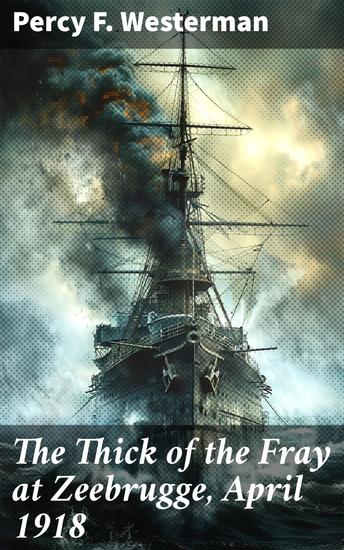
The Thick of the Fray at Zeebrugge April 1918 - Navigating the Depths of WWI Naval Bravery - cover

The Thick of the Fray at Zeebrugge April 1918 - Navigating the Depths of WWI Naval Bravery

Percy F. Westerman

Casa editrice: Good Press

  • 0
  • 0
  • 0

Sinossi

In "The Thick of the Fray at Zeebrugge, April 1918," Percy F. Westerman delivers a gripping portrayal of one of World War I's most audacious naval operations. Blending meticulous historical detail with a vivid narrative style, Westerman immerses readers in the atmosphere of early 20th-century warfare, capturing the chaos and bravery of the Zeebrugge raid. The text serves not only as a thrilling adventure tale but also as an exploration of themes such as duty, heroism, and the moral ambiguities faced by soldiers in the throes of combat, all contextualized within the larger scope of a global conflict that reshaped world history. Percy F. Westerman, a prolific British author and a former naval officer himself, was profoundly influenced by his maritime experiences and his observations of naval warfare. His works often reflect a blend of adventure and authenticity, showcasing his dedication to portraying military life and historical events with accuracy. The author's background provided him with insights that help to bring his characters and scenarios to life, making his narratives both compelling and informative. Readers seeking an engaging read that offers a unique perspective on World War I will find "The Thick of the Fray at Zeebrugge" an essential addition to their library. Westerman's skillful storytelling, combined with his authentic depiction of historical events, makes this work a must-read for history enthusiasts, naval scholars, and adventure lovers alike.
Disponibile da: 12/10/2023.
Lunghezza di stampa: 107 pagine.

Altri libri che potrebbero interessarti

  • Boring History Facts for Sleep - cover

    Boring History Facts for Sleep

    Soothing Knowledge

    • 0
    • 0
    • 0
    Settle down for the night with a calm journey through the quieter side of history. This audiobook shares simple, straightforward historical facts chosen to soothe the mind rather than stir it. Each fact is presented in a slow, steady tone, making it easy to let your thoughts drift away from daily worries. 
    You’ll hear about ancient empires, forgotten inventions, old customs, and small but fascinating details from different eras. These stories don’t demand attention or spark excitement. Instead, they serve as a gentle background, helping you ease into a peaceful state that supports natural sleep. 
    By focusing on plain details and simple narratives, the audiobook encourages your mind to slow down. The steady rhythm of each historical note helps quiet busy thoughts and invites you to relax. Perfect for unwinding at the end of the day, it can become a comforting part of your bedtime routine.
    Mostra libro
  • Ancient Myths And Nazi Propaganda - How Hitler Twisted Ancient History to Justify the Aryan Race Myth - cover

    Ancient Myths And Nazi...

    Davis Truman

    • 0
    • 0
    • 0
    This audiobook is narrated by an AI Voice.   
    A chilling exposé of how one of history’s most infamous regimes distorted the ancient past to engineer a deadly future. 
    In Ancient Myths and Nazi Propaganda, Davis Truman unveils the shocking ways Adolf Hitler and the Nazi elite co-opted classical mythology, archaeology, and pseudo-history to fabricate the myth of Aryan supremacy. Drawing from original documents, Nazi-era publications, and modern scholarship, this groundbreaking work exposes how ancient symbols and legends were weaponized to create a false historical narrative, one that fueled genocide, war, and the darkest chapter of the twentieth century. 
    From misused Greco-Roman iconography to twisted interpretations of Indo-European migration theories, Truman traces the roots of Nazi ideology through a manipulated lens of antiquity. He explores how fabricated “evidence” of ancient Aryan civilization was used to justify racial purity laws, territorial expansion, and the cultural erasure of entire populations. 
    With compelling clarity and academic precision, Ancient Myths and Nazi Propaganda offers a powerful warning: when history is rewritten to serve an ideology, the consequences are catastrophic. 
    Perfect for readers of history, politics, WWII studies, and anyone seeking to understand how ancient and modern myths can be used to manipulate truth and justify atrocity.
    Mostra libro
  • Healing Way The: A Path to Recovery After Abuse - cover

    Healing Way The: A Path to...

    Lillie Mae Henley

    • 0
    • 0
    • 0
    In The Healing Way I share with you my journey through a life burdened by abuse. My hope is that my journey and all that I learned will be a catalyst for your own growth. If you are read¬ing this, I know you have the desire to live without the pain of abuse. You have the same desire to live a healthy life that everyone has. I also know you have more courage within than you think. And somehow the courage will give you the ability to take the risks necessary to change your life. By sharing my journey and all the things I learned, I want to bring you hope. Hope that you can recover from abuse and live a healthy, functional life. In this book, I write about behaviors and attitudes which will help you become a better person. I am not writing about being a good person. Nor am I saying you will become a person who meets others’ expecta¬tions. Becoming a better person means to me, and I hope it begins to mean to you:a person who is willing to learn new behaviors, become more self-aware, and see other perspectives of the pain deep within. The Healing Way talks about the complexities and dynamics of abuse. The behaviors and practices to learn to become a health¬ier person. Specific steps for healing and simple, human knowledge which we rarely learn from parents, teachers, or peers. I had to author this book, because I have experienced and seen the pain abuse brings to individ¬uals, our culture, and our world. From my heart, I hope The Healing Way will help you live a more fulfilling life. Rev. Lillie Henley
    Mostra libro
  • Harpers Ferry and Williamsburg: The History of the Towns that Became America’s Most Famous Living Museums - cover

    Harpers Ferry and Williamsburg:...

    Editors Charles River

    • 0
    • 0
    • 0
    Harpers Ferry, still perhaps best known as Harper’s Ferry, is one of the most unique places in American history. Situated near the confluence of the Shenandoah River and Potomac River, it is one of the few places in the country that practically borders three states, and the location ultimately compelled George Washington himself to place a federal armory and arsenal there. Although Harpers Ferry was always a small, sleepy town, its industrial capacity to manufacture weaponry for the U.S. Army made it important, and ultimately ensured its legacy thanks to John Brown’s raid. 	In the wake of the Civil War, Harpers Ferry became more of a tourist destination, and it has since become a historic district under the auspices of the National Park Service. The restoration has also ensured that it became a living history museum of sorts, renovated to appear as it did historically while educating people about the important events in American history that happened there.  
    	Along with Jamestown and Yorktown, Colonial Williamsburg is known today as part of the Historic Triangle of Virginia, but all three of these old Virginian sites are known for vastly different reasons. While Yorktown was the scene of the final climactic battle of the American Revolution and Jamestown is remembered for being the first English settlement to survive in Virginia, Colonial Williamsburg is now best known as a bridge to the past. As fate would have it, a major initiative during the 20th century would restore Williamsburg to a place of prominence, literally. In one of America’s most ambitious building projects, efforts were undertaken to reconstruct the main parts of Colonial Williamsburg and restore it to a more original appearance, whether it was constructing new buildings with the old architecture or renovating colonial buildings. 
    Mostra libro
  • Simon's Alphabet Adventure - cover

    Simon's Alphabet Adventure

    Deborah Stephney

    • 0
    • 0
    • 0
    Simon, the main character, always wondered why the people of his land were always so sad.  He learned they were sad because their alphabet letters were blown away in a terrible storm.  They had no way to write about the beautiful people, places and things in their land! Simon decided he was going to take a journey to find the lost alphabet letters.  The question is, will he be able to find them and bring them back home so the people of his land will be happy again? Come along on Simon's journey to find out!
    Mostra libro
  • What Is Metaphysics What Is Philosophy and Other Writings - cover

    What Is Metaphysics What Is...

    Martin Heidegger

    • 0
    • 0
    • 0
    This recording contains four important and related works by Heidegger: 'What Is Philosophy', 'What Is Metaphysics', 'On the Essence of Truth' and 'The Question of Being'. 
     
    It starts with 'What Is Philosophy', which originated as a lecture given in Normandy in 1955, and was first published a year later. The translators acknowledge that 'What Is Metaphysics' is often regarded as a particularly key work, they feel that 'a better preliminary understanding' of Heidegger can be obtained from 'What is Philosophy'. They write: Heidegger 'is concerned with the fact that philosophy has lost its receptivity to the Being of being/entity. In other words, philosophy no longer seeks the groundless ground of Being which allows us to ask meaningful questions about being/entity, or its appearances. Heidegger uses Being as the ‘inner light’, that illumination through which we become conscious of our meaning or of our existence and of existence itself. The light allows us to know that we are 'beings'. 
     
    The second work on this recording, then, is the more famous essay 'What Is Metaphysics', published in 1929, to which some 14 years later he added a 'Postscript'. Both texts are presented here. Heidegger states that rather than enter into a discussion about metaphysics, he sets out to ‘discuss a definite metaphysical question.... Our project begins with the presentation of a metaphysical question, then goes on to its development and ends with its answer'. 
     
    In 'On the Essence of Truth', (1930) Heidegger explains: 'The question as to the nature of truth is not concerned with whether truth is the truth of practical experience or of economic calculation...or the truth of scientific research or art...or religious belief...but what is ‘the mark of truth of every kind.' 
     
    The final essay on this recording is 'The Question of Being' (1955). Its original title, (in a literal translation from German), was 'Concerning the Line', and was included in a publication honouring the 60th birthday of the philosopher Ernst Jünger. Heidegger wrote it in the form of a letter in response to an earlier treatise Jünger dedicated to Heidegger called 'Across the Line'. Heidegger questions Jünger’s notion of ‘zero line’, of nihilism: the essence of nihilism stems from a discussion of Being as being/entity. 
     
    Translations by Jean T. Wilde and William Kluback ('What Is Philosophy' and 'The Question of Being') and R. F. C. Hull ('What Is Metaphysics' and 'On the Essence of Truth').
    Mostra libro