Begleiten Sie uns auf eine literarische Weltreise!
Buch zum Bücherregal hinzufügen
Grey
Einen neuen Kommentar schreiben Default profile 50px
Grey
Jetzt das ganze Buch im Abo oder die ersten Seiten gratis lesen!
All characters reduced
The Secret Toll - Journey into the Depths of Literary Secrets - cover

The Secret Toll - Journey into the Depths of Literary Secrets

Paul Thorne, Mabel Thorne

Verlag: Good Press

  • 0
  • 0
  • 0

Beschreibung

The Secret Toll presents an evocative tapestry of narratives that explore the hidden costs of societal progress and personal decisions. Unified under the editorial eye of Paul and Mabel Thorne, this collection weaves together a variety of literary styles, from poignant vignettes to immersive prose, capturing the essence of human emotion against the backdrop of modernity'Äôs relentless march. Each piece contributes a unique perspective, creating a mosaic of stories that challenge the reader to confront the invisible burdens carried within. The anthology highlights pieces that resonate with an emotional depth, illustrating how individual choices ripple into broader societal impacts, all while reflecting the complexities of contemporary life. The contributing voices within The Secret Toll come from a rich diversity of backgrounds, embodying the spirit of exploration that defines this collection. Paul and Mabel Thorne, as editors, curate these works to align with historical and cultural narratives that critique and celebrate societal evolution. The featured authors draw on various literary and cultural movements, all converging to form a dialogue about change, identity, and the unseen costs inherent in both. This confluence of voices enriches the reader's understanding and invites them to ponder the intricate dance between personal ambition and communal responsibility. A must-read for discerning audiences, The Secret Toll offers an unparalleled exploration of the unseen forces that shape individual and collective trajectories. Readers are invited to immerse themselves in the anthology's breadth, gaining insights into the multifaceted impacts of progress and choice. This collection serves not only as a testament to storytelling'Äôs power but also as a platform for viewers to engage in a dialogue about the challenges and promises of our times, all within the pages of a singular volume that bridges diverse perspectives into a cohesive and thought-provoking narrative.
Verfügbar seit: 17.09.2023.
Drucklänge: 125 Seiten.
Weitere Bücher, die Sie mögen werden

  • A Successful Rehearsal - From their pens to your ears genius in every story - cover

    A Successful Rehearsal - From...

    Anthony Hope

    • 0
    • 0
    • 0
    Sir Anthony Hope Hawkins was born on 9th February 1863 in Clapton, London.  
    He was educated at St John's School, Leatherhead, Marlborough College and Balliol College, Oxford.  Hope trained as a lawyer and barrister and was called to the Bar by the Middle Temple in 1887. Despite what was thought to be a promising legal career he had literary ambitions and wrote in his spare time. 
    His early works appeared in various periodicals of the day but for his first book ‘A Man of Mark’ (1890), with no publisher interested, he published with his own resources.  
    More novels and short stories followed, including the mildly successful ‘Mr Witt's Widow’ in 1892. Hope even found time to run as the Liberal candidate for Wycombe in the election that same year but was unsuccessful. 
    His first major literary success came with ‘The Dolly Dialogues’, a collection of previously published magazine pieces followed very quickly by his instant classic, ‘The Prisoner of Zenda’. He now gave up the vestiges of his legal career to pursue writing full-time. 
    Despite never again reaching the same pinnacle of success he was popular and wrote prolifically across novels, plays and of course, short stories though his writing output rapidly diminished after the war. 
    In 1918 he was knighted for his contribution to propaganda efforts during World War I.  
    His short stories are delicate, mannered and often surprising with their wit, humour and interplay of characters who say one thing and usually mean another.  He was very definitely a writer of escapist rather than serious fare but they are no less enjoyable for that. 
    Anthony Hope died of throat cancer on 8th July 1933 at his country home, Heath Farm at Walton-on-the-Hill in Surrey. He was 70.
    Zum Buch
  • Breaking the Color Line - From their pens to your ears genius in every story - cover

    Breaking the Color Line - From...

    Annie McCary

    • 0
    • 0
    • 0
    The bookshelves of American literature are incredible collections that have gathered together centuries of very talented authors.  From this continent their fame spread and whilst among their number many are now forgotten or neglected their talents endure.  Among them is Annie McCary.
    Zum Buch
  • Twenty-Six Men and a Girl - From their pens to your ears genius in every story - cover

    Twenty-Six Men and a Girl - From...

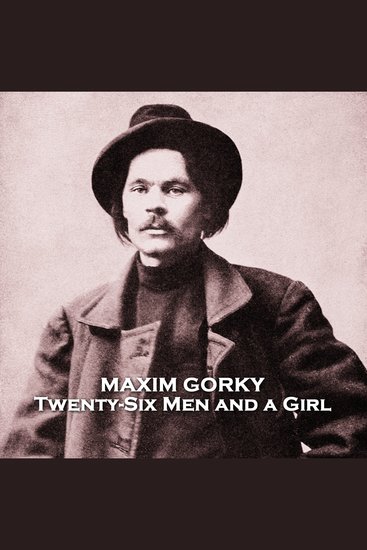
    Maxim Gorky

    • 0
    • 0
    • 0
    Alexei Maximovich Peshkov was born on 28th March 1868, in Nizhny Novgorod, Russia. 
    Better known as Maxim Gorky he was orphaned at 11 and ran away from home at 12.  At 19 he had already attempted suicide and thereafter travelled, by foot, across the Russian Empire for 5 years. 
    His first book ‘Essays & Stories’ in 1898 was a sensation and so began a long career as an author of short stories, novels and plays.  Gorky saw writing as a moral and political act that would help to change the unjust world around him.  He was an ardent early advocate of the emerging Marxist movement and publicly opposed the Tsarist regime leading several times to his arrest.  
    In 1904 he began his own theatre but the censor banned every play and Gorky was forced to abandon the project. 
    But Gorky was a financially successful author, editor, and playwright and gave monies to political parties as well as for civil rights and social reform.  The brutal shooting of workers, which set in motion the Revolution of 1905, pushed Gorky more decisively toward radical solutions.  
    In 1906 he went to the United States to raise funds for the Bolsheviks. Those experiences including a scandal over travelling with his lover and not his wife deepened his contempt for the ‘bourgeois soul.’ 
    Gorky now moved to Capri in Italy, both for health reasons and to escape the increasingly repressive times in Russia.  
    An amnesty for the 300th anniversary of the Romanov dynasty saw him return to Russia in 1914. His politics remained close to the Bolshevik cause.  But soon, after the 1918 revolution, his essays referred to Lenin as a tyrant for his senseless arrests and repression.  He was soon appealing to the outside world for food aid after the catastrophic crop failure. 
    In October 1921 Gorky returned to Italy, now in Fascist hands, and settled in Sorrento until 1932.  His health worsened with the onset of tuberculosis. 
    He wrote several successful books there but now decided to find an understanding with the communist regime. Stalin invited him home and his return was hailed as a major propaganda victory.  He was decorated with the Order of Lenin, and a province, a park, and various streets re-named in his honour. 
    But he had his faults too.  In 1933, Gorky co-edited a book on the White Sea-Baltic Canal and denied even a single prisoner died during its construction, but thousands had. As well, knowing that some Nazis were homosexual, a phrase was attributed to him that said ‘exterminate all homosexuals and fascism will vanish’.  Although he was himself was quoting another he was decidedly homophobic. 
    With the increase of Stalinist repression in 1935 Gorky was placed under unannounced house arrest. 
    Maxim Gorky died on the 18th June 1936 from pneumonia.  He was 68. 
    Stalin and Molotov were among those who carried Gorky's urn of ashes at his funeral.
    Zum Buch
  • The Clusterf*ck Collection - cover

    The Clusterf*ck Collection

    Elliot Grey

    • 0
    • 0
    • 0
    The ClusterF*ck Collection is it's namesake. It's a collection of works that have no rhyme or reason. Some poems are about love and some are about healing. Some short stories are about trauma and some excerpts are more horror themed. It's a well rounded approach at giving the world a glimpse into my own. As a neurodivergent, Native American and trans author I could not be more proud to bring these parts of me to more people.
    Zum Buch
  • A Scene from the Ghetto of Venice - From their pens to your ears genius in every story - cover

    A Scene from the Ghetto of...

    Rainer Maria Rilke

    • 0
    • 0
    • 0
    René Karl Wilhelm Johann Josef Maria Rilke was born into a troubled marriage on the 4th December 1875 in Prague, then part of the Austro-Hungarian Empire.  His mother, having previously lost a baby girl, would dress the young boy up in girl’s clothing.   
    Later his father dispatched him to a military academy at age 10 but after a miserable 5 years the young Rilke left due to illness and instead entered first Prague and then Munich and finally Berlin university to study art history, philosophy and literature. 
    His initial forays into literature was in poetry.  His intense, mystical and lyrical style was much admired and over time inspired many in succeeding generations.    
    His short prose collection ‘Stories of God’, written in an impassioned burst over several nights was published in 1900 and offers a beguiling view of much of Rilke’s influences and outlook.  
    The following year he married the pioneering sculptor and artist Clara Westhoff.  The union produced one child, a daughter Ruth.   
    He lived in Paris for most of the Century’s first decade where he mixed with many great minds of the time.  Although he continued to write he also worked as a secretary to the sculptor, Rodin.   
    It was only after they settled in Switzerland in 1919 that his writing output was in full flow.  Here he wrote profusely in both German and French, which included much on his previous travels, his left-wing sympathies, his religious and existential thoughts, all part of a unique and consummate style. 
    From 1923 on, Rilke increasingly struggled with his health which was now in constant decline and often spent time rehabilitating at a sanatorium.   
    Rainer Maria Rilke died of leukaemia on the 29th December 1926 in Montreux, Switzerland.  He was 51.
    Zum Buch
  • Buried Frozen plus You Are the Protagonist - cover

    Buried Frozen plus You Are the...

    A. J. Payler

    • 0
    • 0
    • 0
    What's buried beneath the frozen ground… will change his world forever 
    The only thing that made those seemingly unending days in prison bearable was knowing what was waiting for him on the outside, buried deep in the frozen ground where she'd sworn to leave his share of the loot. 
    And after years of isolation, all he has to do is dig it up, rejoin her, and get back to the life that's rightfully his.  
    But even the best laid plans oft go awry. And sure, they'd never claimed to be the best of the best, but still… he never could have imagined what he'd find waiting for him, cold and dark at the bottom of that hole. 
    From A. J. Payler, author of The Killing Song, Bank Error in Your Favor, and Terror Next Door comes Buried, Frozen—a story of the terror that lies at the heart of the human condition and the fear that creeps in the darkest, coldest hours of the night. 
      
    Also featuring bonus story, You Are the Protagonist (as seen in Flash in a Flash)! 
    As originally published in Dead of Winter: 13 Tales of Winter Terror (M Presents, January 31, 2024) and Flash in a Flash (May 13, 2024).
    Zum Buch