Rejoignez-nous pour un voyage dans le monde des livres!
Ajouter ce livre à l'électronique
Grey
Ecrivez un nouveau commentaire Default profile 50px
Grey
Abonnez-vous pour lire le livre complet ou lisez les premières pages gratuitement!
All characters reduced
The Right to Be Lazy and Other Studies - cover

The Right to Be Lazy and Other Studies

Paul Lafargue

Traducteur Charles H. Kerr

Maison d'édition: DigiCat

  • 0
  • 0
  • 0

Synopsis

In "The Right to Be Lazy, and Other Studies," Paul Lafargue presents a provocative examination of labor, leisure, and the meaning of work within a capitalist society. Written in a spirited yet analytical style, Lafargue's book critiques the bourgeois work ethic that valorizes constant toil and subjugates the human spirit. Drawing upon Marxist principles, he argues for the inherent value of idleness as a critical form of self-liberation, positioning laziness not as a vice but as a legitimate right in reclaiming individual happiness. As an early socialist thinker, Lafargue's perspective is steeped in the socio-political context of 19th-century Europe, where the burgeoning industrial revolution catalyzed debates on labor and leisure's relationship to human fulfillment. Paul Lafargue, a French Marxist and the son-in-law of Karl Marx, imbues this work with personal and ideological insights that stem from his upbringing and intellectual milieu. His experiences as a radical in a rapidly industrializing society, coupled with a deep commitment to socialist ideals, inform his critique of the oppressive nature of relentless labor. Lafargue's philosophical legacy is cemented by this passion for advocating the revolutionary potential of leisure, contextualizing his arguments within broader Marxist discourse. For those intrigued by labor theory or seeking a deeper understanding of the interplay between work and well-being, Lafargue's argument is a must-read. "The Right to Be Lazy" challenges prevailing notions of productivity while advocating for a radical re-evaluation of our relationship with work. This essential text invites readers to reconsider what it means to live a fulfilled life free from the shackles of perpetual labor.
Disponible depuis: 28/05/2022.
Longueur d'impression: 89 pages.


D'autres livres qui pourraient vous intéresser

  • Mughal Empire - The Early Modern Islamic Empire in South Asia - cover

    Mughal Empire - The Early Modern...

    Kelly Mass

    • 0
    • 0
    • 0
    The Mughal Empire, also referred to as the Mogul or Moghul Empire, was one of the most powerful and influential early modern Islamic empires in South Asia. Established in the 16th century, it controlled vast regions for over two centuries, encompassing territories from the peripheries of the Indus basin in the west, extending to northern Afghanistan, Kashmir in the north, present-day Bangladesh in the east, and stretching as far south as the Deccan Plateau's uplands.The origins of the Mughal Empire trace back to 1526 when Babur, a warrior chieftain from what is now Uzbekistan, founded the empire. Babur's military strategy combined traditional cavalry tactics with the latest artillery techniques, using matchlock guns and cast cannons acquired with Ottoman assistance. These advancements, alongside his strategic acumen, led him to a decisive victory against the Sultan of Delhi, Ibrahim Lodhi, at the First Battle of Panipat. This battle marked a turning point, allowing Babur to establish his dominance over northern India and subdue rival Rajput and Afghan forces.While Babur laid the foundation of the empire, the true structure of the Mughal state is often attributed to his grandson, Akbar the Great. By the late 16th century, under Akbar's rule, the empire expanded its reach and established a well-organized imperial administration that laid the groundwork for political stability, cultural integration, and economic prosperity. Akbar's reign is particularly noted for promoting a policy of religious tolerance, encouraging a synthesis of Hindu and Muslim cultures, and setting up an efficient centralized bureaucracy.
    Voir livre
  • American Presidents in Diplomacy and War - Statecraft Foreign Policy and Leadership - cover

    American Presidents in Diplomacy...

    Thomas R. Parker

    • 0
    • 0
    • 0
    American Presidents in Diplomacy and War chronicles the major foreign policy crises faced by twelve American presidents in order to uncover the reoccurring patterns of successful and less successful uses of diplomatic, economic, and military power. In this book, Thomas R. Parker reveals how America's most successful leaders manage events instead of allowing events to control them. 


    Parker explores how the U.S. presidency, from the days of the early Republic to the present, shaped the world. Ranging from George Washington to George H. W. Bush, Parker shows how successful statecraft requires the understanding of complex situations, the prudent evaluation of various courses of action, the ability to adapt and to anticipate, and personal determination. Parker compares each of these leaders to their contemporaries—reasonable political leaders who nonetheless made serious mistakes, such as Thomas Jefferson and Barack Obama—to examine the dangers of being unable to strike the right balance of aggressiveness and caution and to examine the costs of inexperience and ambivalence toward military power. The book concludes by discussing the increasingly complex international situation of today, particularly the manifold challenges posed by China and Russia to U.S. foreign policy, and the continued necessity of effective statecraft.
    Voir livre
  • Joan of Arc: An Enthralling Guide to a Peasant Girl’s Rise in Medieval France and Her Timeless Legacy as a National Heroine - cover

    Joan of Arc: An Enthralling...

    Billy Wellman

    • 0
    • 0
    • 0
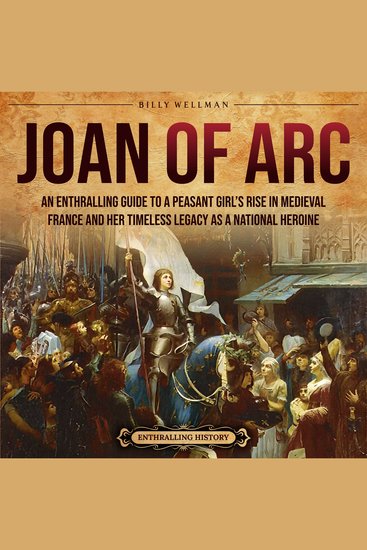
    From Humble Peasant to Divine Warrior: Joan of Arc’s True Story of Faith, Fire, and Unbreakable Courage 
    How did a young girl from a small village become a powerful military leader, a symbol of hope, and a beloved saint? Joan of Arc changed the course of French history with her strong faith and courage. This audiobook takes you through Joan’s life, showing how a humble peasant rose to become one of history’s most amazing figures. 
    Here’s a glimpse of what you’ll find inside:Divine visions that led Joan from her village to the heart of a nation in needHer brave journey across war-torn France to meet the future king, the DauphinMilitary victories that turned a teenage girl into a hero for her countryThe Siege of Orléans, where Joan’s bravery turned the tide against the EnglishHer personal battles with doubt in war and at the royal court, where many questioned herA heartbreaking betrayal that led to her capture, trial, and executionHer martyrdom, which made her a lasting symbol and led to her sainthoodJoan’s legacy and how she has inspired generations with her faith, courage, and strengthAnd so much more! 
    Set in the dramatic world of 15th-century France, this audiobook brings Joan’s story to life with simple language and vivid descriptions. If you’re interested in history, stories of faith, or incredible bravery, this audiobook is for you. 
    Discover Joan’s inspiring journey! Scroll up and click the “add to cart” button to start reading about this famous saint today!
    Voir livre
  • Catholic Church’s Most Influential Religious Military Orders The: The Controversial and Mysterious History of the Knights Templar the Teutonic Knights and the Order of the Holy Sepulchre - cover

    Catholic Church’s Most...

    Editors Charles River

    • 0
    • 0
    • 0
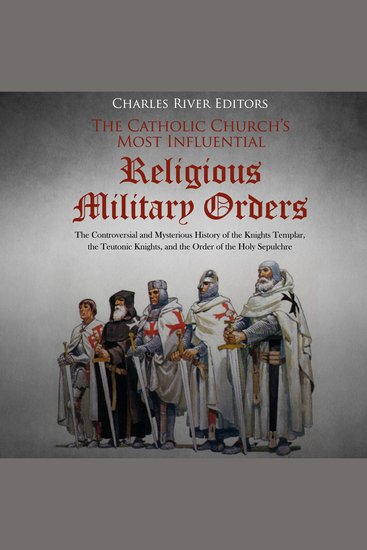
    For centuries, Christians and Muslims were embroiled in one of the most infamous territorial disputes of all time, viciously and relentlessly battling one another for the Holy Land. In the heart of Jerusalem sat one of the shining jewels of the Christian faith, the Church of the Holy Sepulchre. Legend has it that this was where their Savior had been buried before his fabled resurrection. What was more, it was said to house the very cross Jesus Christ had died upon. It was for precisely these reasons that fearless pilgrims, near and far, risked their lives and made the treacherous trek to Jerusalem.  
    	The Order of the Temple of Solomon, also known as the Templars or the Knights Templar, is one of the best-known and least-understood groups in history. They appear prominently in everything from novels (The Da Vinci Code) to films (as the Knights of the Cruciform Sword in Indiana Jones and the Last Crusade) to videogames (Assassin's Creed). In these stories, they are a sinister cult that manipulated historical events since the Middle Ages, via intimidation and assassination. They are usually connected to the Freemasons and, sometimes, to other historical cults like the Hindu Thuggees. 
    	The knights of the Teutonic Order have since been compared to the surreal creature that appeared to the biblical Ezekiel, one that bore 2 faces – one of a man's, and one of a lion's. The human side of the creature is said to symbolize the order's charity, whereas the lion was a metaphor for its valor and gallant spirit, which they relied on to vanquish the heathens of the world. 	Like other secretive groups, the mystery surrounding these military orders helped their legacies endure. While some conspiracy theorists attempt to tie the groups to other alleged secret societies like the Illuminati, other groups have tried to assert connections with them to bolster their own credentials.
    Voir livre
  • Raw Meaty Bones - cover

    Raw Meaty Bones

    Dr. Tom Lonsdale

    • 0
    • 0
    • 0
    Dr Tom Lonsdale’s original, pioneering work Raw Meaty Bones is the foremost book on the nutritional needs of pet dogs, cats and ferrets. First published in 2001—and of still greater importance today—the 14 chapters are packed with information vital for pet owners and pet professionals the world over.Lonsdale explains how industrial diets devastate the health of pets, how dirty tartar encrusted teeth, sore gums and stinky breath signal the downward spiral of ill-health, suffering and needless trips to the vet. By contrast he shows why dogs and cats crave the ripping, tearing and crunching on raw meaty bones—Nature’s miracle treatment and preventative. It’s the tough, chewy texture of the food that imparts the medicinal benefits. And providing your pet does enough ripping and tearing its teeth will be clean, gums healthy and breath sweet. The resultant benefits for the immune system, heart, liver, lungs and kidneys are enormous—one happy, contented pet.   Raw Meaty Bones makes no apology, it reveals a veterinary profession lost without a moral compass beholden to the multi-national pet food companies. It provides the foundations for a pet health revolution—with enormous cost savings for pet owners and benefits for the natural environment worth $billions.If you own a pet, or know someone who does, this book’s for you. Find out more at www.thepetfoodcon.com
    Voir livre
  • The Cultural Revolution - China's Radical Change - cover

    The Cultural Revolution -...

    Nova Ashford

    • 0
    • 0
    • 0
    The Cultural Revolution, which took place in China from 1966 to 1976, was one of the most tumultuous and transformative periods in the country’s history. Initiated by Mao Zedong, the founding father of the People’s Republic of China, the movement sought to preserve Chinese communism by removing capitalist, traditional, and cultural elements from Chinese society. At its core, the Cultural Revolution aimed to enforce Maoist ideology, reaffirm his leadership, and transform the cultural, social, and political fabric of China. It was a radical attempt to reshape Chinese society by addressing perceived corruption and ideological impurity within the Communist Party and broader society. 
    Mao’s motivations for launching the Cultural Revolution were multifaceted. After the failure of the Great Leap Forward (1958-1962), which had resulted in widespread famine and economic chaos, Mao’s position within the Communist Party had been weakened. The Cultural Revolution provided Mao with an opportunity to reassert his control over the party and eliminate rivals, many of whom were seen as too moderate or resistant to his vision of a truly communist society. It also reflected Mao’s concern that China was veering away from the revolutionary ideals that had initially driven the Communist Party. 
    The movement was largely propelled by the Red Guards, a youth-based movement that encouraged the younger generation to challenge authority and remove perceived counter-revolutionary influences. Under the banner of Maoism, the Red Guards sought to destroy the "Four Olds"—old customs, old culture, old habits, and old ideas. This led to widespread destruction of cultural heritage, including temples, books, and artworks. Intellectuals, teachers, and perceived enemies of the revolution were subjected to violent persecution, public humiliation, and forced labor, with many being sent to the countryside for "re-education."
    Voir livre